
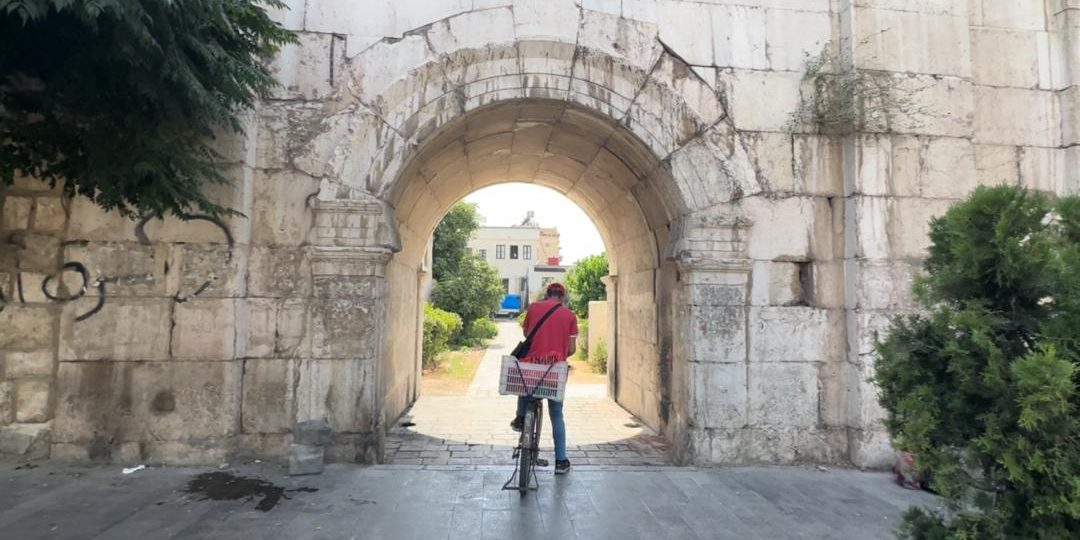
Bab Sharqi in Damascus: Entering Through a Roman Gate
At the eastern edge of Old Damascus, one gate still offers a glimpse of how the Romans planned a city almost two thousand years ago.
Bab Sharqi, the Eastern Gate, stands at the beginning of the old city’s famous Straight Street. It is a place that many people pass through without realising how much history its arches contain.
The gate preserves the outline of an ancient Roman entrance: a larger central passage and smaller side passages, reflecting a city where different forms of traffic needed their own space.
Yet the most interesting feature may be what lies beyond it. Bab Sharqi leads into a living network of homes, churches, small shops and streets that connect Roman Damascus with the city’s later Christian, Islamic and Ottoman chapters.
Start here and the old city reveals itself gradually, one doorway and one neighbourhood at a time.
At a Glance
A Gate Built for an Ancient City
Roman cities were often organised around principal streets leading toward gates and public spaces. Damascus was already ancient before the Romans, but its urban fabric developed further under Roman rule.
Bab Sharqi retains a particularly recognisable Roman gate arrangement. Its larger central opening was designed for wheeled traffic, while narrower side passages served pedestrians.
Not all of the masonry visible today necessarily belongs to one construction phase. Gates are repaired, adapted and reused for centuries, especially when they continue to form important entrances to a busy city.
The photographer and traveller Gertrude Bell recorded Bab Sharqi in January 1911. Her photograph shows the gate and street in daily use long before modern tourism, demonstrating how historic architecture remains part of everyday life.
When looking at the arches, imagine not only soldiers and merchants but also the constant movement of ordinary residents entering and leaving the city.

Straight Street begins directly inside the eastern gate, making a walk westward a practical introduction to the Old City.
Today the street is lined by living neighbourhoods and commercial activity rather than preserved as a single untouched Roman road.
Look at the spaces around you as carefully as the gate. The experience is about continuity and change, not a perfect reconstruction of Roman antiquity.
From Roman Via Recta to Straight Street
The old east–west route is known as Straight Street or Via Recta. Its name is also familiar from the New Testament, where the Book of Acts refers to a street called Straight in the story of Saul and Ananias.
The ancient route did not remain physically unchanged. Buildings, surfaces and street widths altered over time, while new religious and commercial centres emerged around it.
Still, the long direction of the street is a remarkable guide to the city’s older structure. Walking west reveals successive layers of architecture and community life.
The area near Bab Sharqi is closely associated with the Christian quarter, where churches, schools and families have long formed part of Old Damascus.
From here, visitors can connect the gate with Saint Ananias Chapel, the Mariamite Cathedral and further streets that eventually lead toward the great souqs.

Why the Gate Is More Than a Monument
The most rewarding view of Bab Sharqi is not only its stone arches. It is the scene around them: people returning home, shops opening, neighbours greeting each other and travellers finding their way.
Historic gates often take on new roles. They may become landmarks for directions, points of meeting or transitions between the old city and modern streets.
While the Roman plan is still legible at Bab Sharqi, the contemporary surroundings belong to a city that has changed through many centuries.
Do not assume every nearby building is Roman or that the Christian quarter is a museum district. It is a living neighbourhood with private homes, places of worship and commercial activity.
A good walk balances architectural curiosity with respect for people who use these spaces every day.
Begin your Old City walk at the eastern gate and follow the line of Straight Street. The changing buildings make the history of Damascus easier to read than a list of monuments does.

How to Visit
Bab Sharqi stands at the eastern edge of the Old City. The gate is best visited as part of a walking route rather than treated as a long standalone attraction.
- Allow around 15–25 minutes for the gate itself, or 60–90 minutes if continuing along Straight Street.
- Be attentive to vehicles and people passing through the gate and near the surrounding roads.
- Photograph the full triple-gate arrangement from a safe permitted position rather than blocking a passage.
- Explore nearby churches respectfully, checking their visiting arrangements separately.
- Ask permission before photographing residents or private homes in the Christian quarter.
- Wear comfortable footwear for uneven surfaces and the longer walk toward the city centre.
- Consider combining Bab Sharqi with Saint Ananias Chapel, the Mariamite Cathedral and the markets.
Discover the stories and places of Syria with local guides.
Join our tours →One Last Thought
Bab Sharqi reminds us that an ancient gate is never only about coming or going. It is a place where the history of a city meets the lives of people passing through it today.
Latest Syria news
- Bab Sharqi in Damascus: Entering Through a Roman Gate

- Al-Manhal: Where Damascus Is Rebuilding Its Future Through Bread and Books
- Bakdash Ice Cream: The Sweetest Tradition in Old Damascus
- EgyptAir Plans Cairo Flights to Damascus and Aleppo in December
- Sulaymaniyya Takiyya: Damascus’ Ottoman Sanctuary for Travellers


You might also enjoy
NearbyStraight Street WalkThe Roman road through Old DamascusRead the story → Christian heritageSaint Ananias ChapelA sacred site nearbyRead the story →
 DamascusMariamite CathedralHistoric worship in the Christian quarterRead the story →
 Explore SyriaDiscover DamascusMore landmarks, people and storiesRead the story →