Mar Musa is not a normal tourist stop. It is not a place where you simply arrive, take photos, and leave. It is a full experience. It begins before you enter the monastery. It begins on the road, when you leave the busy towns behind and start driving into the dry mountains. It continues when you reach the parking area below the monastery and look up at the stone buildings hanging above the valley. Then comes the climb, the silence, the stairs, the heat, the dust, the view, the church, the frescoes, the prayers, the shared food, and the simple life of the community.
Mar Musa is beautiful, but it is not comfortable in the hotel sense. It is peaceful, but not easy. It is open to people, but it must be respected. It is a Christian monastery, but it welcomes people from different religions and backgrounds. Muslims, Christians, non-religious visitors, foreigners, Syrians, pilgrims, hikers, readers, and people looking for quiet can all feel something special there, as long as they come with respect.
This guide explains the Mar Musa experience in a simple and practical way. It tells you what to wear, what to bring, how difficult the stairs are, how much time you need, what happens inside the monastery, what the rules are, what the rooms and showers are like, what food to expect, and how to behave so you do not ruin the experience for yourself or for others.
What is Mar Musa?
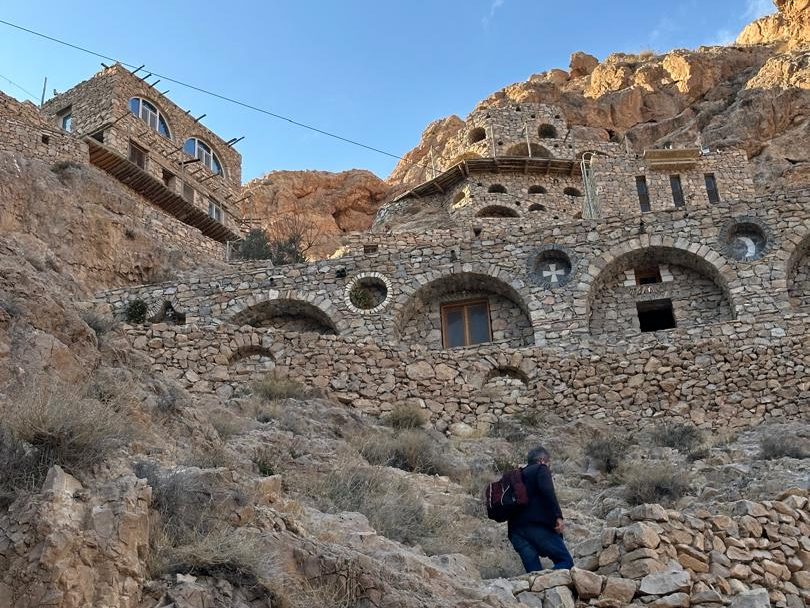
Mar Musa, also called Deir Mar Musa al-Habashi, means the Monastery of Saint Moses the Abyssinian. It is an ancient monastery near the town of Al-Nabk, north of Damascus. It sits high in the rocky mountains, on the edge of the Syrian semi-desert. The monastery is remote. There is no busy market around it, no restaurants, no hotels, no shops, and no normal tourist services nearby. This is part of its identity.
The monastery is around 1,300 meters above sea level. Because of this height, the weather can change between day and night. Summer days can be hot, dry, and sunny, while evenings can feel cooler. Winter can be cold and windy.
Mar Musa is famous for its location, silence, ancient church, frescoes, spiritual atmosphere, and modern message of hospitality and Muslim-Christian dialogue. The monastery is also connected with Father Paolo Dall’Oglio, the Italian Jesuit priest who helped revive the place in modern times and made it known internationally as a place of prayer, simplicity, and dialogue.
Where is Mar Musa?
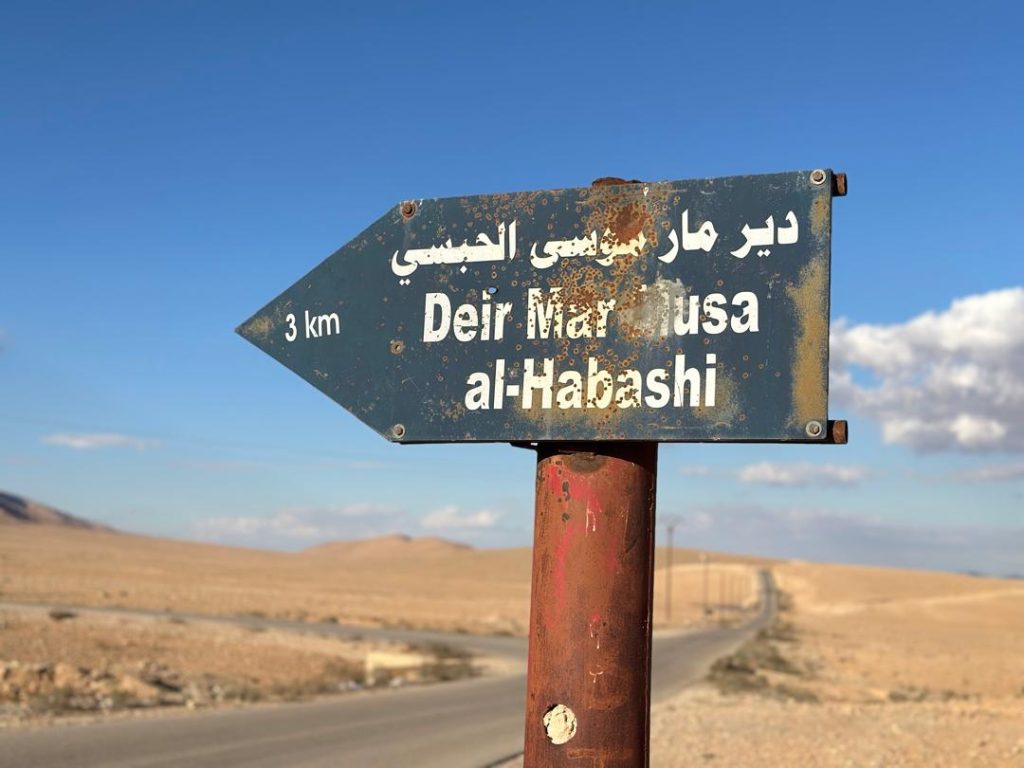
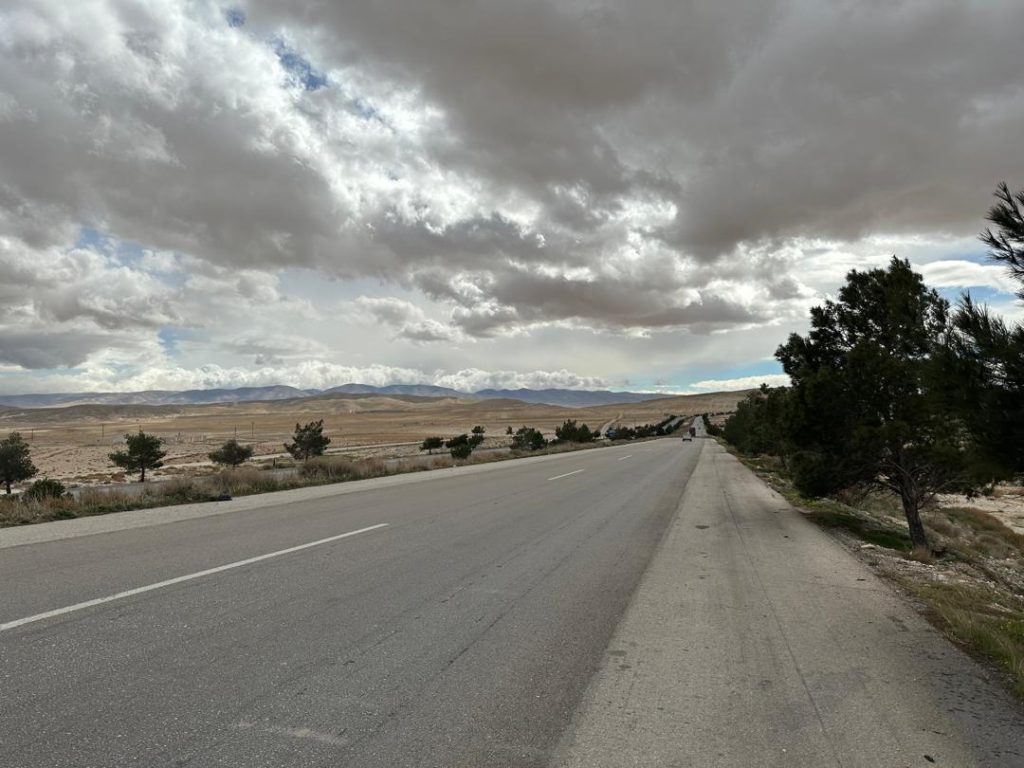
Mar Musa is near Al-Nabk, around 80 km north of Damascus. From Damascus, you drive north on the main road toward Homs, then turn east from Al-Nabk toward the monastery. After leaving Al-Nabk, the landscape becomes quieter and more empty. You will drive into a semi-desert mountain area, and after some time you reach the parking area below the monastery.
The monastery itself cannot be reached directly by a normal visitor car. You stop at the bottom, then climb the stone stairs up to the monastery.
How far is it from Damascus?
From Damascus, the trip usually takes around one and a half to two hours by private car, depending on traffic, road condition, and where exactly you start from in Damascus. If you are coming from the old city or central Damascus, plan around two hours to be comfortable.
The last part of the road after Al-Nabk is quieter and rougher. If you are driving your own car, drive slowly. There can be surprising holes, bumps, uneven parts, and rough patches. Do not drive fast just because the road looks empty.
How far is it from the main road?
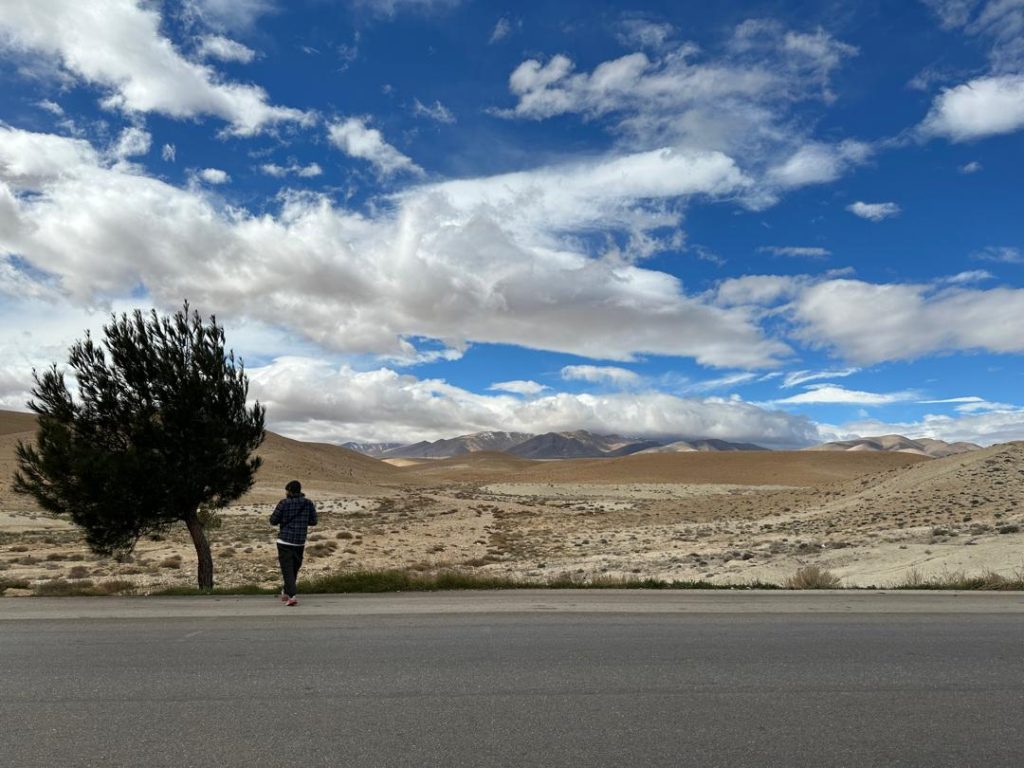
From the Damascus-Homs highway near Al-Nabk, you drive east toward the monastery. The monastery road takes you away from the main highway and into the mountains. The drive from Al-Nabk to the parking area below the monastery is usually around 15 to 20 km, depending on the exact route and where you start counting from.
Once you leave the main town area, do not expect shops or services. Buy anything you need before leaving Al-Nabk.
How do you get there?
The easiest way is by private car, driver, or organized tour. This is the best option for most visitors because the monastery is remote and the final part of the journey is not served by regular public transport.
You can also take public transportation from Damascus to Al-Nabk, but from Al-Nabk you still need a taxi, private car, or local lift to reach the monastery area. Public transport does not normally take visitors directly to the foot of the stairs.
Hitchhiking and local lifts are common in some rural parts of Syria, and people can be generous, but tourists should not depend on hitchhiking as their main plan. It is better to arrange the return journey before you go. Phone coverage can disappear after leaving Al-Nabk, so do not wait until the end of your visit to think about how you will return.
Mobile coverage and internet
Mobile coverage becomes weak or disappears once you drive a few kilometers east of Al-Nabk toward the monastery. Do not depend on your phone for maps, calls, internet, or emergency communication in the final part of the route.
Download your map before you go. Tell your driver the plan clearly. If you are coming with a group, agree on the pickup time before climbing.
Inside the monastery, do not expect strong or normal internet. Mar Musa is a place to disconnect. Even if some connection exists, visitors should not treat the monastery like a café or coworking space. This is not the place for loud calls, videos, music, or constant phone use.
The road condition
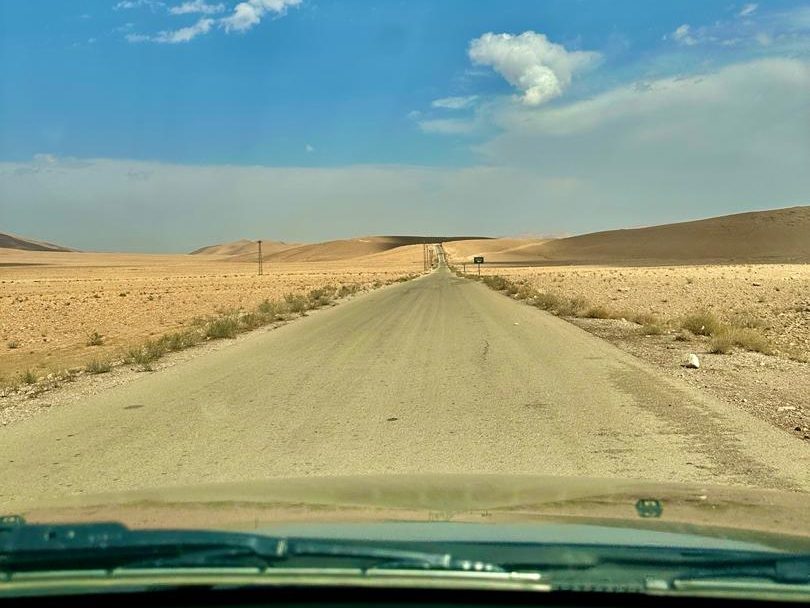
If you are driving, pay attention. The road to Mar Musa can have bumps and holes, especially in the last section. Some parts may surprise you because the landscape is open and empty, but the road is not always smooth.
A normal car can usually reach the lower parking area, but drive carefully. After rain or in bad weather, road conditions can become more difficult. At night, the road is not ideal because there are fewer lights, fewer people, and weaker phone coverage. It is better to visit during daylight.
The first impression
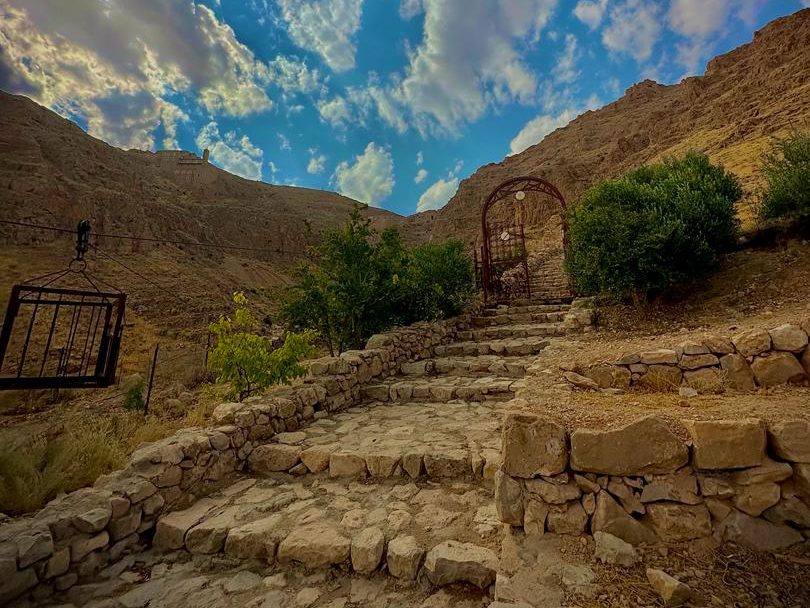
When you arrive below Mar Musa, you see the monastery above you. It looks like it is growing out of the mountain. The buildings are made of stone and blend with the rock. Below, the landscape is dry and open. Above, the monastery is quiet and strong.
This first moment is important. You understand immediately that this is not a normal visit. You must climb. You must slow down. You must leave comfort behind for a while.
The climb is not just a way to reach the monastery. It is part of the experience.
The stairs to Mar Musa
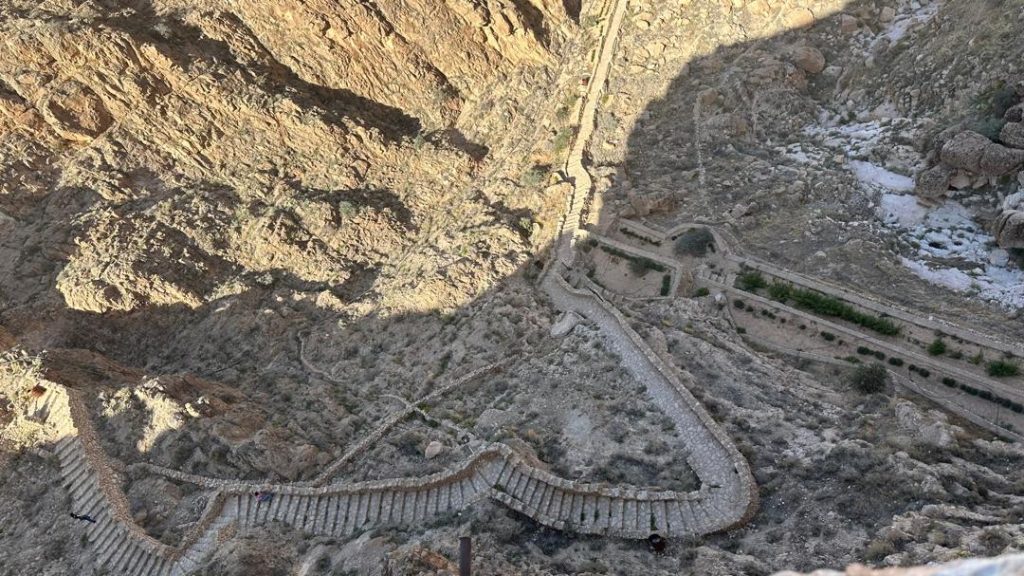
To reach the monastery, visitors climb a long stone staircase. The stairs are outdoor stone steps. They are not like clean, equal stairs in a modern building. Some steps are uneven. Some are higher than others. Some parts feel more like a stone hiking path than a staircase.
Most visitors describe the climb as more than 400 steps. Some people count differently depending on where they begin, but for practical purposes, tell visitors to expect around 400+ stone steps.
The climb usually takes around 20 to 30 minutes for someone with average fitness. Some visitors do it faster, but there is no need to rush. Older visitors, people who stop often, people taking photos, or people climbing in summer heat may need 40 to 60 minutes.
The descent can also be difficult, especially for the knees. Going down is not always easier. The stones can be dusty, and tired legs can slip. Walk carefully both ways.
How much time do you need to climb?
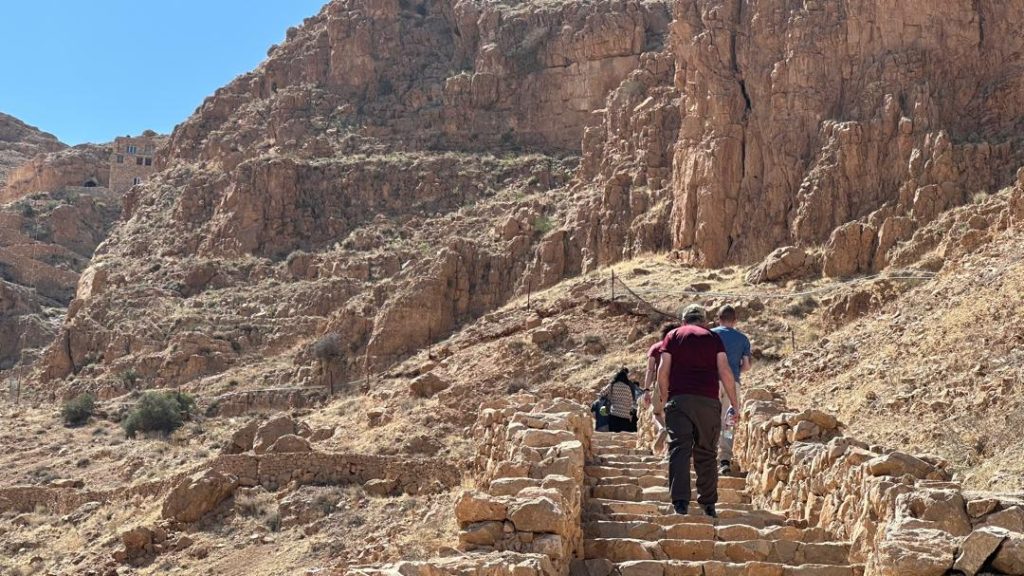
A simple calculation helps visitors understand the climb.
If you climb 400 steps in 20 minutes, you are taking about 3 seconds per step.
If you climb 400 steps in 30 minutes, you are taking about 4.5 seconds per step.
If you climb 400 steps in 45 minutes, you are taking about 6 to 7 seconds per step.
If you climb 400 steps in one hour, you are taking about 9 seconds per step.
This means the climb is not about speed. It is about breathing, balance, and patience. A healthy visitor can usually do it, but people with knee problems, breathing problems, heart problems, back problems, or balance problems should think carefully before going.
Breaks during the climb
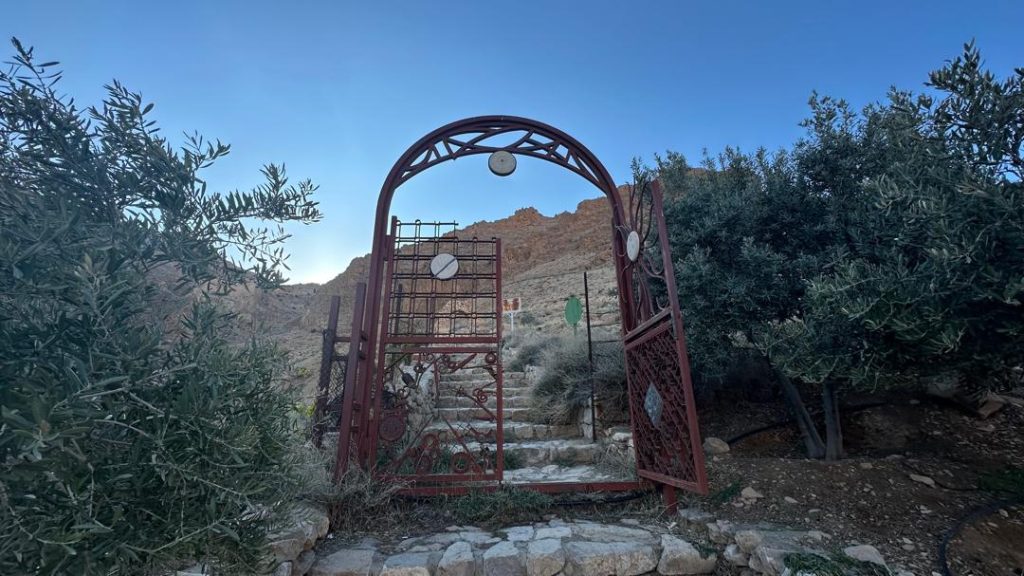
Take short breaks during the climb. Do not wait until you are exhausted. A good rhythm is to walk for five to seven minutes, then stop for one or two minutes. In summer, stop more often.
Drink small amounts of water. Do not drink all your water at once. Stand to the side so others can pass. If there is shade, use it. If there is no shade, keep the break short and continue slowly.
For groups, the guide should never push everyone to climb quickly. The slowest person sets the rhythm. Mar Musa is not a race.
What if I want to give up?
You can stop. There is no shame in that.
If you feel dizzy, weak, short of breath, or unsafe, stop immediately. Sit carefully at the side of the path where you do not block others. Drink water. Rest. Tell your guide or group. If you feel better, continue slowly. If not, go back down carefully with someone.
Do not continue only because others are climbing. It is better to stop than to fall, faint, or injure yourself.
Silence on the stairs
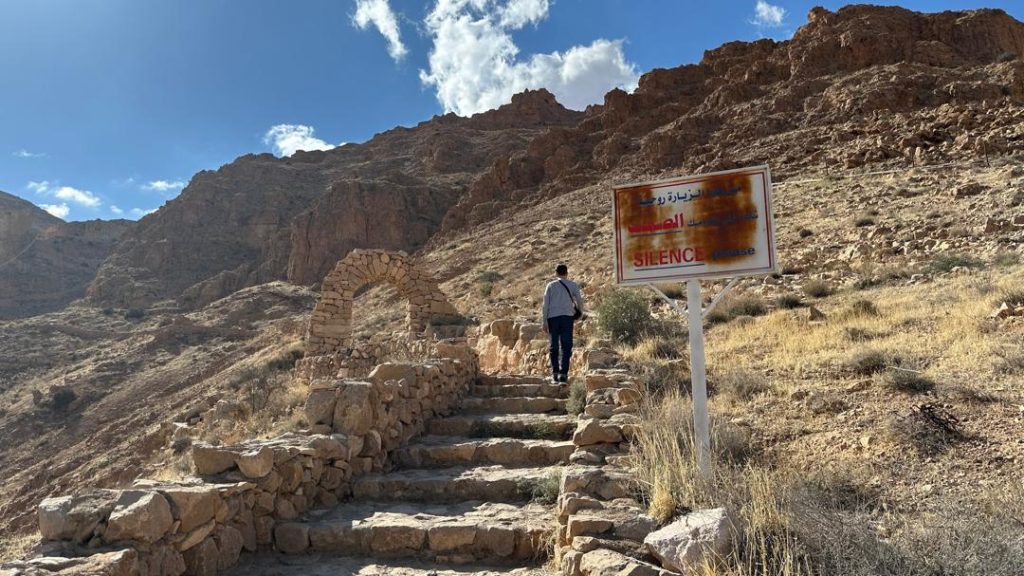
One of the most important rules is silence, or at least a very low voice, on the stairs.
For some visitors, the stairs are just a physical climb. For others, they are part of a spiritual journey. Some people climb while praying. Some climb in silence. Some are thinking about their life, their faith, their grief, or their personal struggles. Some are not religious but still want quiet.
Do not ruin that by talking loudly, laughing loudly, shouting to friends, playing music, or turning the climb into a noisy group activity.
Speak only when needed. If you must talk, speak softly. The silence of Mar Musa begins before you enter the monastery. It begins on the way up.
Shoes: what should you wear?
Wear hiking shoes or strong walking shoes with good grip. This is very important.
The path is paved with stones, but it is still a mountain path. The stones can be uneven, dusty, and slippery. Smooth shoes, sandals, flip-flops, fashion shoes, or weak sneakers are not suitable.
Good shoes should have:
A strong sole.
Good grip.
Comfort around the foot.
Support if your ankles are weak.
If you visit in winter, after rain, or in dusty wind, proper shoes become even more important. Hiking shoes are not just a nice idea. For Mar Musa, they are almost a must.
Clothes: what should you wear?
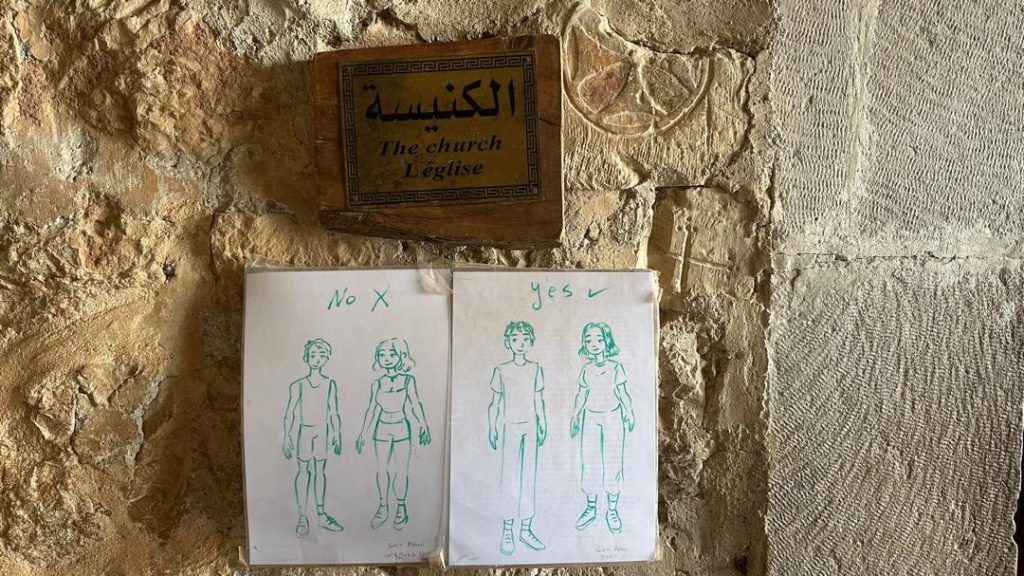
Wear comfortable pants and a comfortable shirt. Your clothes should allow you to climb, bend, sit, and move easily. Avoid very tight jeans, short skirts, very short shorts, or anything that makes walking difficult.
Mar Musa is also a religious place, so dress modestly. Men and women should avoid revealing clothes. Shoulders and knees should be covered if possible. Loose trousers, long comfortable pants, a modest shirt, and a light long-sleeve layer are good choices.
Women do not need to dress like nuns. Non-Christians do not need special religious clothing. The idea is simple: dress respectfully because you are entering a monastery.
Summer heat and sun
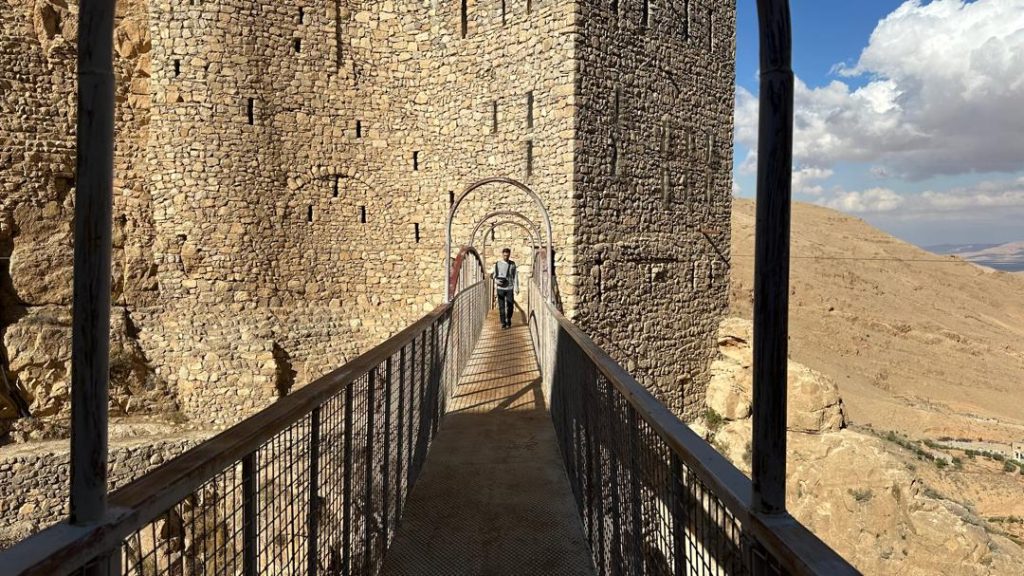
Mar Musa is in a dry semi-desert area. In summer, it can be hot, sunny, and exposed. The sun can feel strong on the stairs because there is not much shade. Even if the air feels dry, the sun can still burn your skin and exhaust your body.
In summer, expect daytime temperatures around 30°C to 35°C, and sometimes hotter under direct sun. On the stone stairs, it can feel stronger than the number suggests.
Bring:
Sunscreen.
Sunglasses.
A cap or hat.
Water.
Light modest clothes.
A breathable shirt.
The best time to climb in summer is early morning or late afternoon. Avoid the strongest midday heat when possible.
Winter and cold weather
Because Mar Musa is high and exposed, winter can be cold. The wind can be strong, and evenings may feel much colder than Damascus or Al-Nabk. Bring warm clothes if visiting in winter, especially if staying overnight.
Even in summer, bring a light jacket or warm layer for the evening. The difference between daytime sun and evening air can surprise visitors.
Dust and breathing problems
The area around Mar Musa is dry and windy. The wind can carry dust, especially because the monastery is in a semi-desert landscape. If you have asthma, allergies, sinus problems, or breathing difficulties, bring a mask and your medicine.
If you use an inhaler, keep it with you, not inside a bag sent up separately. If the day is very dusty, walk slowly and do not force your body.
Water
Bring water for the climb. This is essential.
The monastery has filtered drinking water in the kitchen and from the dispenser on the terrace, but you need water before you reach the top. Do not begin the climb without a bottle, especially in summer.
Once inside the monastery, use water respectfully. Water is precious in the desert. Do not waste it.
What personal things should you bring?
Mar Musa is in the middle of nowhere. There is no nearby market where you can buy what you forgot. Bring your personal needs with you.
Bring:
Water for the climb.
Sunscreen.
Sunglasses.
A cap or hat.
Hiking shoes.
Comfortable modest clothes.
A warm layer.
Personal medicine.
A mask if you have breathing problems.
Toothbrush and toothpaste.
Soap and shampoo.
A small towel.
Power bank.
Flashlight or phone torch.
Sanitary pads or personal hygiene products.
Diapers or incontinence products if needed.
Shaving tools if needed.
Simple snacks if you need special food.
Cash for donation.
Your passport or ID.
Do not expect the monastery to provide personal items. The place is simple. Come prepared.
The low and narrow entrance
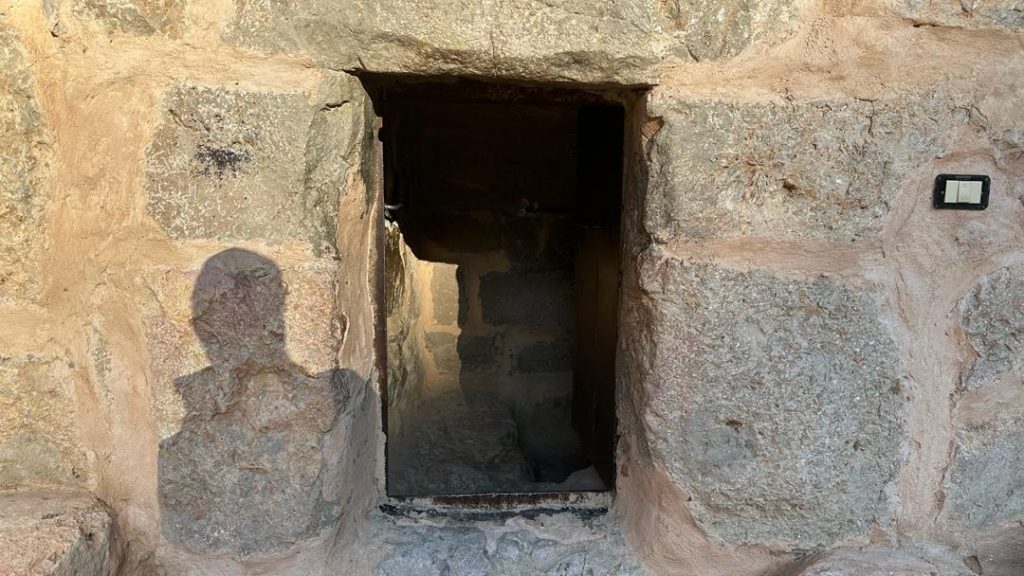
One of the surprising details inside Mar Musa is the very low and narrow old entrance. The door is around one meter high. You need to bend deeply, and some people may need to almost kneel or use their hands to balance themselves while entering.
For many visitors, this feels symbolic. You lower your body before entering an ancient sacred place. It feels like entering with humility.
But practically, it can be difficult. People with knee problems, back problems, hip problems, balance problems, or limited mobility may find it hard. If someone cannot bend or kneel safely, Mar Musa may not be suitable for them.
This should be explained clearly before the visit. Mar Musa is ancient. It was not built like a modern accessible building.
Is Mar Musa suitable for elderly visitors?
It depends on the person.
A healthy older visitor who walks regularly may manage the climb slowly with breaks. But a person with knee problems, back problems, breathing problems, heart problems, or balance issues may find the experience too difficult.
The main visitor route includes many stone stairs and a low entrance. The monastery should not be described as an easy or accessible visit. For elderly visitors, the safest way to present it is this: only go if you can climb around 400 uneven stone steps and bend through a low entrance.
Bags and the cable system
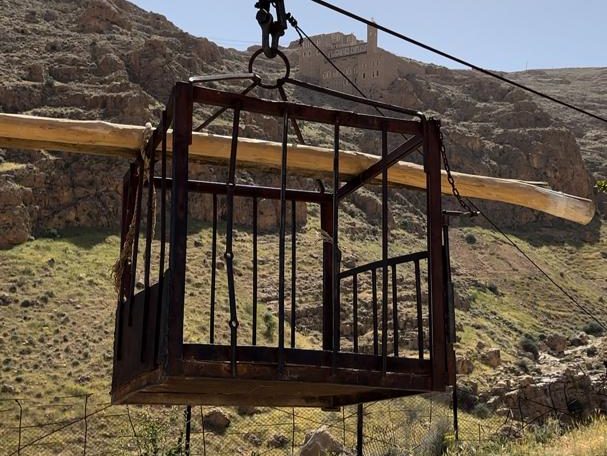
There is a cable/pulley system used for moving supplies and bags up to the monastery. This is useful because carrying heavy luggage up the stairs is difficult.
Visitors should still travel light. Do not bring a huge suitcase. Bring a small backpack or overnight bag. Keep important items with you, especially passport, money, medicine, phone, camera, and documents.
Do not send your valuables separately. The monastery also clearly states that it is not responsible for lost belongings.
Belongings and responsibility
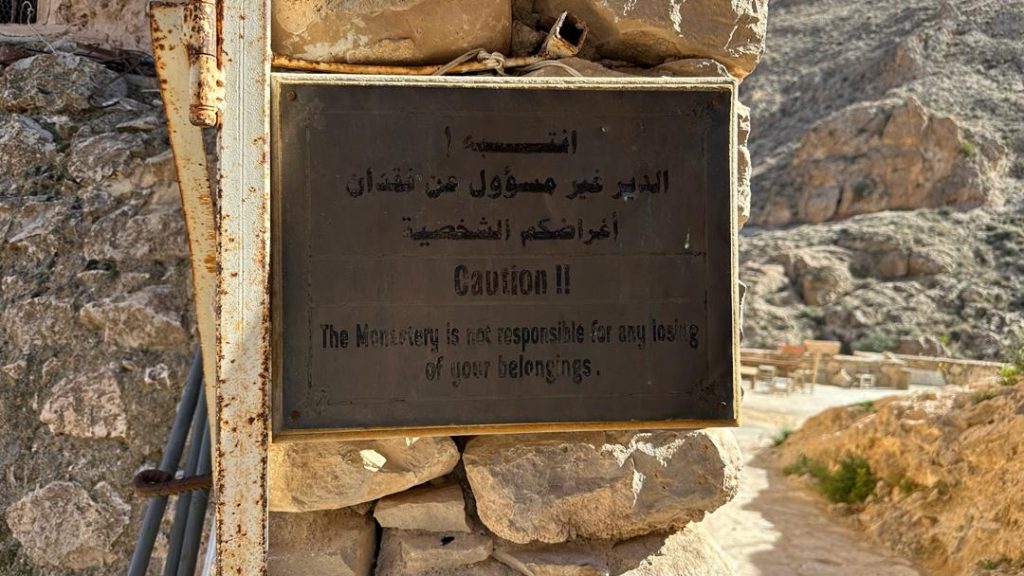
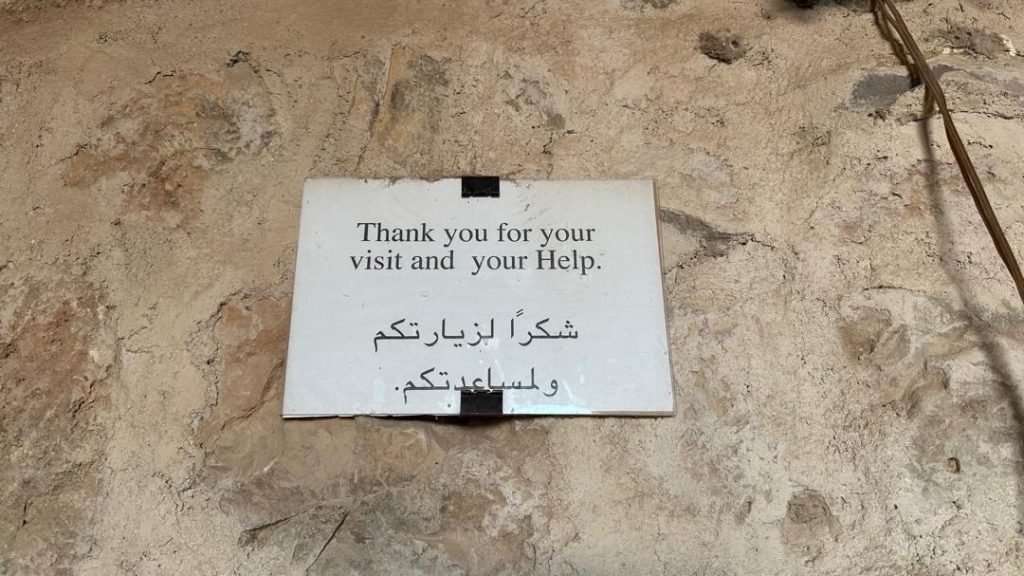
The monastery clearly states that it is not responsible for the loss of belongings. This notice is posted in Arabic, English, and French.
Visitors must take care of their own things. Keep your passport, money, phone, camera, medicine, and important documents safe. Do not leave valuables unattended in rooms, bathrooms, the terrace, the church, or shared spaces.
Mar Musa is a place of trust, but you are still responsible for your belongings.
Is Mar Musa open to non-Christians?
Yes. Mar Musa is a Christian monastery, but it welcomes respectful visitors from all backgrounds. Muslims can visit. Non-religious people can visit. People from other religions can visit. You do not need to be Christian to enter, stay, eat, read, or experience the place.
The church is a Christian sacred space, but it is open to respectful people. You can sit quietly, look at the frescoes, listen to prayers, or simply be present.
The important thing is respect. You do not need to pretend to believe something you do not believe. You only need to behave respectfully.
Can Muslims visit and stay?
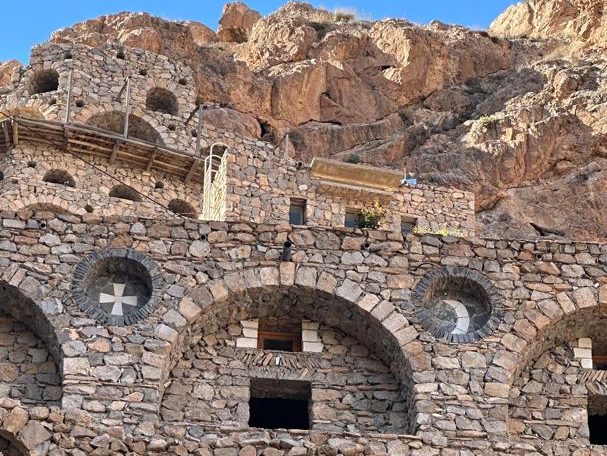
Yes. Muslims can visit and stay respectfully. Mar Musa has a strong spirit of Muslim-Christian dialogue. The monastery has welcomed Muslims, Christians, Syrians, foreigners, religious people, and non-religious people.
A Muslim visitor can attend prayers as an observer, join meals, help with work, read, walk, and enjoy the silence. Participation does not mean changing religion. It means sharing space respectfully.
Can non-religious people visit?
Yes. You can be non-religious and still find Mar Musa meaningful. You can enjoy the silence, the architecture, the landscape, the library, the history, the frescoes, the shared meals, and the human atmosphere.
You do not have to pray. You do not have to take part in rituals. But you should respect those who do.
Daily prayer schedule
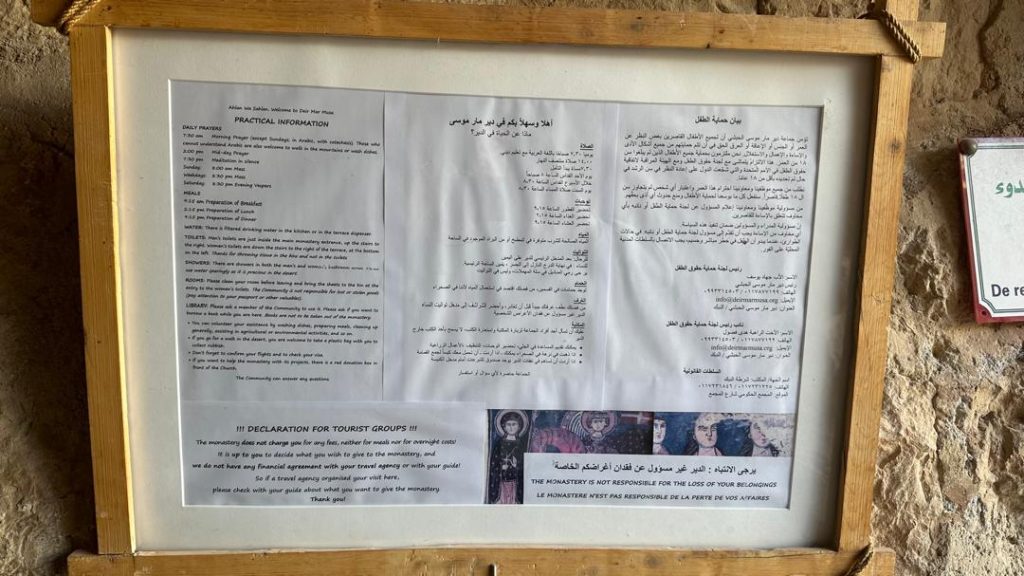
The monastery has a clear posted schedule.
Morning Prayer is at 7:30 am, except on Sundays. It is in Arabic and includes catechesis, meaning religious teaching or explanation. Visitors who do not understand Arabic are welcome. They can simply sit quietly, walk in the mountains, or help with washing dishes.
Mid-day Prayer is at 2:00 pm.
Meditation in silence is at 7:30 pm.
Sunday Mass is at 9:00 am.
Weekday Mass is at 8:30 pm.
Saturday Evening Vespers are at 8:30 pm.
This means the day is shaped by prayer and silence. Visitors do not have to understand everything. They do not have to be Christian. They only need to respect the rhythm.
Do visitors have to join prayers?
No. Visitors are not forced to join prayers. But prayer is part of the life of the monastery. If you are present during prayer time, behave quietly.
You can join, sit, listen, observe, or step away respectfully. If you do not understand Arabic, that is fine. If you are Muslim or non-religious, that is also fine. The important thing is not to disturb others.
Meditation and silence
Silent meditation is part of the daily rhythm. It happens at 7:30 pm. This is one of the most beautiful parts of the Mar Musa experience.
Silence is not empty. In Mar Musa, silence is part of the place. It helps people slow down. It gives space for prayer, thought, rest, grief, healing, and peace.
During silent times, do not talk, whisper, move around loudly, use your phone, or take photos. Let the silence be real.
Meal times
The monastery board lists the preparation times for meals:
Breakfast preparation starts at 9:15 am.
Lunch preparation starts at 2:15 pm.
Dinner preparation starts at 9:15 pm.
These are preparation times, not restaurant serving times. Meals are part of community life. Guests may help prepare, serve, wash dishes, or clean after eating.
Do not expect a menu. Do not expect private service. Do not arrive with the mentality of a hotel customer. The food is shared hospitality.
What kind of food is served?
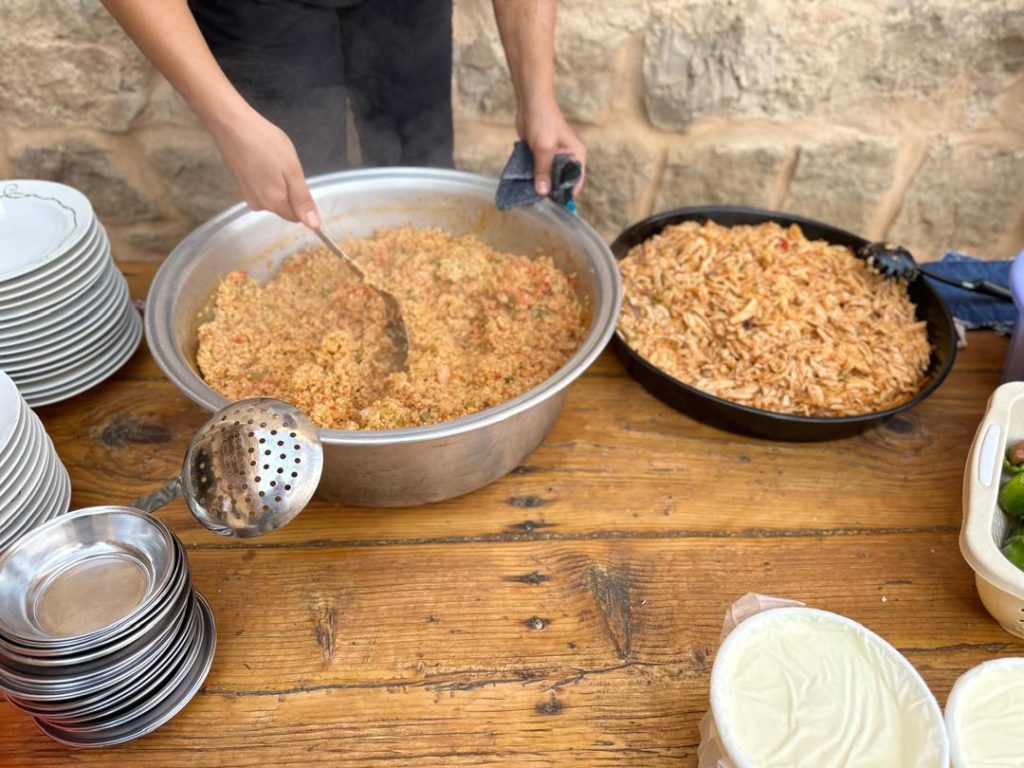
Food at Mar Musa is simple. It may include bread, cheese, olives, vegetables, rice, lentils, soup, stew, eggs, jam, tea, coffee, and whatever is available. Sometimes it may be vegetarian. Sometimes the meal depends on what the community has.
If you have special dietary needs, bring simple backup snacks. If you are diabetic, allergic, gluten-free, vegan, or need special food, prepare yourself. The monastery is generous, but it is not a restaurant.
Eat what is offered with gratitude.
Is staying free?
Yes. The monastery clearly states that it does not charge fees for meals or overnight stay.
This is important. Mar Musa does not work like a hotel. There is no fixed room price or meal price. Hospitality is offered freely.
But this does not mean visitors should treat the place cheaply. Donations are welcome and important.
Donations
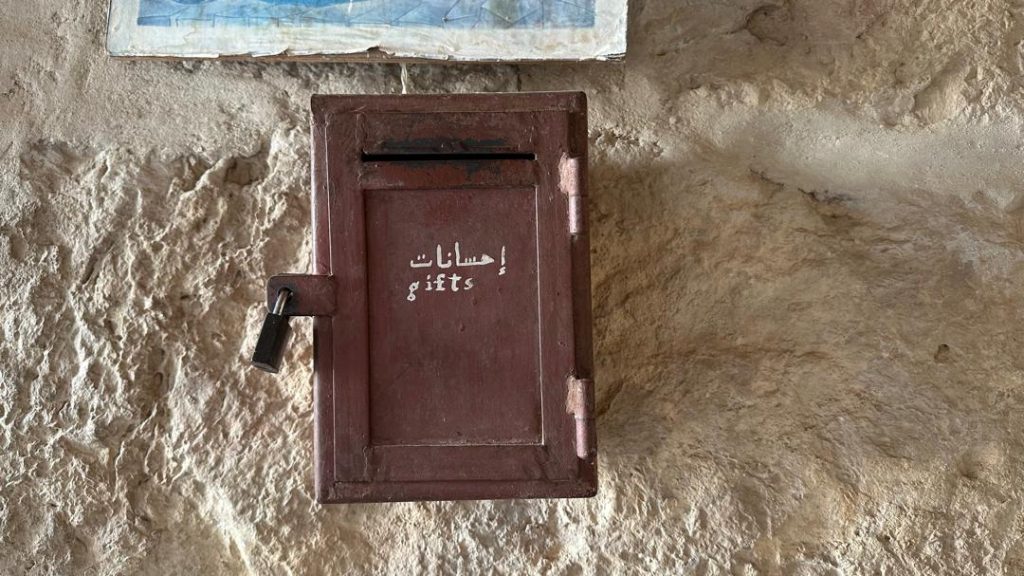
The monastery has a donation box in front of the church. If you want to support the monastery and its projects, you can leave a donation there.
A donation is not an entrance fee. It is a way of saying thank you. It helps with food, water, electricity, maintenance, restoration, hospitality, and community work.
If you eat, sleep, drink water, use the space, or receive hospitality, it is good to donate if you can.
Tourist groups and travel agencies
The monastery has a clear declaration for tourist groups.
It says the monastery does not charge fees for meals or overnight costs. It is up to each visitor to decide what they want to give to the monastery.
It also says the monastery does not have any financial agreement with any travel agency or tour guide.
This is very important for transparency. If a tour agency or guide organizes your visit, the payment to the agency or guide is separate from any donation to the monastery. Visitors should understand that donations go to the monastery, not as a hidden fee, but as a voluntary support.
Helping in the monastery
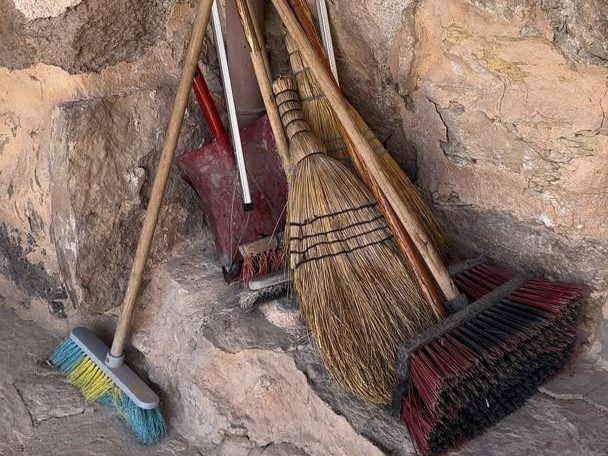
Visitors can help. This is part of the experience.
The monastery board mentions helping with washing dishes, preparing meals, general cleaning, agricultural activities, environmental activities, and similar tasks.
If you stay overnight, helping is natural. Wash dishes after meals. Help prepare food if needed. Clean your space. Do not sit like a hotel guest while others work.
Mar Musa is a living community. Hospitality goes both ways. You receive, and you also give.
Rooms and sleeping
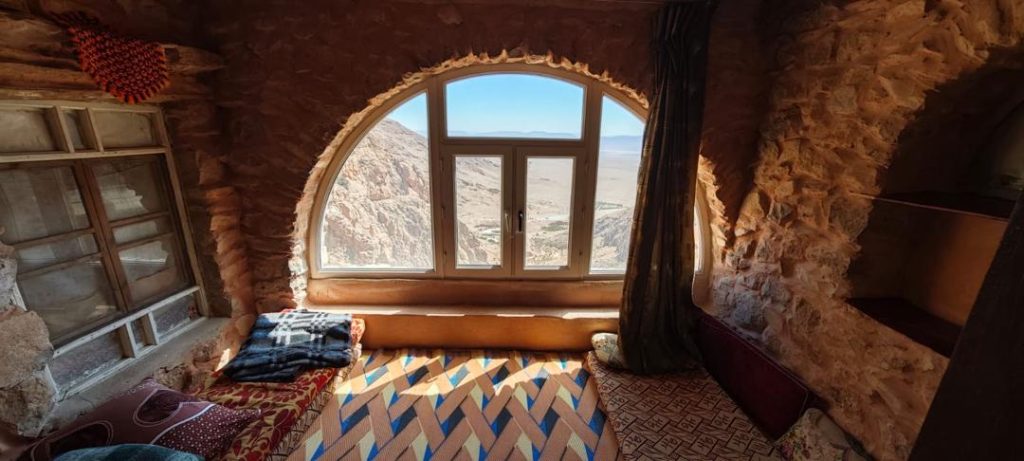
The rooms are simple. This is not hotel accommodation. Visitors should expect basic shared monastery-style rooms, not luxury, privacy, or modern comfort.
Before leaving, visitors should clean their room. The monastery board clearly asks visitors to clean their room before leaving and bring the sheets to the bin at the entrance to the women’s toilets.
This tells you something important: the visitor is responsible for the space they use. You do not leave the room messy and walk away.
Bring modest sleepwear. Keep your things organized. Respect others. Do not make noise at night.
Sleeping time and waking time
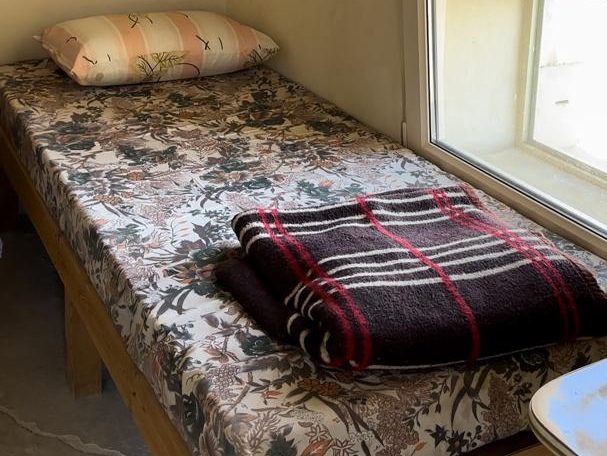
Mar Musa follows an early and quiet rhythm. Morning Prayer is at 7:30 am, so visitors who stay overnight should expect to wake up early or at least keep quiet while the community begins the day.
At night, because dinner preparation is at 9:15 pm and some prayers happen in the evening, sleep may be later than in some monasteries. But the atmosphere after evening activities should remain quiet. This is not a place for late-night noise, loud conversations, music, or social drinking.
A simple rule: after evening prayers, dinner, and shared time, keep quiet and let people sleep.
Bathrooms and toilets
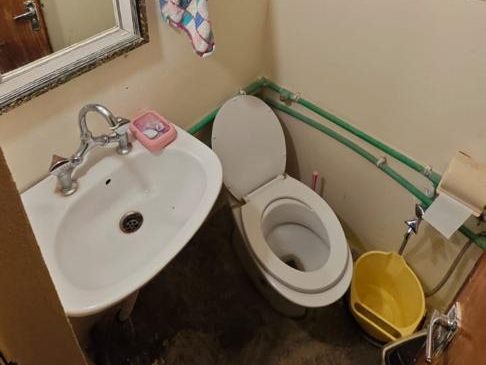
There are separate toilet areas for men and women.
Men’s toilets are just inside the main monastery entrance, up the stairs to the right.
Women’s toilets are down the stairs to the right of the terrace, at the bottom on the left.
Visitors must throw tissues in the bins, not in the toilets. This is a very important practical rule. Old plumbing and remote systems can be damaged easily.
Do not throw toilet paper, wet wipes, sanitary pads, or anything else into the toilet.
Showers
There are showers in both the men’s and women’s bathroom areas.
Visitors can shower, but water is precious in the desert. Use water sparingly. Do not take long showers. Do not waste hot or cold water. Bring your own towel, soap, shampoo, and personal hygiene items.
The shower experience is simple. Do not expect hotel pressure, hotel comfort, or unlimited water.
Hot water
Hot water may be available, but visitors should still think of showering as a basic monastery shower, not a hotel shower. Use it quickly and respectfully. In a remote desert monastery, water and heating are not things to waste.
Is there AC?
Do not expect air conditioning. Mar Musa is an ancient stone monastery in a remote location. In summer, rooms may be warm during the day, but the altitude and stone structure can make evenings cooler.
Bring light modest clothes for daytime and a warmer layer for evening.
Is there heating in winter?
Winter can be cold. Heating may be simple and limited. Bring warm clothes, socks, and layers if you stay overnight in winter. Do not expect hotel-style heating.
Is there a washing machine?
Do not depend on a washing machine as a visitor. For a short stay, bring enough clothes. If you need to wash something small, hand-washing may be possible, but keep in mind that water is precious. Do not arrive expecting laundry service.
Drinking water
Filtered drinking water is available in the kitchen and from the dispenser on the terrace.
This is very helpful, but you should still bring your own water for the climb. Once you are inside, drink what you need, but do not waste water.
Electricity and solar panels
The monastery uses simple systems, including solar panels. Electricity should be treated as limited and precious. Charge your phone when possible, but do not expect unlimited power access like in a hotel.
Bring a power bank. This is especially useful because mobile coverage and electricity access can be limited.
The library
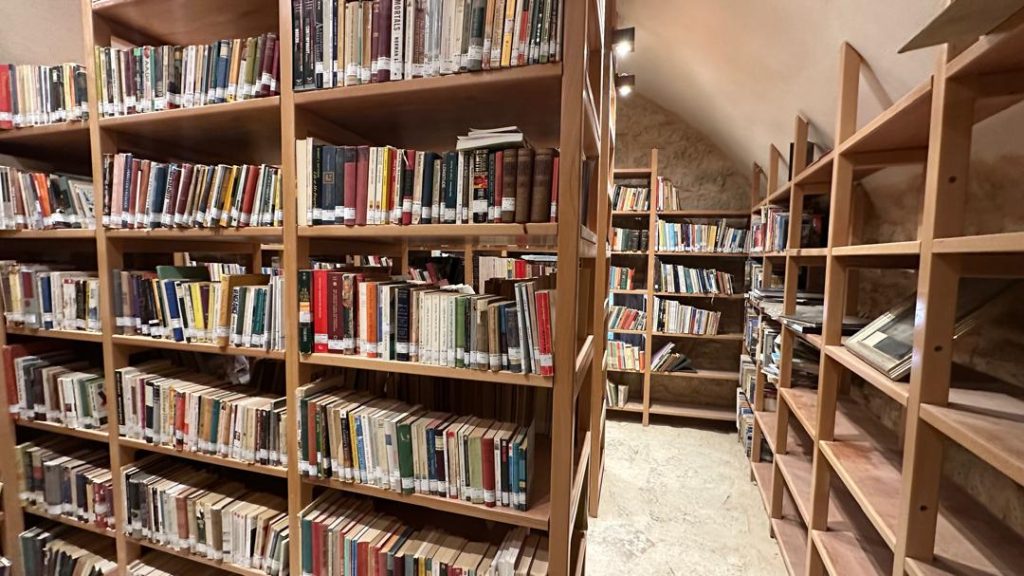
The library is available, but visitors should ask a member of the community before using it.
Books can be borrowed while staying at the monastery, but they must not be taken out of the monastery. This is very clear. The library is for reading there, not for taking books away.
The library may include books about Christianity, Islam, spirituality, theology, interfaith dialogue, history, Syria, Arabic studies, philosophy, culture, and serious literature. Books may be in Arabic, English, French, Italian, and other languages.
Read quietly. Return books properly. Do not damage anything.
Can I donate books?
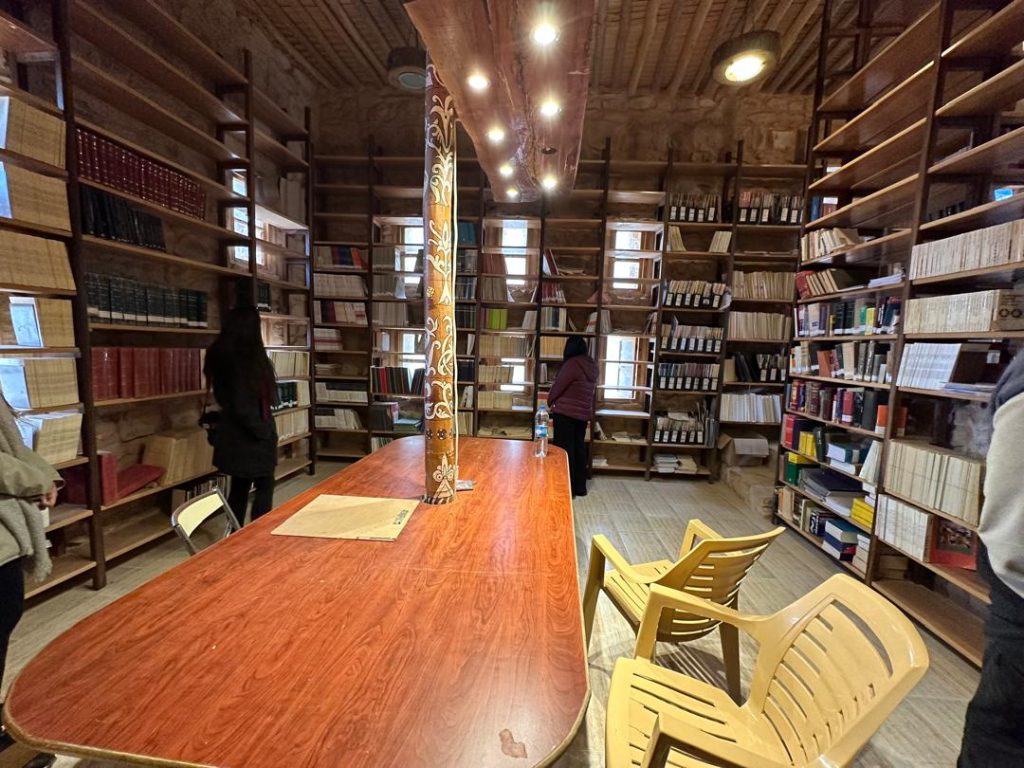
You can donate books if they are useful and suitable. Good book donations would be serious books about religion, spirituality, Christianity, Islam, dialogue, philosophy, Syria, history, culture, Arabic studies, or meaningful literature.
Do not bring random old books just to get rid of them. A monastery library is not a storage place for unwanted books. Donate only books that fit the spirit of the place.
The church
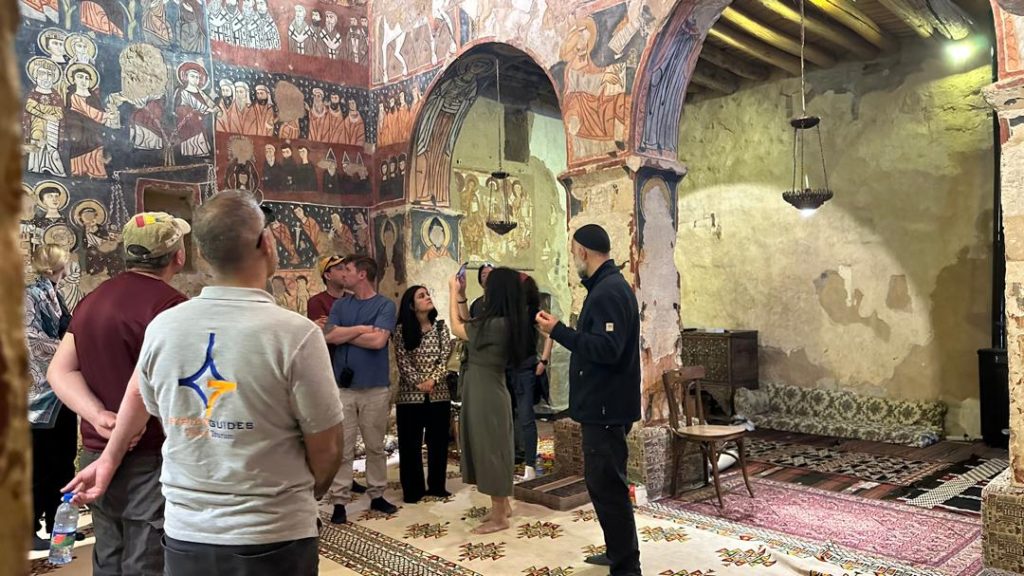
The church is one of the heart points of Mar Musa. It is ancient, small, and powerful. It is open to respectful visitors, regardless of religion.
Enter quietly. If people are praying, do not move around loudly. Do not use flash. Do not touch the frescoes. Do not lean on painted walls. Do not treat the church like a museum room where your photo is more important than the place.
If there are carpets, remove your shoes. Watch what others do. Bring clean socks if possible.
Sit quietly. Look slowly. Let the place speak.
Shoes inside the monastery
Take off your shoes when entering carpeted areas, especially the church and other quiet prayer or sitting spaces. This may also apply to cave-like rooms or rooms with carpets.
Your hiking shoes will be dusty after the climb. Do not walk on carpets with dusty shoes.
Photography
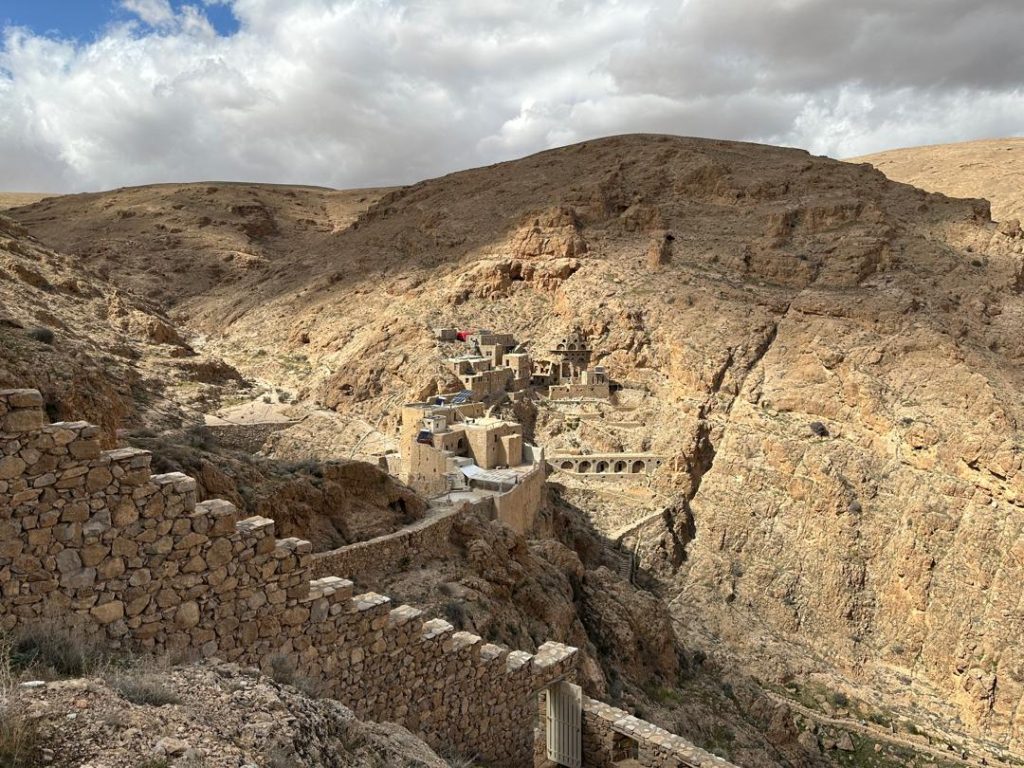
Photography of the landscape is usually fine. The view from Mar Musa is one of the most beautiful semi-desert views in Syria.
Inside the church and near the frescoes, be careful. Do not use flash. Flash can harm old paintings and disturb people. Do not photograph people praying without permission. Do not photograph monks, nuns, guests, or children without permission.
If you are unsure, do not take the photo. Respect is more important than content.
The frescoes
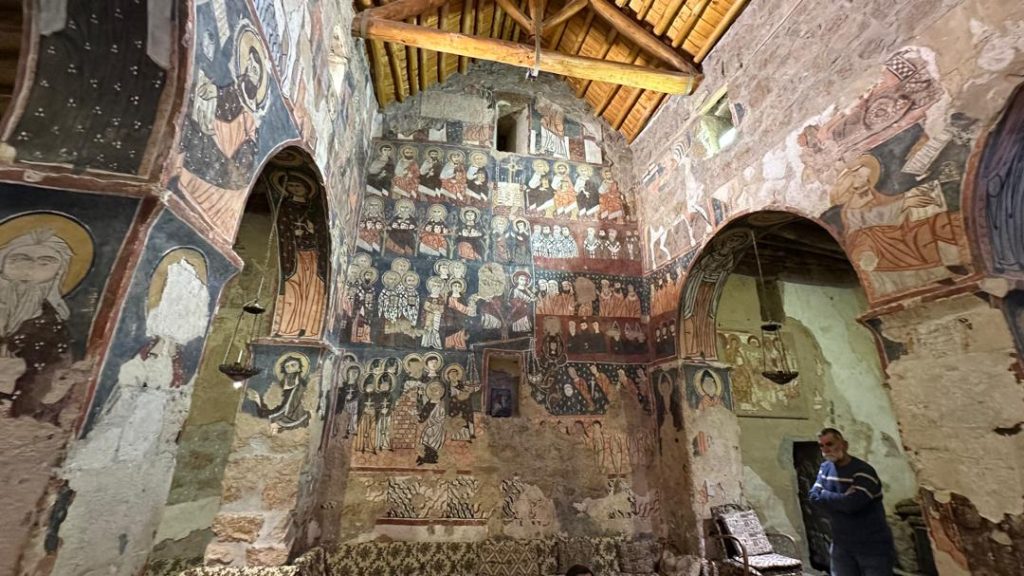
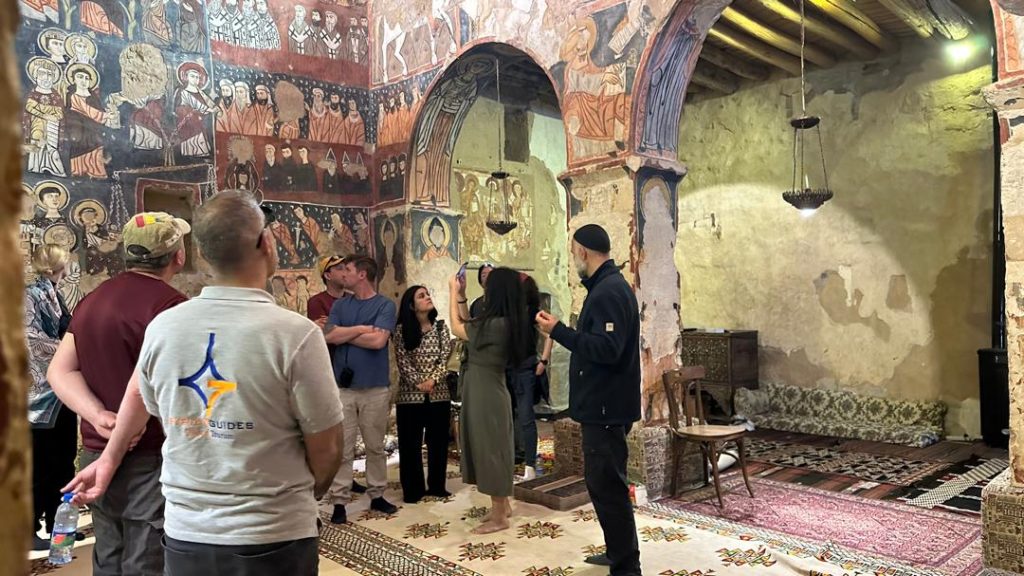
The frescoes are one of the greatest treasures of Mar Musa. They are old wall paintings from different periods. The church has three layers of frescoes, meaning that the walls were painted in different historical phases. This gives the church a deep feeling of time. You are not only looking at one moment. You are looking at centuries.
The most famous fresco is the Last Judgement. It shows a medieval Christian vision of judgement, heaven, sin, punishment, and salvation. Saint Peter is shown holding the key to heaven. There are holy figures, angels, nuns, priests, sinners, and symbolic scenes.
Some parts show sinners and moral warnings. Visitors may hear explanations about thieves, killers, cheaters, liars, adulterers, sinful priests, and non-Christians. These scenes should be understood as medieval religious art. They were not made as decoration only. They were made to teach, warn, and make people think.
Do not rush through the church. The frescoes need time. Stand quietly and look carefully.
The age of the monastery
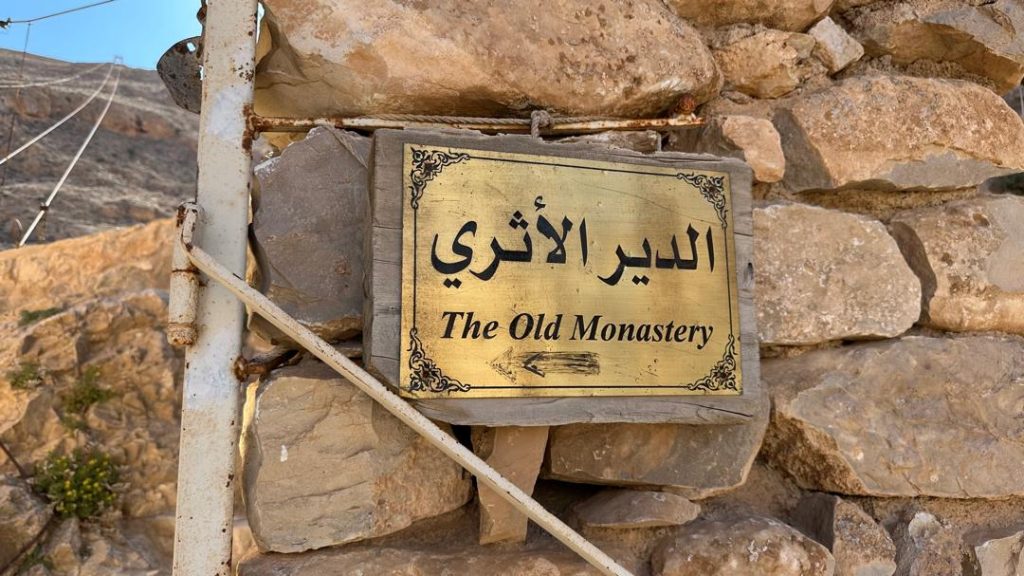
Mar Musa is often described as around 1,500 years old. The church itself goes back to the medieval period, and the monastery existed from very early Christian times. The tower is often described as around 1,000 years old. These numbers help visitors understand the depth of the place.
When you walk through Mar Musa, you are not walking through a modern reconstruction only. You are walking through layers of Syrian Christian history, monastic life, abandonment, revival, restoration, and living community.
The story of Saint Moses
The monastery is connected by tradition to Saint Moses the Abyssinian. The story says he came from Abyssinia, which is linked with Ethiopia, and chose a spiritual life instead of power and comfort. He became associated with this mountain place, and the monastery took his name.
Like many ancient religious stories, history and tradition mix together. But the meaning is clear: Mar Musa is a place of leaving the noise of the world, seeking God, and living simply.
Father Paolo
Father Paolo Dall’Oglio is one of the most important modern names connected to Mar Musa. He was an Italian Jesuit priest who came to the monastery when it was in ruins and helped revive it. He helped restore the buildings and frescoes and gave the monastery a renewed mission.
His vision focused on prayer, simplicity, hospitality, and Muslim-Christian dialogue. For many people, Father Paolo is part of the modern soul of Mar Musa.
He disappeared in Syria in 2013, and his memory remains deeply connected to the monastery.
Father Jihad, Father Jacques, and Sister Huda
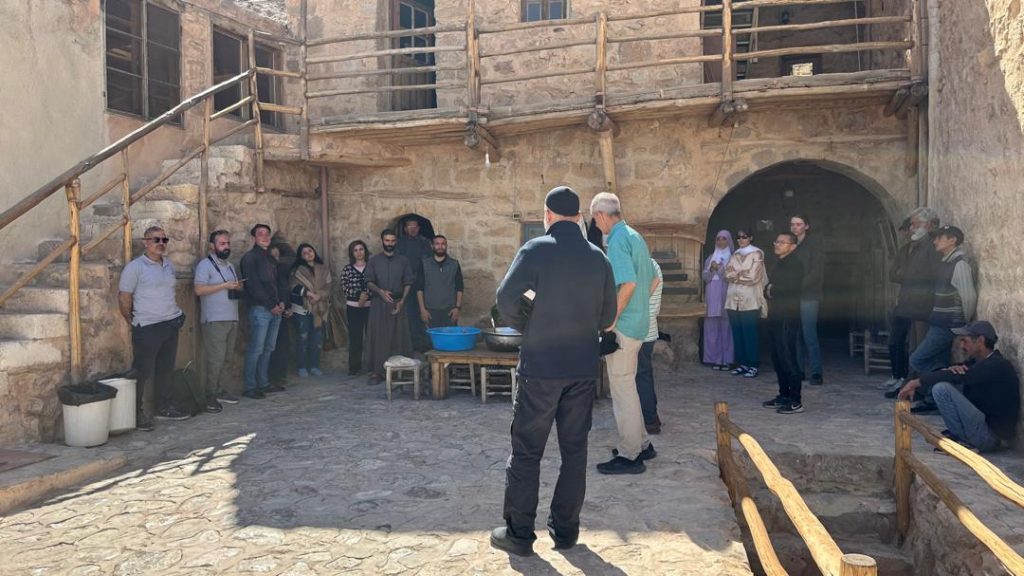
Several names are strongly connected to Mar Musa and its community.
Father Jihad Youssef is one of the main figures connected with the monastery and its life.
Father Jacques Mourad is also connected with the Mar Musa community and later became a major church figure in Syria.
Sister Huda is one of the important women connected with the community and its hospitality.
Visitors may hear these names when learning about Mar Musa. The monastery is not only stone and history. It is also people, service, prayer, and daily responsibility.
The community
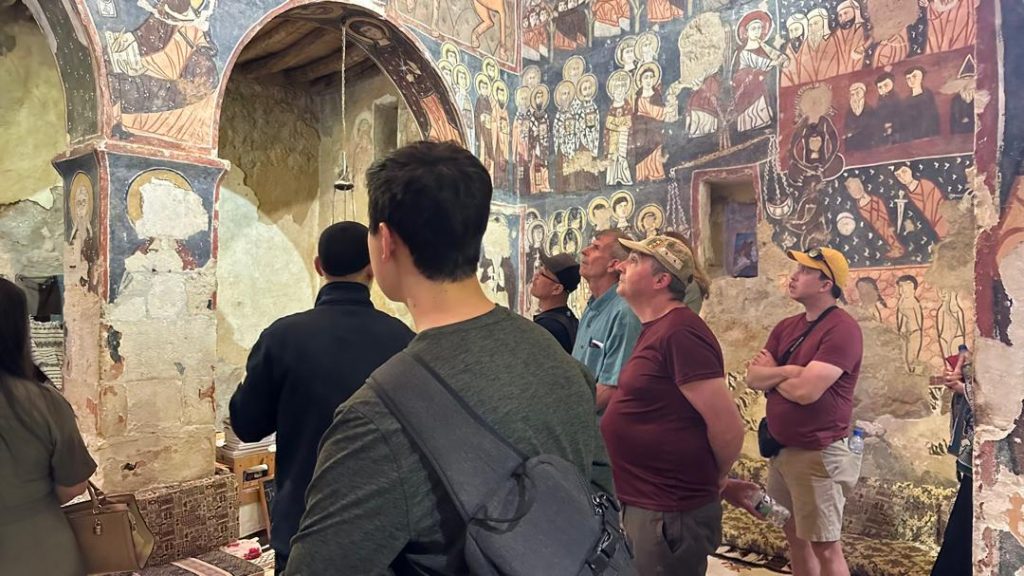
The Mar Musa community is mixed and international in spirit. You may meet Syrians from different cities, local Christians, Muslims, foreigners, Italians, French visitors, English speakers, volunteers, readers, retreat visitors, and people who simply want silence.
People may speak Arabic, English, French, Italian, or other languages. The atmosphere is usually friendly, but it is also quiet and simple.
Not everyone comes for the same reason. Some come for faith. Some come for history. Some come for silence. Some come for retreat. Some come because they heard that Mar Musa is one of the most special places in Syria.
Respect everyone’s reason.
Activities at Mar Musa
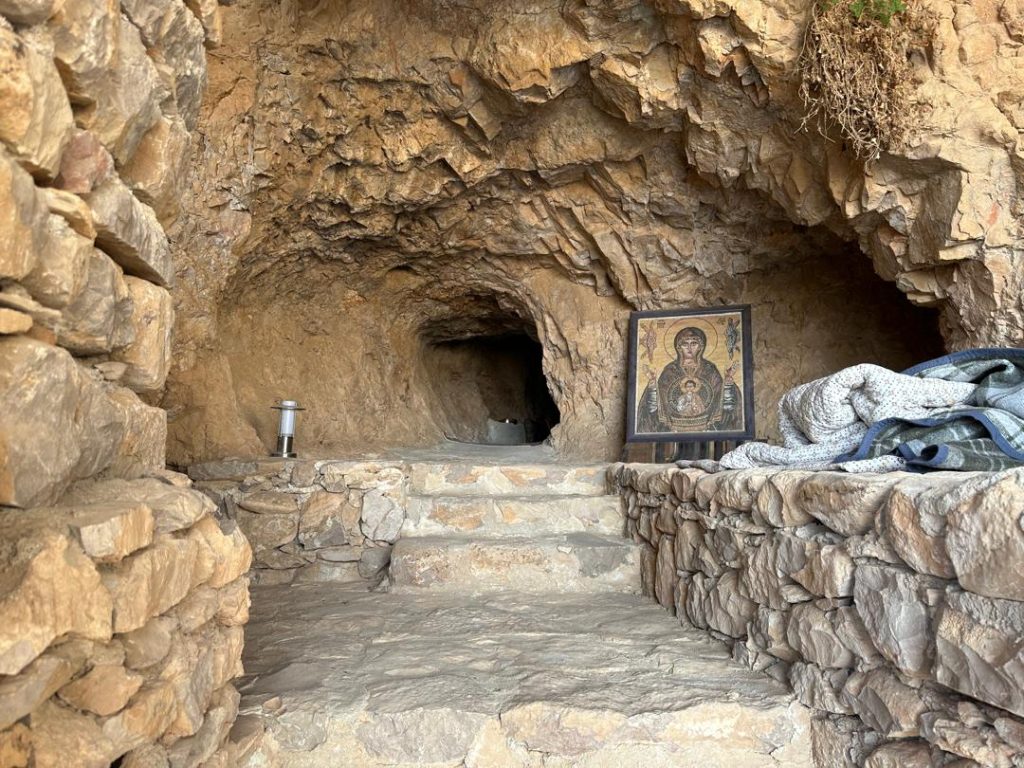
Activities at Mar Musa are simple. Do not expect entertainment. The main activities are:
Climbing to the monastery.
Visiting the church.
Seeing the frescoes.
Joining or observing prayers.
Silent meditation.
Reading in the library.
Helping with cooking or dishes.
Cleaning your space.
Talking quietly with the community.
Walking in the surrounding mountains.
Sitting on the terrace.
Watching the semi-desert horizon.
Resting from noise.
This simplicity is the experience.
Walking and hiking around Mar Musa
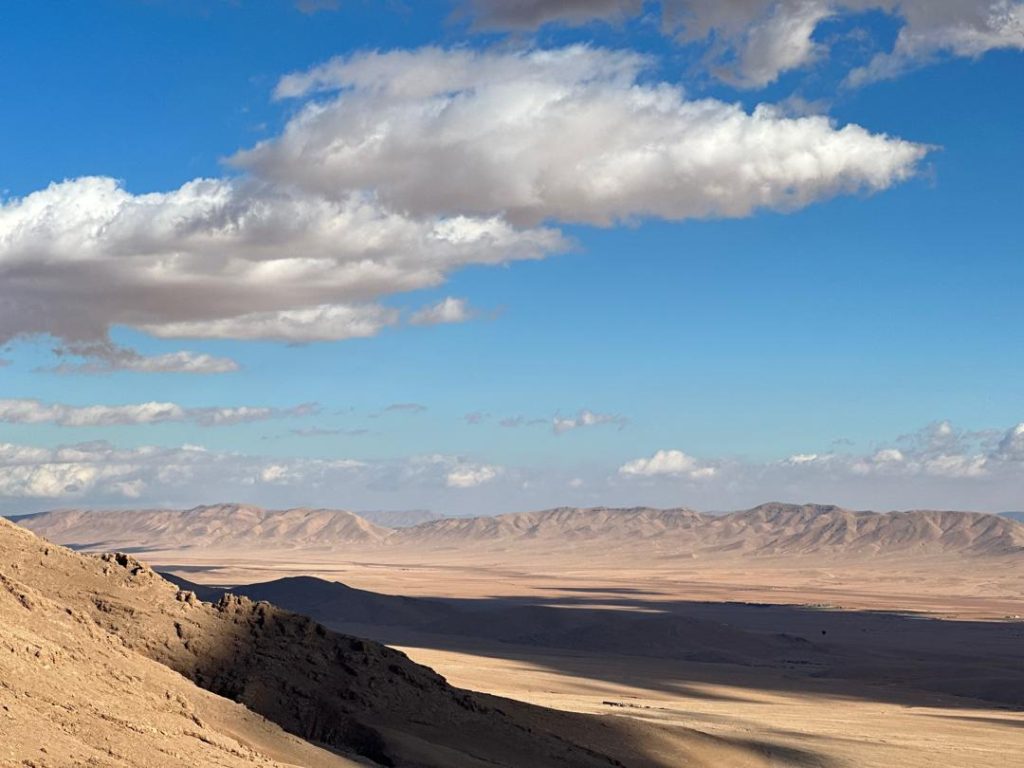
You can walk in the surrounding desert and mountain area. The monastery even encourages visitors who walk in the desert to take a plastic bag and collect rubbish.
This is a beautiful idea. The land is not only for photos. It should be protected.
Wear proper shoes. Carry water. Avoid the strongest summer heat. Do not walk far alone if you do not know the area. The landscape is dry, open, and remote. Phone coverage may be weak.
From the top, the view is mesmerizing. You see the semi-desert stretching toward the horizon. The silence, the wind, the dry mountains, and the wide sky are part of what makes the place unforgettable.
Rubbish and environmental respect
Do not leave rubbish. Not on the stairs, not around the parking area, not in the rooms, not on the terrace, not in the desert.
If you go walking, take a small bag and collect rubbish if you see any. This matches the spirit of the monastery. You do not only consume the beauty of the place. You protect it.
Child protection
The monastery has a posted child protection statement. It says that children under 18 have the right to protection from harm, abuse, neglect, and exploitation, regardless of age, gender, disability, race, or background.
Visitors should respect children’s privacy and safety. Do not photograph children without permission. Do not approach children in a strange or careless way. Group leaders, guides, volunteers, and photographers should be especially careful.
If there is any serious concern about child safety, it should be reported to the responsible people.
Smoking
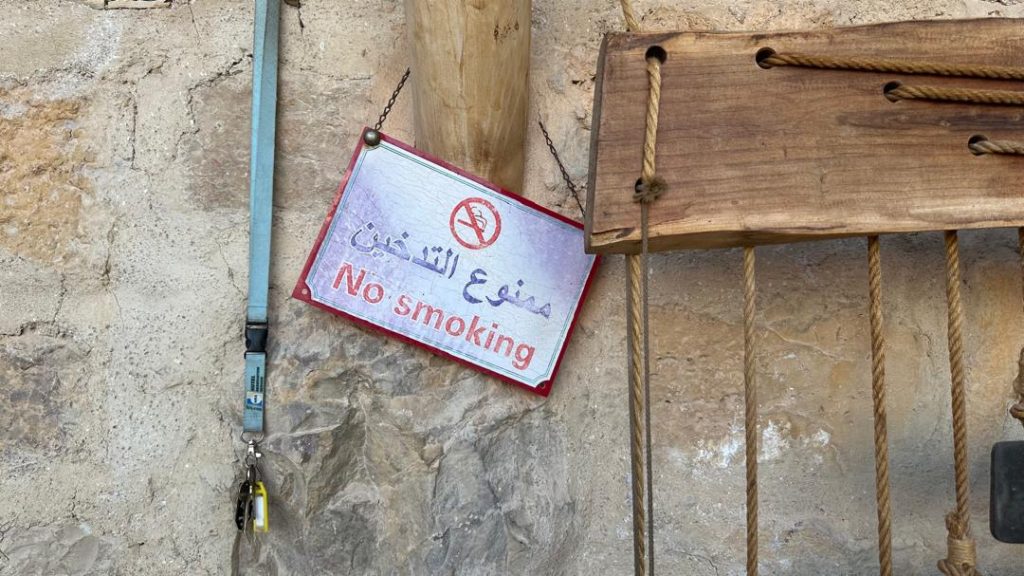
Smoking should be avoided in shared areas, rooms, the church, the library, and prayer spaces. If smoking is allowed, it should only be in a specific outdoor place and never where it disturbs others.
Do not throw cigarette ends on the ground. The landscape is dry and fire risk matters. The respectful choice is to smoke as little as possible, far from others, and only where appropriate.
Alcohol
Alcohol should not be shown openly in Mar Musa. This is a monastery, and it also welcomes Muslim visitors. Open drinking would be disrespectful to the place and to other guests.
If someone has alcohol privately, it should remain private and discreet. Do not drink in shared spaces. Do not offer alcohol around. Do not turn the monastery into a social drinking place.
The spirit of Mar Musa is prayer, silence, hospitality, and respect.
Is there a market nearby?
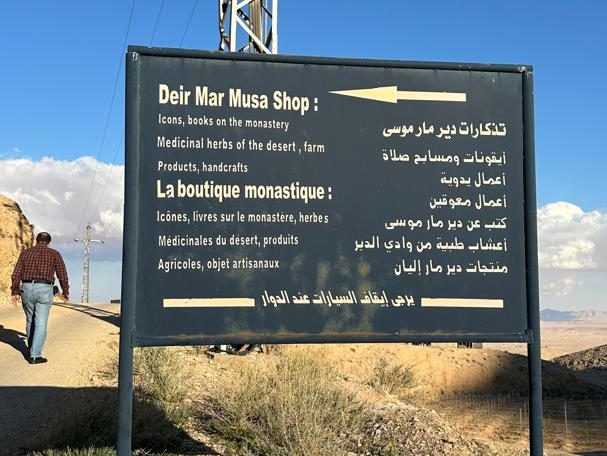
No. There is no market beside the monastery. Bring what you need before leaving Damascus or Al-Nabk.
This includes water for the climb, personal medicine, hygiene products, snacks, sanitary pads, diapers or incontinence products if needed, shaving tools, phone charger, power bank, and any special food.
Do not arrive expecting to buy things nearby.
Emergency cases
Mar Musa is remote. The monastery is high above the parking area, and the climb itself can make emergency movement difficult.
If someone gets sick or injured, the first challenge is dealing with the situation inside the monastery or on the stairs. Then the person may need to be taken down and driven toward Al-Nabk or Damascus, depending on the seriousness.
Visitors with medical conditions should be careful. Bring your medicine. Tell your guide if you have asthma, heart problems, diabetes, allergies, knee problems, or any serious condition. Do not climb if your body is warning you.
The nearest practical town is Al-Nabk. Serious cases may require Damascus.
Can I visit Palmyra from Mar Musa?
Yes, Mar Musa can be combined with Palmyra in a larger itinerary, but it is not a small nearby stop. From the Mar Musa/Al-Nabk area to Palmyra is still a long drive across inland Syria. Plan several hours, depending on route, road conditions, permissions, and the day’s travel situation.
A practical itinerary could be Damascus to Mar Musa and back to Damascus as a day trip.
Another option is Damascus to Mar Musa, overnight at the monastery, then continue toward Palmyra the next day.
Do not treat Palmyra as something you can casually add without planning. It needs time, a driver, and updated local knowledge.
Best time to visit
Spring and autumn are the best seasons. The weather is more comfortable, the light is beautiful, and the climb is easier.
Summer is possible, but it can be hot. Go early or late. Bring water, sunscreen, sunglasses, and a hat.
Winter is possible, but it can be cold and windy. Bring warm clothes and be careful if the stones are wet or slippery.
How much time should you plan?
For a short visit from Damascus, plan most of the day.
A comfortable day trip may look like this:
Leave Damascus in the morning.
Drive to Al-Nabk.
Continue to the monastery parking area.
Climb slowly to the monastery.
Rest at the top.
Visit the church and frescoes.
Sit on the terrace.
Drink water or tea if offered.
Walk around quietly.
Descend carefully.
Return to Damascus before dark.
From the parking area, you should allow at least three hours for the climb, visit, rest, and descent. If you want to stay longer, read, join prayer, or share a meal, allow more time.
Suggested day trip plan
Leave Damascus around 8:00 am.
Reach the parking area around 10:00 am.
Start climbing slowly.
Reach the monastery around 10:30 am or 10:45 am.
Rest and drink water.
Visit the church and frescoes.
Sit quietly on the terrace.
Join community time if appropriate.
Have simple lunch if arranged or offered.
Spend time reading or walking.
Descend in the afternoon.
Return to Damascus before evening.
This is a simple plan. Do not rush Mar Musa. The place is best when you give it time.
Suggested overnight plan
Arrive before sunset.
Climb while there is still daylight.
Settle into your room.
Join the evening silence or prayer if you wish.
Share dinner and help with dishes.
Sleep quietly.
Wake up early or keep quiet during Morning Prayer.
Have breakfast.
Read, walk, help, or sit in silence.
Visit the church again.
Leave the room clean.
Bring sheets to the correct bin before leaving.
Donate if you can.
Descend carefully.
This overnight experience gives you a deeper feeling of Mar Musa than a short visit.
Etiquette of the monastery
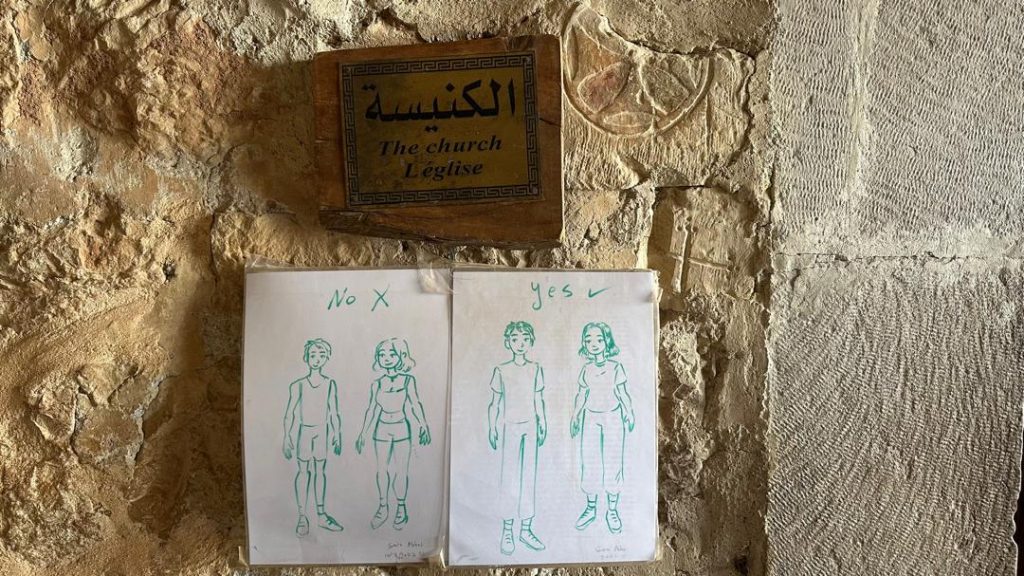
The rules are simple, but important.
Speak softly.
Keep silence on the stairs.
Do not play music.
Do not shout.
Do not use your phone loudly.
Dress modestly.
Remove shoes in carpeted sacred spaces.
Do not use flash in the church.
Do not touch frescoes.
Do not waste water.
Do not leave rubbish.
Clean your room before leaving.
Help with dishes or meals when possible.
Keep valuables safe.
Respect prayer times.
Respect people who want silence.
Donate if you can.
Remember that you are a guest, not a customer.
Why silence matters
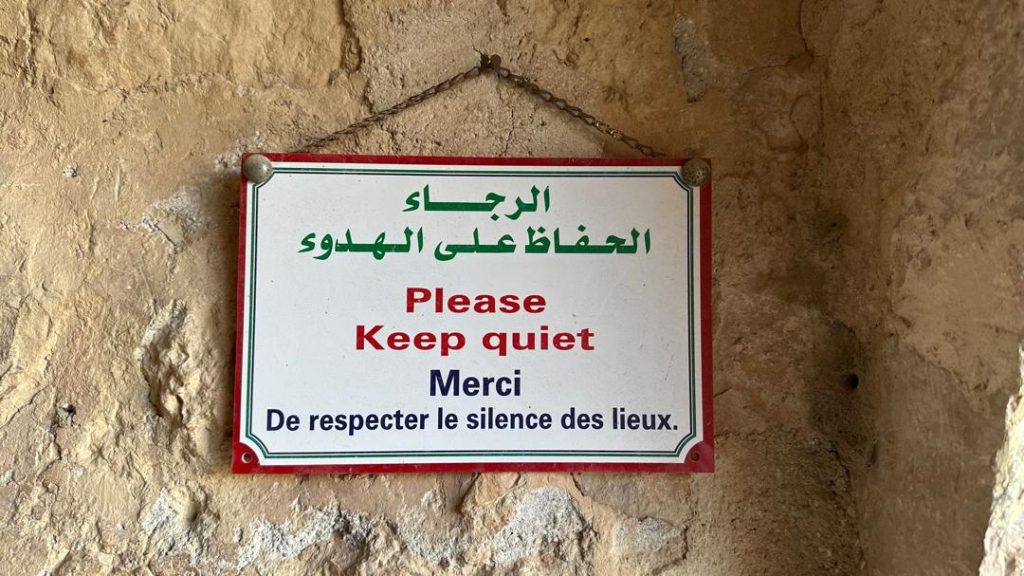
Silence is not only a rule. It is the heart of the experience.
Mar Musa gives people something rare: a place where they can hear their own thoughts. Some people come with pain. Some come with questions. Some come with faith. Some come without faith but with a tired heart. Some come because they need distance from noise.
When visitors speak loudly, play music, or treat the monastery like a tourist picnic, they take that silence away from others.
So the best thing you can do is simple: lower your voice.
What makes Mar Musa special?
Mar Musa is special because it combines many things at once.
It is ancient.
It is remote.
It is simple.
It is spiritual.
It has beautiful views.
It has historic frescoes.
It has a living community.
It welcomes different people.
It asks visitors to slow down.
It is not luxurious, but it is meaningful.
It is not easy, but it stays in your memory.
Many places in Syria are beautiful. Mar Musa is different because you do not only look at it. You experience it with your body. You climb. You sweat. You slow down. You enter through a low door. You sit in an old church. You hear silence. You look at the desert. You share simple food. You leave lighter than you arrived.
Full FAQ About Mar Musa
Can I visit Mar Musa if I am not Christian?
Yes. Mar Musa welcomes respectful visitors from different religions and backgrounds.
Can Muslims visit?
Yes. Muslims can visit, stay, attend respectfully, share meals, read, walk, and enjoy the monastery.
Can non-religious people visit?
Yes. You do not need to be religious. You only need to respect the place.
Do I have to join prayers?
No. You can join, observe, sit quietly, or step away respectfully.
What time is Morning Prayer?
Morning Prayer is at 7:30 am, except on Sundays.
What if I do not understand Arabic?
Morning Prayer is in Arabic, but visitors who do not understand Arabic are welcome. They can sit quietly, walk in the mountains, or help with washing dishes.
What time is Mid-day Prayer?
Mid-day Prayer is at 2:00 pm.
What time is silent meditation?
Silent meditation is at 7:30 pm.
What time is Sunday Mass?
Sunday Mass is at 9:00 am.
What time is weekday Mass?
Weekday Mass is at 8:30 pm.
What happens on Saturday evening?
Saturday Evening Vespers are at 8:30 pm.
What time is breakfast?
Breakfast preparation starts at 9:15 am.
What time is lunch?
Lunch preparation starts at 2:15 pm.
What time is dinner?
Dinner preparation starts at 9:15 pm.
Is staying free?
Yes. The monastery does not charge fees for overnight stay.
Are meals free?
Yes. The monastery does not charge fees for meals.
Should I donate?
Yes, if you can. Donations are voluntary but important. There is a donation box in front of the church.
Does the monastery have financial agreements with travel agencies?
No. The monastery states that it has no financial agreement with any travel agency or tour guide.
Are rooms private?
Visitors should expect simple shared monastery-style rooms, not private hotel rooms.
Do I need to clean my room?
Yes. Clean your room before leaving.
What should I do with the sheets?
Bring the sheets to the bin at the entrance to the women’s toilets before leaving.
Is the monastery responsible for lost belongings?
No. The monastery is not responsible for lost or stolen belongings.
Are showers available?
Yes. There are showers in both the men’s and women’s bathroom areas.
Is hot water available?
Hot water may be available, but the shower is still basic. Use water sparingly.
Are there toilets?
Yes. Men’s toilets are inside the main entrance, up the stairs to the right. Women’s toilets are down the stairs to the right of the terrace, at the bottom on the left.
Can I throw tissue in the toilet?
No. Throw tissues in the bins, not in the toilets.
Is drinking water available?
Yes. Filtered drinking water is available in the kitchen and from the terrace dispenser.
Should I bring water?
Yes. Bring water for the climb.
Is there AC?
No, do not expect AC.
Is there heating?
Heating is simple or limited. Bring warm clothes in cold weather.
Is there a washing machine?
Do not depend on a washing machine. Bring enough clothes for your stay.
Can I use the library?
Yes, but ask a community member first.
Can I take books outside the monastery?
No. Books should not be taken out of the monastery.
Can I borrow books during my stay?
Yes, with permission, while staying at the monastery.
Can I donate books?
Yes, if they are useful and suitable. Serious books about religion, spirituality, dialogue, history, Syria, philosophy, culture, and literature are best.
Can I help in the monastery?
Yes. Visitors can help with dishes, preparing meals, cleaning, agricultural work, environmental work, and similar tasks.
Is helping required?
It is part of the spirit of the place. If you stay, you should help when possible.
How many stairs are there?
Expect around 400+ stone steps.
How long does the climb take?
Usually 20 to 30 minutes for average visitors, and 40 to 60 minutes for slower visitors.
Are hiking shoes necessary?
Yes. Hiking shoes or strong walking shoes are strongly recommended.
Can I wear sandals?
No, sandals are not a good idea. The stones are uneven and dusty.
Is the climb difficult?
It is moderate for healthy visitors, difficult for people with knee, back, breathing, heart, or balance problems.
Is Mar Musa suitable for elderly visitors?
Only if they can manage the stairs, uneven stone path, and low entrance. It is not an easy accessible visit.
What if I cannot finish the climb?
Stop, rest, drink water, and go back down if needed. Do not force yourself.
Is there a cable system for bags?
Yes, there is a cable/pulley system used for moving things up. Travel light and keep valuables with you.
Is the entrance low?
Yes. The old entrance is very low and narrow, around one meter high. You need to bend deeply.
Is it bad for knee problems?
It can be. The stairs, descent, and low entrance can be difficult for people with knee problems.
What should I wear?
Comfortable modest clothes. Cover shoulders and knees if possible. Wear proper shoes.
Do women need to cover their hair?
No special head covering is required for normal visitors, but modest clothing is important.
Are shorts allowed?
Very short shorts are not respectful. Longer modest shorts or trousers are better.
Is sunscreen necessary?
Yes, especially in summer.
Do I need sunglasses?
Yes. The sun and bright stone landscape can be strong.
Do I need a hat?
Yes, especially in summer.
Is it hot in summer?
Yes. Summer can be hot, dry, and exposed. Expect around 30°C to 35°C and stronger heat under direct sun.
Is it dusty?
It can be. The wind may carry dust because the area is semi-desert.
Should I bring a mask?
Yes, if you have breathing problems, allergies, or asthma.
Is there a market nearby?
No. Bring everything you need.
What personal items should women bring?
Comfortable modest clothes, hygiene products, sanitary pads, medicine, towel, soap, shampoo, water, sunscreen, sunglasses, and any personal needs.
What personal items should men bring?
Comfortable modest clothes, shaving tools if needed, medicine, towel, soap, shampoo, water, sunscreen, sunglasses, and any personal needs.
Are diapers or incontinence products available nearby?
No. Anyone who needs them should bring them.
Is smoking allowed?
Do not smoke in shared or sacred spaces. If smoking is allowed, it should only be in a specific outdoor place and away from others.
Is alcohol allowed?
Do not show or drink alcohol openly. If someone has alcohol privately, it should remain private and discreet.
Can I take photos?
Yes, in many outdoor areas. Inside the church or near frescoes, be respectful and do not use flash.
Can I photograph people?
Only with permission.
Can I photograph children?
Do not photograph children without clear permission.
Are drones allowed?
Drones should be considered inappropriate unless there is special permission. Do not bring or fly a drone casually.
Can I hike around the monastery?
Yes, but walk carefully, carry water, wear proper shoes, and do not go far alone.
Should I collect rubbish if I walk?
Yes. The monastery encourages visitors walking in the desert to take a plastic bag and collect rubbish.
Can I visit Palmyra from Mar Musa?
Yes, it can be part of a larger itinerary, but it is a long drive and needs planning.
How far is Palmyra from Mar Musa?
It is not nearby. Expect a long drive of several hours depending on route and conditions.
Is Mar Musa good for children?
Yes, if children can climb safely and behave quietly. Parents must watch them carefully.
Is Mar Musa a hotel?
No. It is a monastery and a living community.
What is the most important rule?
Respect the silence, the people, the prayer, the water, the rooms, and the place.
Final advice
Do not go to Mar Musa in a hurry.
Do not go with bad shoes.
Do not go without water.
Do not go expecting luxury.
Do not go only for a photo.
Go slowly. Go quietly. Go ready to climb. Go ready to help. Go ready to listen.
When you climb the stairs, remember that other people may be climbing for reasons you do not know. Some are tourists. Some are pilgrims. Some are carrying grief. Some are looking for God. Some are simply tired from life and need silence.
So keep your voice low.
Let the mountain speak.
Let the monastery be what it is.