
Some cities are remembered through their monuments. Others stay with you because of their music, streets or people.
Aleppo is remembered through all of them—but it may be understood best through its food.
Here, a meal can carry the history of an ancient trading city. Sour cherries are cooked with lamb. Roasted peppers are blended with walnuts and pomegranate molasses. Bulgur is transformed into countless varieties of kibbeh. Pistachios appear in sweets, kebabs and festive dishes. Spices are used carefully, not simply to add heat, but to create balance and depth.
Aleppian cooking is generous, detailed and surprisingly complex. It can be smoky, sour, sweet, spicy and rich—sometimes within the same plate.
This is why many Syrians speak of Aleppo not merely as a city with good food, but as a true culinary capital.
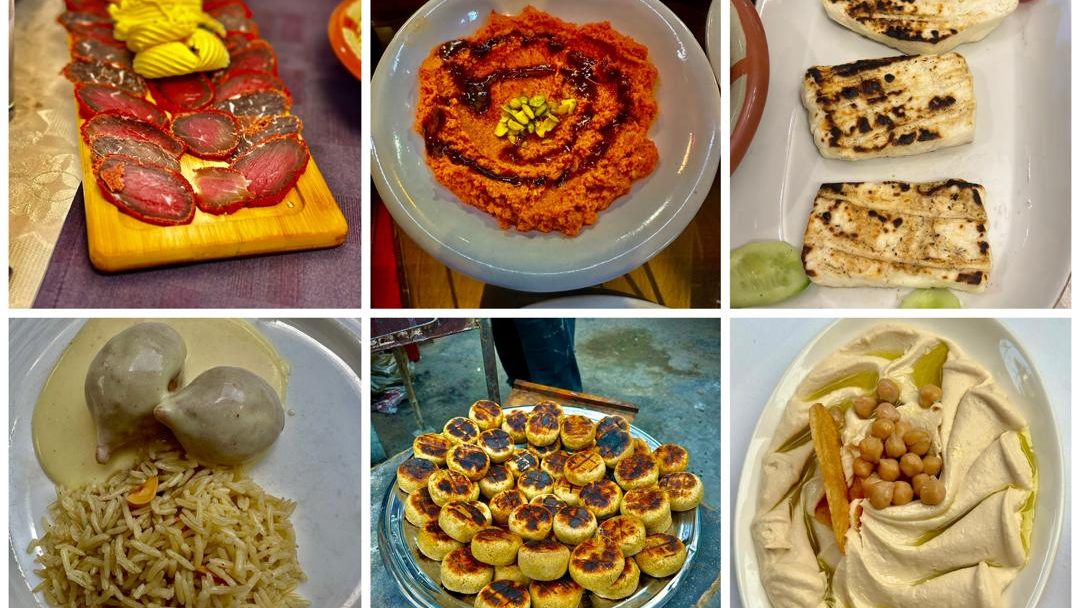
A City Where Food Is Taken Seriously
Ask an Aleppian about the best version of a Syrian dish and prepare for a long conversation.
They may explain which neighbourhood makes it properly, which type of meat should be used, whether the sauce needs more pomegranate molasses, how finely the bulgur should be ground or why a particular relative’s recipe is better than anything served in a restaurant.
This is not simply pride. Food in Aleppo is treated as knowledge.
Recipes are remembered, debated and passed between generations. A good cook is judged not only by whether a dish tastes pleasant, but by texture, balance, presentation and respect for the original method.
A plate of kibbeh, for example, may appear simple. Yet its outer shell must be thin without breaking. The meat must be seasoned correctly. The bulgur must be prepared to the right consistency. The filling must remain moist, while the finished piece should feel crisp on the outside and tender within.
In Aleppo, cooking is not rushed.
It is practised.
Geography Made Aleppo a Meeting Place
Aleppo’s culinary richness is closely connected to its geography.
For thousands of years, the city stood at the meeting point of routes linking the Mediterranean coast with Mesopotamia and regions farther east. UNESCO describes Aleppo as a crossroads of trade routes from as early as the second millennium BC, shaped by successive Hittite, Assyrian, Greek, Roman, Arab, Mamluk and Ottoman periods. (UNESCO World Heritage Centre)
Caravans arrived carrying textiles, metals, dried fruits, spices and other goods. Merchants rested in the city’s khans, sold their products in its markets and exchanged more than merchandise. They also brought techniques, flavours and habits.
Ingredients and ideas moved together.
Aleppo’s location beside productive agricultural areas also gave its cooks access to grains, vegetables, olives, pistachios, fruits, herbs, sheep and other regional ingredients. The combination of trade, agricultural wealth, urban prosperity and a diverse population helped make the city an important centre of Middle Eastern gastronomy. (The Aleppo Project)
Its cuisine did not develop in isolation. It grew through contact.
A Cuisine Created by Many Communities
Aleppo was historically home to communities with different religious, ethnic and cultural backgrounds.
Muslim and Christian Arabs, Armenians, Kurds, Turkmens, Circassians and Jews all formed part of the city’s social world at different times. Families lived in neighbouring quarters, traded in the same markets and developed their own customs while influencing one another.
This diversity did not produce a single uniform cuisine. It created layers.
Some households prepared dishes differently because of religious rules. Others introduced new forms of pastry, preserved food or festive cooking. Merchants had access to ingredients from distant places, while village traditions entered the city through farmers, workers and seasonal produce.
The cuisine of Aleppo’s historic Jewish community is one example of this layered inheritance. Its recipes combined Mediterranean and Levantine ingredients with distinct community traditions and were later carried by Aleppian families to New York, Latin America and elsewhere. Many of these recipes had previously survived through memory rather than written cookbooks. (Google Books)
Aleppian cooking therefore belongs to the city as a whole, but within it are numerous family, neighbourhood and community cuisines.
That complexity is one reason it is so difficult to reduce Aleppo’s food to a few famous dishes.
The Aleppian Love of Sweet and Sour
One of the most recognisable characteristics of Aleppian cooking is its use of contrasting flavours.
Sweetness is paired with acidity. Rich meat is balanced by fruit. Pepper is softened by walnut. Pomegranate molasses adds both sweetness and sharpness. Tamarind, sumac, sour cherry, lemon and quince can give a dish its identity.
This taste for contrast produces food that feels rich without becoming monotonous.
An Aleppian sauce might begin sweetly and finish with a sour edge. A meat dish may contain fruit, yet it is not necessarily a dessert-like combination. The fruit provides acidity, colour and aroma while cutting through the fat of the meat.
The result is food that asks you to pay attention.
It changes as you eat it.
Kebab Bil Karaz: Aleppo on One Plate
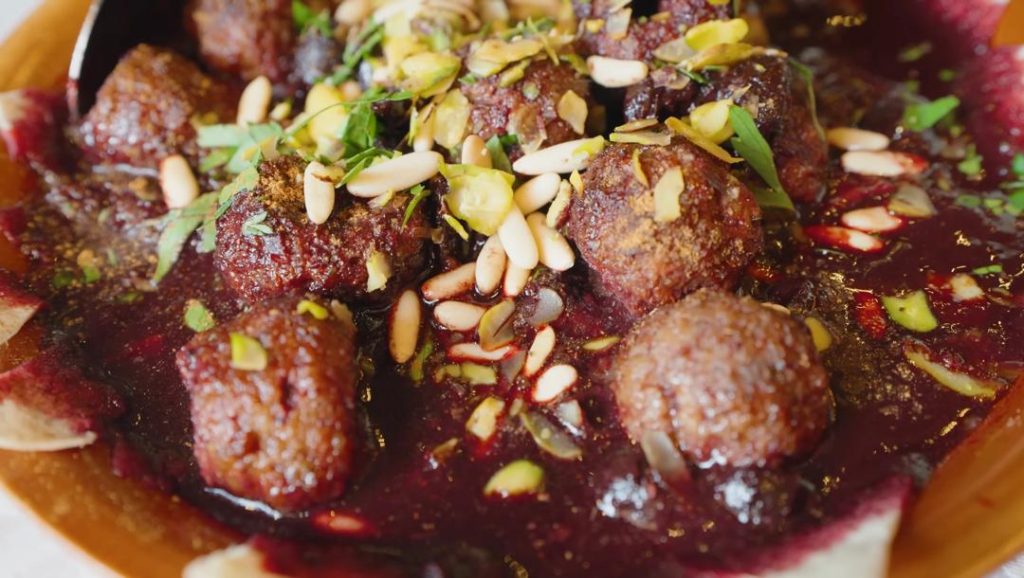
Perhaps no dish represents Aleppo’s approach to flavour better than kebab bil karaz, or cherry kebab.
Small pieces or balls of seasoned minced meat are cooked in a deeply coloured sauce made from sour cherries. The finished kebab is commonly served over pieces of bread, which absorb the sauce, and may be garnished with parsley and pine nuts.
At first, combining cherries and meat can sound unusual.
Then you taste it.
The richness of the lamb meets the sharpness of the fruit. The sauce is sweet, but not overly sweet; sour, but not aggressively acidic. Bread catches the juices, while herbs and nuts add freshness and texture.
It is dramatic in colour and flavour, yet carefully balanced.
Cherry kebab is strongly associated with Aleppo and has travelled with Aleppian families to other parts of Syria and into diaspora communities. (Wikipedia)
It is not simply one of the city’s signature dishes.
It is a lesson in how Aleppo cooks.
Aleppo Does Not Have Just One Kebab
Cherry kebab may receive the most attention, but Aleppo’s kebab tradition is much broader.
Meat may be mixed with parsley, onions, pistachios or spices. It may be grilled over charcoal, cooked in tomato sauce or paired with aubergine, peppers or fruit.
Among the varieties visitors may encounter are:
Kebab khashkhash, served with a lively tomato and red-pepper sauce.
Kebab hindi, in which seasoned meat is baked with tomatoes and onions.
Kebab with aubergine, combining smoky vegetables with grilled or baked meat.
Pistachio kebab, enriched with Aleppo’s famous green nuts.
Kebab mayyali, arranged with vegetables and cooked as a colourful tray dish.
The word kebab therefore describes a world of preparations rather than one recipe.
A serious Aleppian grill restaurant may offer a long menu in which small changes in seasoning, shape, sauce or cooking method create entirely different dishes.
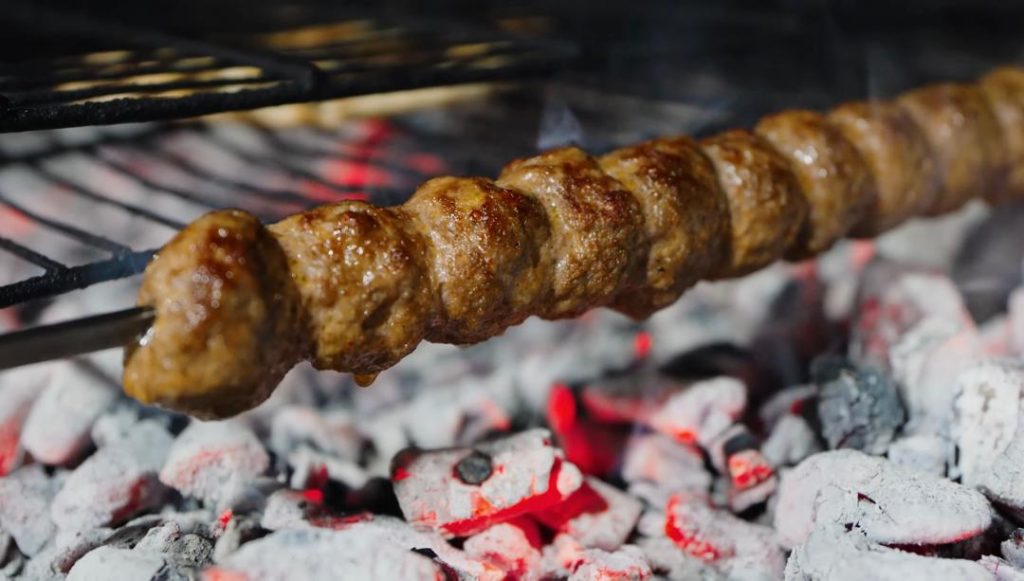
The charcoal itself is part of the flavour. Meat should arrive with a lightly smoky exterior while remaining juicy within. Bread, grilled tomatoes, onions, parsley and pepper accompany it without distracting from it.
Kibbeh as a Measure of Culinary Skill
Kibbeh exists across Syria and the wider Levant, but Aleppo developed an exceptional range of versions.
Its basic components appear simple: bulgur and meat, often surrounding a filling of minced meat, onion and nuts. Yet those ingredients can be shaped, cooked and seasoned in numerous ways.
Kibbeh may be:
- Formed into pointed shells and fried
- Spread into trays and baked
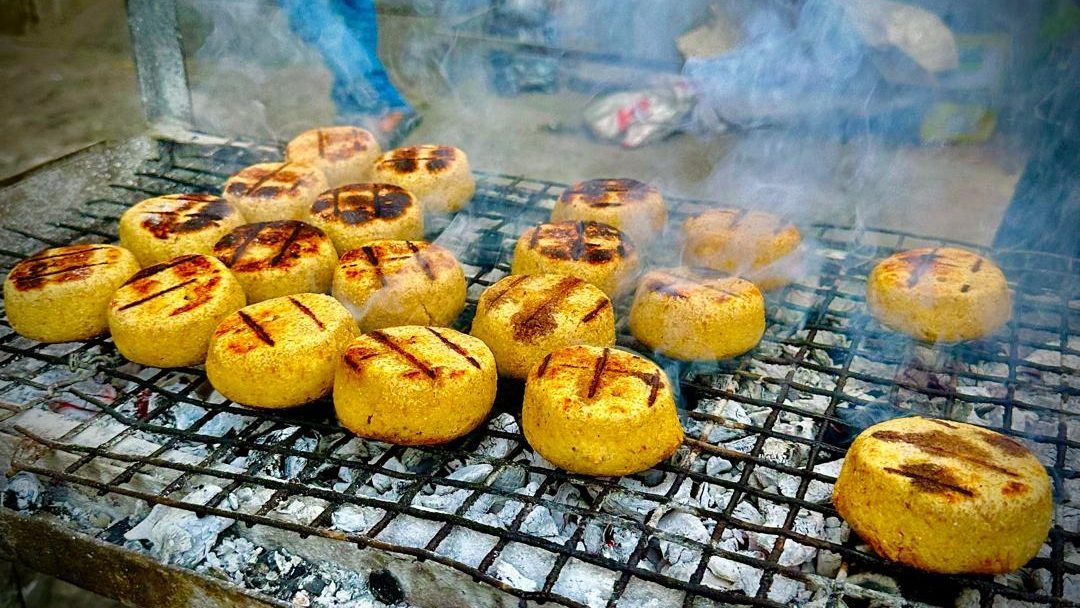
- Grilled over charcoal
- Cooked in yoghurt sauce
- Prepared with sumac or quince
- Served raw when ingredients and conditions permit
- Shaped into discs, balls or delicate handmade forms
Every version demands a different technique.
For fried kibbeh, the shell must be smooth and evenly shaped. For tray-baked kibbeh, the surface may be cut into geometric patterns before cooking. For kibbeh cooked in sauce, the pieces must remain intact while absorbing flavour.
This is where home cooking becomes craftsmanship.
Family members may gather to shape large quantities for a celebration. Hands move quickly as each piece is formed, filled and closed. Experienced cooks can make the shell remarkably thin without allowing it to tear.
Visitors often see the finished platter.
The real story is the labour behind it.
Muhammara: A Dish That Travelled the World
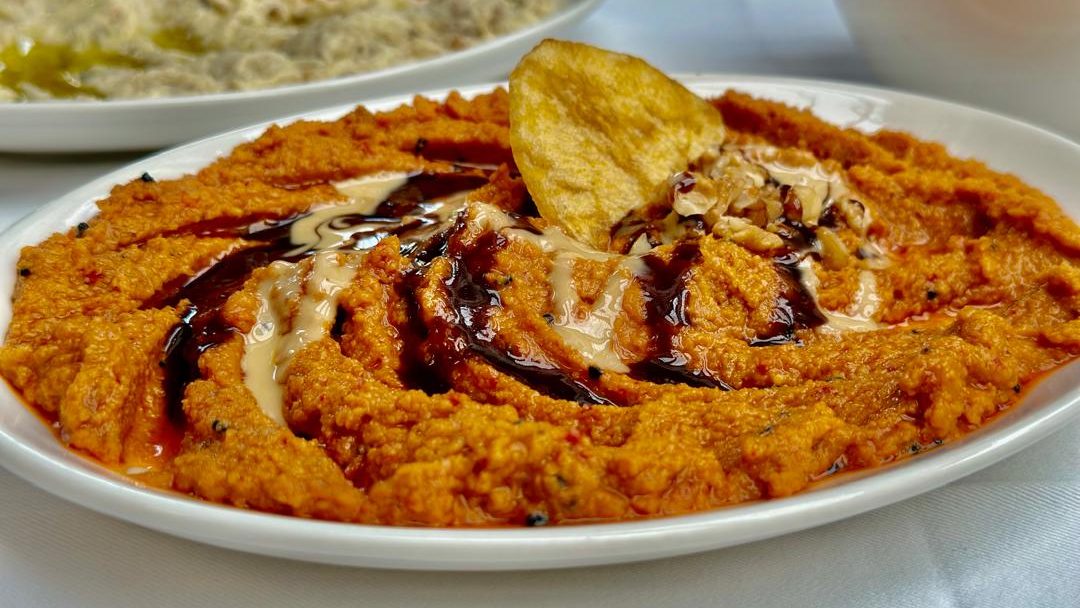
Another Aleppian creation with international recognition is muhammara.
It is a deep-red spread traditionally made with red pepper, walnuts, breadcrumbs, olive oil and pomegranate molasses. Recipes vary: some are smooth, while others retain more texture; some emphasise smokiness, while others are sweeter, sharper or hotter.
The ingredients show the Aleppian preference for layered flavour.
Pepper provides warmth and depth. Walnuts add richness. Pomegranate molasses introduces sweetness and acidity. Breadcrumbs bring the ingredients together, while olive oil softens the mixture.
Muhammara is usually served as part of a mezze table with fresh bread, but it can also accompany grilled food. It originated in Aleppo before becoming popular elsewhere in the Middle East and far beyond it. (Bon Appétit)
Today, versions appear in restaurants around the world.
But tasting it in Aleppo gives it context.
It is no longer simply a fashionable red-pepper dip. It becomes part of a larger language of walnuts, pepper, fruit molasses, bread and hospitality.
Aleppo Pepper: Warmth Without Overwhelming Heat
The city also gave its name to one of the region’s best-known seasonings: Aleppo pepper.
Traditionally made from red peppers dried and crushed into flakes, it is appreciated for moderate heat and a flavour that can seem fruity, earthy and slightly smoky.
Aleppian cooking does not usually use pepper only to make food aggressively hot. Its role is more subtle. It adds warmth, colour and depth, allowing the flavour of meat, vegetables or grains to remain clear.
It can appear in kebabs, marinades, salads, sauces and dips.
This is typical of Aleppo’s culinary personality: strong flavour, but controlled flavour.
The goal is not to overpower the guest.
It is to make them take another bite.
Vegetables Are Treated With Imagination
Aleppian cuisine is famous for meat and kebabs, but focusing only on them misses much of its sophistication.
Aubergines, peppers, courgettes, tomatoes, artichokes, legumes and leafy vegetables are stuffed, fried, grilled, dried or simmered in complex sauces.
Vegetables may be cooked with garlic and coriander, preserved for winter or combined with yoghurt and bread. Some are hollowed out with great care and filled with rice, meat and seasoning. Others become part of elaborate mezze dishes.
Pomegranate molasses may turn a simple vegetable preparation into something darker and more intense. Saveur documented an Aleppian artichoke speciality in which the hearts are served with a sweet-and-sour pomegranate-molasses sauce. (Saveur)
Even inexpensive ingredients can require significant labour.
This reveals an important part of Syrian cooking: luxury is not defined only by expensive products. It can also come from time, patience and transformation.
Aubergine, bulgur or lentils can become food worthy of an important guest when prepared with enough care.
The Mezze Table: Many Small Invitations
An Aleppian meal may begin before the main dish appears.
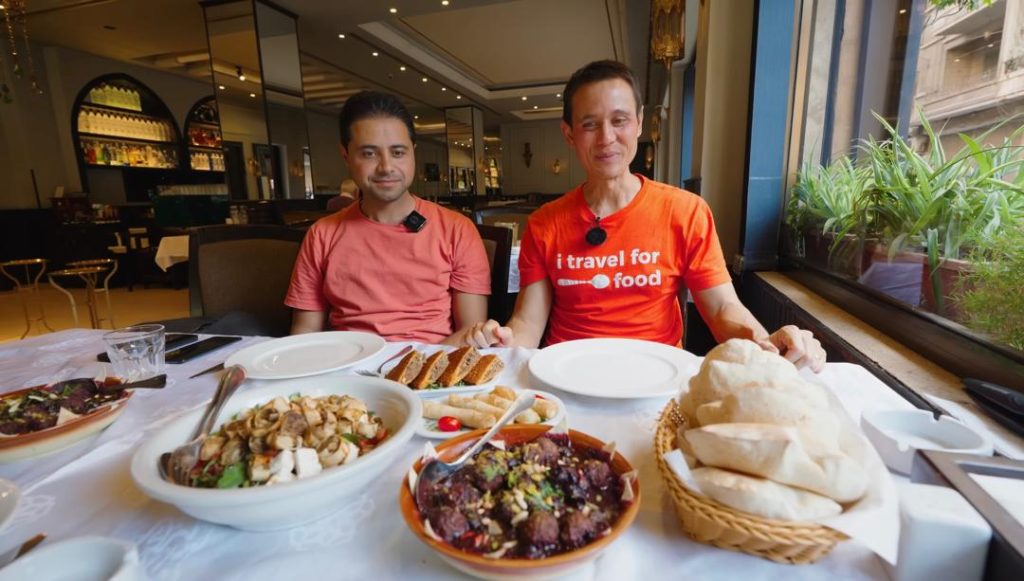
A mezze table can include bowls of hummus, muhammara, moutabbal, olives, pickles, yoghurt, salads, herbs, cheese and small pastries. Fresh bread connects everything.
The point is not simply to eat several starters.
Mezze changes the rhythm of the meal.
People reach, share and discuss. Plates remain in the centre rather than belonging to one diner. One person tears bread, another passes a bowl, and someone insists that the guest taste a particular speciality.
The table becomes social.
This way of eating also allows Aleppo’s range of flavours to appear together: smoky aubergine beside sharp pickles, creamy yoghurt beside pepper and walnut, fresh herbs beside rich meat.
No single plate needs to carry the entire meal.
Each one contributes a different voice.
The Souq Was Part of the Kitchen
Aleppo’s historic markets were not separate from its cuisine.
They supplied it.
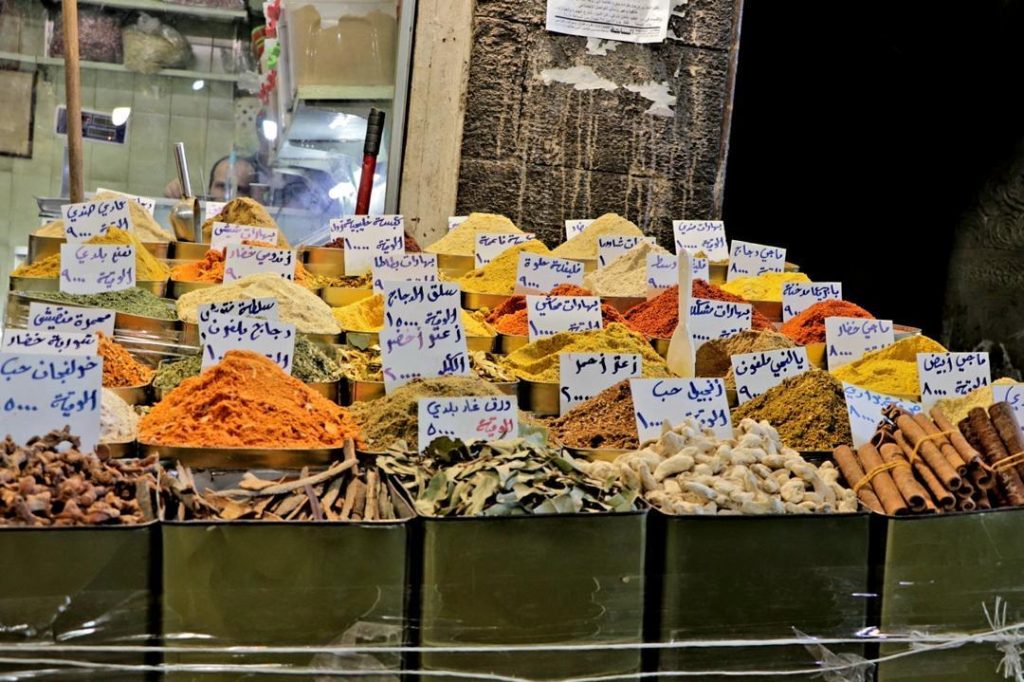
The old souqs around the Citadel contained specialised sections where merchants sold spices, grains, meat, soap, textiles, sweets and household goods. Khans accommodated merchants and stored products arriving through long-distance trade.
UNESCO describes the souqs and khans as central parts of Aleppo’s historic urban fabric and evidence of the city’s social, cultural and economic importance. (UNESCO World Heritage Centre)
A cook could judge produce season by season. Spices were smelled before purchase. Meat came from trusted butchers. Nuts, dried fruit and grains were selected according to quality, origin and purpose.
Food knowledge therefore began before cooking.
It began with knowing where to shop, whom to trust and what to look for.
Although large parts of the historic market suffered enormous damage during the war, sections have been restored and commercial life has returned to a number of its lanes. The revival of these spaces matters not only for architecture, but for the food economy and identity connected to them. (The Aleppo Project)
Food That Follows the Seasons
Traditional Aleppian cooking is closely connected to the calendar.
Spring brings fresh herbs, green almonds and seasonal vegetables. Summer provides tomatoes, aubergines, peppers, courgettes and fruits. Autumn is associated with harvests and preparation. Winter brings preserved ingredients, hearty dishes and foods suited to colder days.
Families traditionally prepared mounneh—supplies stored for the months ahead.
Peppers could be dried. Aubergines and courgettes could be hollowed and preserved for later stuffing. Fruits became jams, syrups or molasses. Olives were cured. Cheese and yoghurt were transformed into longer-lasting forms.
These tasks were often collective.
Several family members might work together, preparing quantities too large for one person. The process created a household reserve, but it also passed knowledge from one generation to another.
A child watching an older relative prepare food was learning more than a recipe.
They were learning timing, texture, economy and belonging.
Breakfast Can Be an Event
Aleppo does not save all its culinary energy for dinner.
Breakfast may include hummus, foul, cheese, olives, yoghurt, vegetables, eggs and fresh bread. Some restaurants specialise in morning dishes, attracting families who turn breakfast into a social outing.
One distinctively Aleppian dish is mamouniyeh, a warm semolina preparation usually enriched with butter or ghee and sugar, then topped with cinnamon and sometimes cheese or nuts.
Its comforting sweetness makes it feel somewhere between breakfast and dessert.
A morning meal might be followed by tea or coffee, but it rarely feels hurried. Plates remain on the table while conversation continues.
The Aleppian approach to breakfast reflects the wider cuisine: even everyday food deserves attention.
Sweets Built Around Pistachios, Syrup and Craft
Aleppo’s love of food continues into its pastry shops.
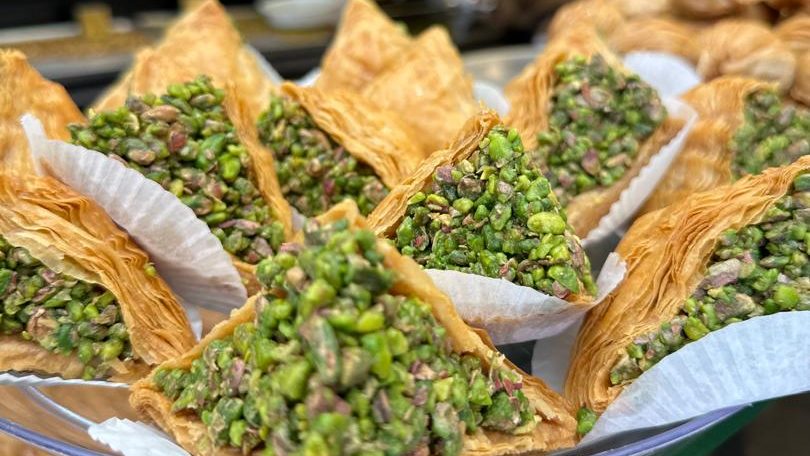
Trays display baklava, ma’amoul, ballourieh and other sweets prepared with pistachios, walnuts, semolina, filo-like pastry, cheese or fragrant syrups.
The best pieces depend on contrast.
Crisp pastry meets soft filling. Pale strands of dough surround intensely green pistachios. Syrup adds sweetness without destroying texture. Rose water or orange-blossom water may be noticeable, but should not dominate.
Pistachios are especially important to the identity of Aleppian sweets. Their colour alone makes a pastry counter appear luxurious.
Yet, as with kibbeh, appearance requires technique. Layers must be thin and even. Nuts must remain fresh. Syrup must be absorbed without making the pastry heavy.
A box of sweets is also a social object.
It may be carried when visiting relatives, offered during holidays or presented to guests. Choosing the correct shop—and the correct assortment—can be taken very seriously.
The Most Important Restaurant May Be Someone’s Home
Restaurants allow visitors to taste many famous dishes, but Aleppian food culture was built largely in homes.
Family recipes often differ in small but meaningful ways. One household may use more tamarind. Another may prefer a sharper pomegranate molasses. A grandmother may measure spices by memory rather than spoons.
These differences are not mistakes.
They are identities.
The home is also where visitors experience the full meaning of Syrian hospitality. Food arrives in quantities that seem far greater than necessary. The host encourages the guest to continue eating. Another plate appears before the first is finished.
Refusing too quickly may be interpreted as politeness rather than a final answer.
The meal communicates affection, respect and generosity. Preparing many dishes tells the guest that their arrival mattered.
In Aleppo, feeding someone well is one of the clearest ways to honour them.
A Cuisine Carried Across the World
Conflict and migration displaced many people from Aleppo, but they also carried the city’s food far beyond Syria.
Aleppian kitchens now exist in Istanbul, Berlin, Paris, London, New York, Mexico City, São Paulo and many other places. Recipes survive in restaurants, family gatherings, videos and cookbooks.
Food can travel more easily than architecture.
A damaged house cannot be packed into a suitcase. A souq cannot be recreated exactly in another country. But a person can remember how their mother seasoned kibbeh, how their grandfather preferred his kebab or how a holiday table was arranged.
Those memories become recipes.
Cookbooks such as Aromas of Aleppo document how Aleppian communities preserved food traditions after migration, particularly when recipes had previously been transmitted orally. (Google Books)
This global presence has introduced Aleppian dishes to new audiences. But it also makes visiting the original city more meaningful.
In Aleppo, the food reconnects with its landscape, markets, dialect and social rituals.
What Should a First-Time Visitor Taste?
No single meal can explain the cuisine, but a first culinary journey through Aleppo should ideally include:
Kebab bil karaz for the city’s famous balance of meat, fruit, sweetness and acidity.
Muhammara to taste the combination of pepper, walnut and pomegranate molasses.
Several kinds of kibbeh, rather than only the familiar fried version.
Charcoal-grilled kebab, eaten immediately while the meat is still hot and juicy.
Aubergine and vegetable dishes that reveal the cuisine beyond grilled meat.
Mamouniyeh for a traditional Aleppian breakfast.
Fresh bread with mezze, eaten slowly and shared.
Pistachio sweets, preferably from a shop trusted by locals.
The most important advice is simple:
Arrive hungry, but do not rush.
Aleppian food is not designed to be checked off a list. It deserves several meals, repeated tastes and conversations with the people preparing it.
More Than a Collection of Recipes
Calling Aleppo a great culinary city does not mean that every dish began there or belongs exclusively to it.
Food moves across borders. Neighbouring cities share ingredients. Families adapt recipes. Communities influence one another.
Aleppo’s greatness comes from what it did with those connections.
It absorbed products and ideas arriving through trade. It drew from fertile agricultural surroundings. It allowed different communities to preserve their traditions while contributing to a wider urban cuisine. It refined familiar ingredients through time, technique and constant discussion.
Most importantly, it created a population that cares deeply about how food should taste.
That culture of attention may be Aleppo’s greatest culinary achievement.
Come for the Citadel. Stay for the Table.
Travellers may first be drawn to Aleppo by its Citadel, old stone neighbourhoods, historic mosques, churches, khans and covered markets.
Then lunchtime arrives.
Smoke rises from a charcoal grill. Bread lands warm on the table. A bowl of crimson muhammara appears beside plates of herbs and pickles. Someone orders cherry kebab and insists you try several kinds of kibbeh.
The city begins to reveal itself through flavour.
You taste the fruit of the surrounding land, the influence of old trade routes, the traditions of different communities and the patience of generations of cooks.
By the end of the meal, Aleppo no longer feels like a place you have only visited.
It feels like a place that has welcomed you.
And that is why people who know Aleppo rarely speak about its food casually.
They speak about it with pride, longing and appetite.
Sources and Further Reading
- UNESCO World Heritage Centre. “Ancient City of Aleppo.”
Historical background on Aleppo’s role as a crossroads of trade routes, its successive civilisations, historic souqs, khans and urban heritage. - Antonia Asimakopoulou. “Reviving Aleppo’s Gastronomic Past.” The Aleppo Project
An examination of Aleppo’s culinary heritage, agricultural setting, cultural diversity, historic food economy and reputation as a centre of Middle Eastern gastronomy. - Poopa Dweck. Aromas of Aleppo: The Legendary Cuisine of Syrian Jews
A detailed collection documenting the dishes, celebrations and food traditions of Aleppo’s Syrian Jewish community. - Marché Adonis. “Cherry Kebab: Kabab bil Karaz.”
Background and recipe information about Aleppo’s famous combination of seasoned meat and sweet-sour cherries. - Syrian Guides. “Why You Need to Try Cherry Kebab in Aleppo.”
A closer look at the cultural significance, ingredients and distinctive sweet-and-sour flavour of Aleppo’s cherry kebab. - Food Heritage Foundation. “Muhammara.”
Information about the Aleppian origins of muhammara and its traditional combination of red peppers, walnuts and pomegranate molasses. - Saveur. “Muhammara: Red Pepper and Walnut Dip.”
A traditional-style muhammara recipe using red peppers, walnuts, Aleppo pepper and pomegranate molasses. - Serious Eats. “What Is Aleppo Pepper?”
An explanation of Aleppo pepper’s Syrian origins, production, flavour profile and traditional culinary uses. - Saveur. “Artichokes in Cilantro and Pomegranate Sauce.”
An example of northern Syrian cooking that combines vegetables with coriander, garlic and sweet-sour pomegranate molasses. - Clifford A. Wright. “The Heart of the Syrian Artichoke.” Saveur.
An exploration of the cultural importance of artichokes and vegetable cookery in Syria. - Saveur. “Middle Eastern Mezze Recipes.”
Background on mezze as a shared style of eating built around small dishes, dips, salads and bread. - Saveur. “Out of Aleppo.”
A short account of how Aleppian families carried their culinary traditions and food memories with them after leaving the city.