
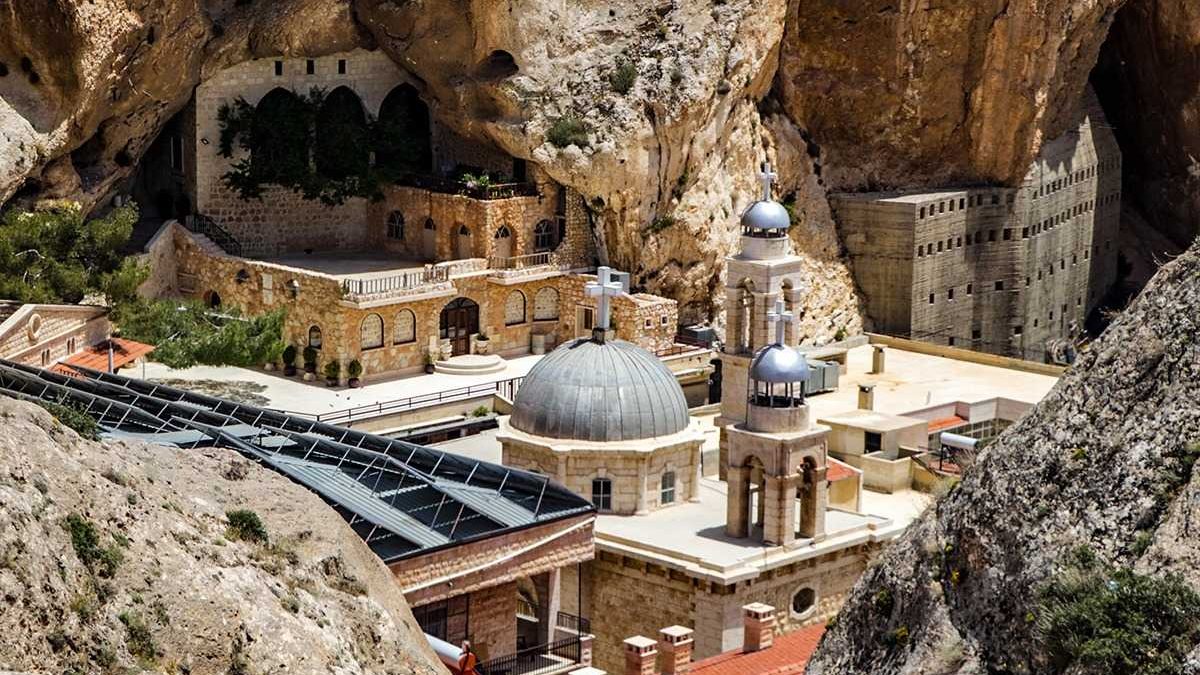
For most of the year, Maaloula is a quiet mountain town. Its pale houses climb the rocky slopes of the Qalamoun Mountains, church bells echo through the narrow valley, and ancient monasteries overlook the village from opposite sides of the cliffs.
Then September arrives.
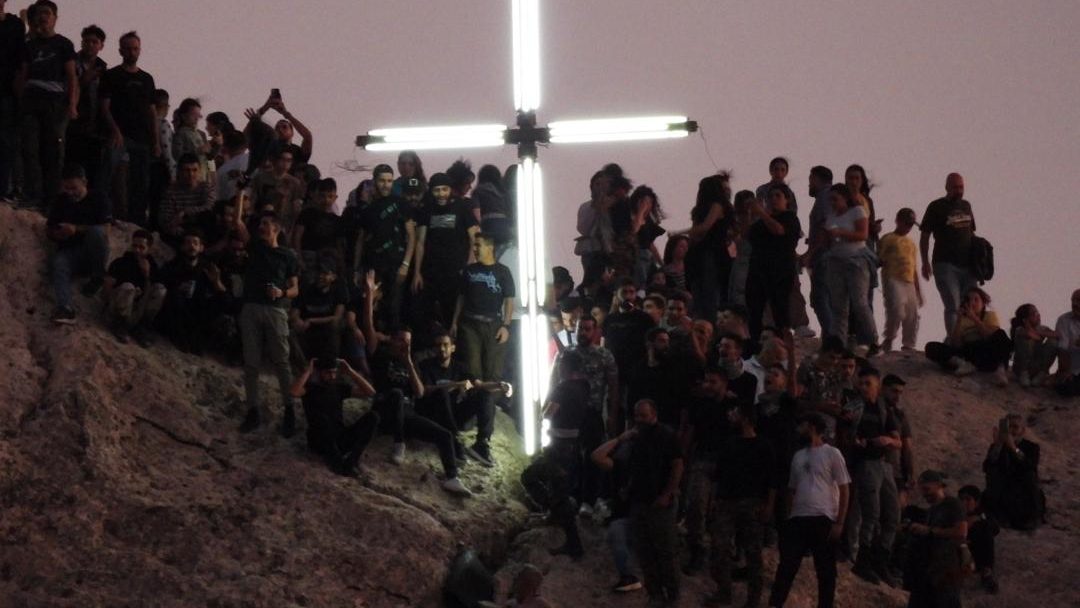
On the eve of the Festival of the Cross, flames appear on the mountaintops. Bells ring across the valley. Crosses glow from balconies and terraces, while residents and visitors gather for prayers, processions, songs and communal celebrations. From a distance, the mountains seem to be sending signals through the darkness.
This is the Festival of the Cross in Maaloula—one of Syria’s most visually powerful and deeply rooted Christian celebrations. The Festival of the Cross in Maaloula offers more than a church service. The entire town becomes part of the ritual: its mountains, streets, homes, monasteries and people.
For visitors, it offers a rare opportunity to witness Christianity not only as ancient history, but as a living Syrian tradition passed from one generation to the next.
A Festival That Belongs to the Whole Town of Maaloula
On 14 September, many Christian communities in Eastern and Western traditions observe the Festival of the Cross.
The feast commemorates two events preserved in Christian tradition: the discovery of the Cross in Jerusalem by Saint Helena, the mother of Emperor Constantine, during the fourth century, and its later return to Jerusalem under Emperor Heraclitus. More broadly, the celebration honors the transformation of the cross from an instrument of execution into a Christian symbol of salvation, life and hope.
In Maaloula, however, the feast has developed a distinctive local character. The feast keeps the religious meaning central and expresses it through fires, processions, bells, and gatherings beyond monastery walls.
The result is both solemn and joyful.
At one moment, visitors may be standing quietly during prayers. Soon afterward, they may hear singing in the streets, see young people carrying torches or watch families gathering on balconies above the procession.
Why Do People Celebrate the Feast with Fire?
The fires are the most recognizable part of Maaloula’s celebration.
Local tradition holds that people discovered the Cross in Jerusalem. They lit fires on high places to spread news across region. Observers saw a fire on the next mountain, where someone lit another, forming signals carrying the announcement toward Constantinople.
Maaloula’s residents traditionally connect their own mountain fires with this story. As darkness falls, bonfires or illuminated crosses appear on the surrounding peaks, recalling the ancient method of sending news across long distances. The flames are therefore more than decoration: they represent proclamation, remembrance and the transmission of faith.
Whether understood as historical memory, local legend or religious symbolism, the image is unforgettable. The rocky valley becomes dark, and then one light appears above the village. Another follows. Soon the mountain itself seems to participate in the feast.
For residents, the fire announces that people are raising the Cross again.
For visitors, it creates the sensation of witnessing a message traveling through time.
The Celebration Begins Before 14 September
Although the official feast falls on 14 September, the main public atmosphere traditionally begins on the evening of 13 September.
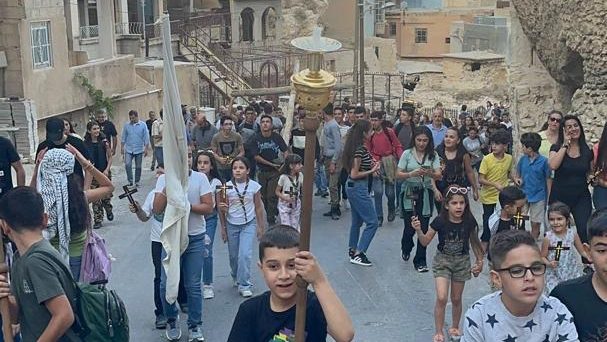
Historical and ethnographic accounts describe separate processions associated with Maaloula’s Greek Catholic and Greek Orthodox communities. Procession leaders called out chants and greetings as young participants carried crosses, torches, and banners, and followers repeated the greetings. The routes moved through different parts of the village before gathering around religious and communal spaces.
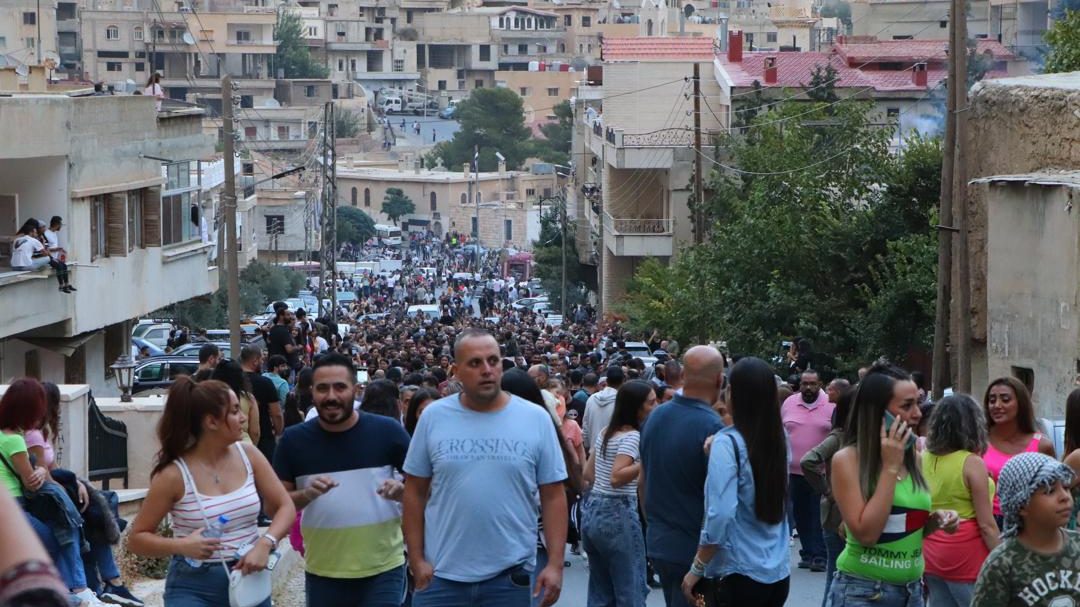
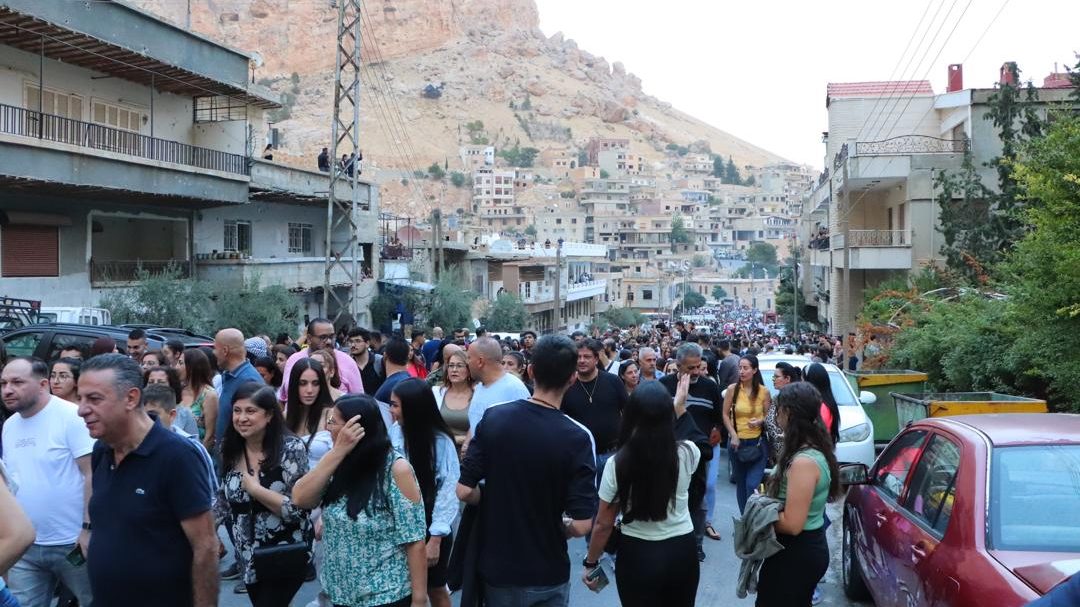
As evening approaches, the town begins to fill with residents returning from Damascus and visitors arriving from other parts of Syria and neighboring countries. Families prepare to receive relatives and friends, while balconies and terraces become gathering places from which people watch the movement below.
Church bells begin to ring. Crosses are illuminated. Groups move toward the mountains, sometimes singing as they climb.
The energy builds slowly until the entire village seems awake.
Climbing Toward the Cross
One of the defining experiences of the festival is the ascent toward the higher parts of Maaloula.
The town is naturally dramatic. Homes sit along steep slopes beneath limestone cliffs, while paths rise toward monasteries, caves, crosses, and viewpoints above the valley. During the feast, these paths become ceremonial routes.
Young people traditionally play a particularly visible role. Local reports describe groups sometimes known as the “Youth of the Cross,” who help prepare the celebration, carry crosses and torches, organize processions and preserve the customs associated with the feast. Young people participate to ensure priests and elders do not maintain the festival alone, and pass it to younger generations.
The climb can be noisy and joyful. Songs, calls and laughter mix with the sound of church bells. Participants grow prayerful when others raise crosses and bless fires.
From the upper slopes, the view opens across Maaloula. Houses appear stacked inside the valley, monastery lights glow against the cliffs, and the crowd below becomes a moving line of light.
The climb is physically upward, but its symbolism is equally important. People call the feast the Exaltation, or raising, of the Cross. In Maaloula, that idea becomes visible as people carry the symbol from the village streets toward the mountain sky.
A Village of Two Living Christian Traditions
Maaloula’s celebration reflects the presence of both Greek Catholic and Greek Orthodox communities.
The Greek Catholic Monastery of Saints Sergius and Bacchus—commonly known as Mar Sarkis—stands above one side of the town. The Greek Orthodox Convent of Saint Thecla, or Mar Taqla, lies below the cliffs on the other side. Maaloula also contains several historic churches associated with different neighborhoods and local communities.
During the Festival of the Cross, processions have traditionally emerged from both Catholic and Orthodox churches. They may follow separate routes through their respective neighborhoods before converging for larger celebrations.
This does not make the festival feel divided. Instead, the parallel processions reveal the internal geography of the town. Each community honors its own churches, families and streets, while participating in a feast shared across Maaloula.
An ethnographic study of Maaloula’s religious festivals describes procession leaders pausing beneath homes to call out personalized greetings to the families standing on balconies. Residents responded with cheers, ululation, sweets and refreshments. The procession thus recognized not only saints and churches, but individual households as part of the community.
The route becomes a map of belonging.
When Every House Becomes Part of Maaloula Festival
One of the most beautiful aspects of the Festival of the Cross is that it does not remain confined to formal religious buildings.
Families decorate balconies and windows with illuminated crosses. Candles and electric lights shine from homes built along the slopes. In some years, crosses remain illuminated for days after the feast, continuing through Maaloula’s September and early October religious season.
From a viewpoint above the town, these small lights appear scattered across the valley. The large cross on the mountain may dominate the skyline, but the smaller crosses on homes make the meaning more intimate.
Each family carries the festival into its own space.
The celebration shows an important characteristic: we do not treat religion, family, and neighborhood life as entirely separate worlds. A church procession passes beneath a family balcony. A home becomes a place for welcoming visitors. A terrace becomes a viewing platform. A mountain path becomes a pilgrimage route.
The architecture of Maaloula allows the entire town to behave like one large amphitheater.
People in the streets look upward toward the balconies.
People on the balconies look upward toward the mountains.
And above them all stands the illuminated cross.
The Sound of the Festival in Maaloula
The Festival of the Cross is as memorable for its sound as for its light.
Church bells ring across the valley, amplified by the surrounding cliffs. Religious hymns emerge from churches and processions. People repeat popular chants in groups, while music and dabke create a more festive rhythm in squares and courtyards.
Maaloula’s processions have traditionally included a leader known as the sheikh al-shabab, or leader of the youth, who calls out short verses, greetings and praises for the crowd to repeat. These calls may honor the Cross, the town, religious figures or families along the route.
The soundscape may shift quickly. Women on a balcony ululate sharply after a solemn hymn. Drums, clapping, or fireworks can accompany bells. A prayer procession may eventually give way to a communal dabke.
This mixture does not reduce the religious meaning of the feast. In the local understanding, the community honors the sacred event with joy.
We do not commemorate the Cross only through silence.
It is celebrated through life.
Arabic, Aramaic and the Voice of Maaloula
Maaloula is internationally known as one of the few communities where a variety of Western Neo-Aramaic has survived into modern times.
The language spoken traditionally in the town is an endangered modern Aramaic variety known as Maaloula Aramaic. It belongs to the Western Neo-Aramaic group, alongside related varieties historically spoken in nearby Syrian villages. Aramaic itself has been used in the Middle East for more than three millennia, although the modern language of Maaloula is not identical to the ancient dialect spoken in first-century Galilee.
During religious and cultural occasions, visitors may hear Arabic alongside Aramaic prayers, songs, verses or expressions. Local reports about the Festival of the Cross describe poems and praises performed in both languages.
This gives the celebration another layer of importance. It is not only preserving a Christian feast; it is also creating a public space in which Maaloula’s linguistic heritage can be heard.
A language survives when it is spoken at home, taught to children and used in meaningful situations. A festival provides all three: families reunite, generations mix and traditional expressions are repeated before a large audience.
For a visitor, hearing Aramaic within Maaloula’s mountain setting can be deeply moving. Yet its value should not be reduced to the popular phrase “the language of Jesus.” It is also the living language of Maaloula’s own people, with its own pronunciation, vocabulary, stories and modern history.
Food, Tea and Open Doors
Religious festivals in Syria are also social occasions, and the Festival of the Cross is no exception.
Families prepare food for relatives and visitors, tea is served, and meals may continue late into the evening. Local accounts describe communal cooking, including wheat prepared in large pots and distributed during the festivities.
Hospitality matters because many visitors do not simply attend the event and leave. Some remain overnight with relatives, friends or in accommodation connected with religious institutions. Historically, people have traveled from Damascus, Lebanon and Jordan to join Maaloula’s celebration.
This changes the atmosphere of the town.
The festival becomes a reunion for families whose members now live elsewhere. Former neighbors meet again. Courtyards fill with voices. People move from one home to another, carrying food, exchanging news and remembering previous celebrations.
For outsiders, this is an important reminder: the Festival of the Cross is not a performance staged for tourists. It is a community event into which visitors may be welcomed.
The difference matters.
More Than One Night of Celebration
The Festival of the Cross begins an important sequence of autumn religious celebrations in Maaloula.
It is followed later in September by the Feast of Saint Thecla, whose convent is one of the town’s principal pilgrimage sites. In early October comes the Feast of Saints Sergius and Bacchus, associated with the monastery overlooking the opposite side of Maaloula. Recent local accounts describe the season as extending from the Cross celebration through these later feasts.
This means the Festival of the Cross is not an isolated event. It opens a period during which different parts of the village honor their churches, patron saints and community traditions.
Each feast has its own routes, gatherings and emphasis. Yet together they connect Maaloula’s religious calendar with its physical landscape.
Saint Thecla belongs to the gorge and convent below the cliffs.
Saints Sergius and Bacchus belong to the monastery above the town.
The Cross belongs to the mountains and to the illuminated village between them.
Faith, Identity and Memory
For Maaloula’s residents, the Festival of the Cross expresses several kinds of identity at once.
Christian in nature, it is also specifically Maaloulan. It belongs to the church calendar, but also to the town’s mountains, families and neighborhoods. It recalls an event from Christian tradition, but it also preserves memories of childhood, relatives and earlier generations.
A resident may remember climbing toward the fires as a child. Another may remember watching from a grandmother’s balcony. A family living in Damascus may return each September because the feast remains their strongest connection to the village.
This is how traditions endure.
Not because they remain unchanged, but because people continue to find themselves inside them.
The prayers preserve faith.
The processions preserve community.
The Aramaic words preserve language.
The fires preserve memory.
A Celebration Shaped by Difficult Years
Maaloula has endured conflict, displacement and damage to religious buildings and homes. Many residents left during the war, and not all families returned permanently. The preservation of local traditions therefore carries additional emotional weight.
The form of the Festival of the Cross can also change according to security conditions and the circumstances of the community.
In September 2025, for example, organizers reduced some of the usual public festivities. Large gatherings, concerts and parts of the traditional entertainment were canceled or limited because of security concerns and mourning following violence elsewhere in Syria. Religious services, children’s processions, illuminated crosses and the lighting of fires on the mountains were nevertheless maintained.
This is important for visitors to understand. There is no guarantee that every year will include the same program, crowds or public activities. The central religious date remains fixed, but the precise schedule depends on local decisions.
The adaptation does not mean the tradition has disappeared.
It shows which parts the community considers essential.
Even in a quieter year, the bells ring, prayers are offered and the Cross remains visible above Maaloula.
What Visitors Can Expect
A visitor arriving during the Festival of the Cross should expect Maaloula to feel very different from an ordinary sightseeing day.
Roads and streets may be busier. Religious services can attract residents, pilgrims and guests. Some processions move through narrow or steep parts of the town, while mountain viewpoints may require walking over uneven ground.
The atmosphere can shift between prayer and celebration, so visitors should observe what local participants are doing. Quiet behavior is appropriate during liturgies and blessings, while clapping and participation may be welcomed during public songs or dabke.
Photography is generally part of the modern festival atmosphere, but visitors should still ask before taking close photographs of individuals, clergy or people praying. Churches and monasteries should be entered in modest clothing, and religious spaces should never be treated merely as dramatic backgrounds for social-media content.
Most importantly, follow local instructions. The route, access to mountain areas and size of public gatherings can change from year to year.
The festival is most meaningful when approached with curiosity and respect rather than as a spectacle to consume.
The Best Way to Experience the Feast
To understand the Festival of the Cross, it is helpful to arrive in Maaloula before the main evening activities begin.
Daylight allows visitors to explore the town’s geography: the Monastery of Saints Sergius and Bacchus, the Convent of Saint Thecla, the old houses, churches and mountain passages. Once the sun sets, those same places take on different roles within the festival.
A monastery visited as a historic monument becomes the source of a procession.
A quiet mountain path becomes a route of torchlight.
A balcony becomes part of the public celebration.
A cross that seemed distant during the day becomes the brightest object in the night sky.
Staying into the evening also allows visitors to experience the progression of the feast rather than seeing only one moment. The anticipation, gathering, bells, ascent and lighting of the fires belong together.
This is not a celebration best understood in fifteen minutes.
It unfolds across the town.
Why the Festival of Maaloula Is So Powerful
Many countries hold religious processions. Many communities light candles or gather for feast days.
What makes Maaloula different is the unity between ritual and place.
The mountain fires make sense because Maaloula is surrounded by peaks. The processions become dramatic because the streets climb through the valley. The church bells travel farther because the cliffs return their sound. The illuminated crosses appear everywhere because the houses rise one above another.
The celebration could not be transferred to another setting without becoming something else.
It belongs to this landscape.
It also belongs to a community that has preserved a Western Neo-Aramaic language, maintained ancient pilgrimage sites and continued to organize its calendar around monasteries, saints and neighborhood relationships.
The visitor is not simply seeing an old custom.
They are seeing how a place remembers itself.
Experience the Festival of the Cross in Maaloula
Reading about the Festival of the Cross can offer a glimpse into its history and meaning, but nothing compares with standing in Maaloula as the bells echo through the valley, processions move through the streets and lights begin to appear across the mountains.
Syrian Guides has created a special 8-day September group tour, built around the opportunity to experience the Cross Feast celebrations in Maaloula firsthand. The journey also explores Old Damascus, Palmyra, Homs, Krak des Chevaliers, Hama, Aleppo and Bosra, combining Syria’s most important historical sites with one of its most memorable living traditions. The departure is guaranteed, and the group is kept small to create a more personal and meaningful experience.
Rather than watching the celebration from a distance, you will experience Maaloula when its religious heritage, mountain landscape and community traditions come together in one extraordinary evening.
Join Our Cross Feast Group Tour
Travel through Syria. Meet its people. And witness one of its most powerful traditions with your own eyes.
When the Mountain Carries the Message
As night settles over Maaloula, the pale cliffs disappear into darkness.
Then the lights begin.
A cross glows above the town. Fires appear on the mountain. Bells move through the valley, followed by hymns, voices and the distant rhythm of celebration.
For a moment, the modern world feels very far away.
The scene recalls the old story behind the feast: news traveling from one high place to another, carried not by paper, screens or signals from satellites, but by fire.
In Maaloula, that message is still repeated every September.
The Cross has been raised.
The light has not disappeared.
And the mountains are telling the story once again.
Sources and Further Reading
- SANA. “Maaloula Celebrates 17 Centuries of the Feast of the Cross: An Aramaic Legacy of Faith and Tradition.”
Detailed coverage of the mountain fires, processions, Youth of the Cross, Arabic and Aramaic recitations, and communal food traditions. - The Holy See. “Angelus, 14 September 2025.”
Background on the Feast of the Exaltation of the Holy Cross, the discovery traditionally associated with Saint Helena and the return of the Cross under Emperor Heraclitus. - Greek Orthodox Patriarchate of Antioch and All the East. “The Convent of St Thecla, Maaloula.”
Information about Maaloula, the Convent of Saint Thecla, the town’s monasteries, pilgrimage traditions and the survival of Aramaic. - Ghattas Eid, Esther Seyffarth and Ingo Plag. “The Maaloula Aramaic Speech Corpus: From Printed Material to a Lemmatized and Time-Aligned Corpus.”
A scholarly source on Maaloula Aramaic as an endangered Western Neo-Aramaic variety spoken in Syria. - SANA. “Christian Communities Celebrate the Feast of the Holy Cross in Maaloula.”
Video coverage of the contemporary celebration in Maaloula. - SyriacPress. “Sober Celebrations for This Year’s Feast of the Cross in Maaloula.”
Reporting on the adapted 2025 celebration, including prayers, illuminated crosses, mountain fires and the wider autumn feast season. - Ishtar TV. “Sober Celebrations for This Year’s Feast of the Cross in Maaloula.”
Further details about the reduced 2025 programme, balcony crosses, mountain fires and the feasts of Saint Thecla and Saints Sergius and Bacchus. - Associated Press. “A Christian Town in Syria Keeps the Biblical Language of Aramaic Alive, but It Fears for Its Future.”
Background on Maaloula’s Christian community, monasteries, Aramaic heritage, wartime damage and present-day challenges.