
In a quiet workshop in Old Damascus, thousands of fine threads stretch across a wooden loom. At first, they appear almost impossible to separate. Then the weaver presses a pedal, the loom shifts, and a shuttle passes through the silk. Gradually, a jasmine flower, a curling leaf or a pair of birds begins to appear. This is known as Damascus Brocade.
Instead, the designer does not paint the design onto the cloth. We do not print the design, nor do we embroider it afterward. It is created inside the fabric itself, one crossing of thread at a time.
This is Damascene brocade, known locally as brokar: one of Syria’s most luxurious traditional textiles and one of the crafts most closely associated with the artistic identity of Damascus.
Weavers historically wove brocade from silk and enriched it with metallic threads, never intending it to be ordinary fabric. Craftsmen used brocade for ceremonial clothing, formal interiors, valuable gifts, and objects meant to communicate wealth and prestige. Medieval writers praised the quality of Damascus’s textiles, rulers ordered them for their courts, and generations of craftsmen continued developing new designs for foreign dignitaries and royal occasions.
Yet the real story of Damascus brocade is not simply about kings and queens. It is about the families who designed the patterns, prepared the silk, punched the cards, operated the looms and preserved an extraordinary skill through political upheaval, industrial competition and war.
Today, the fabric’s royal reputation survives, but the craft itself faces a far more uncertain future.
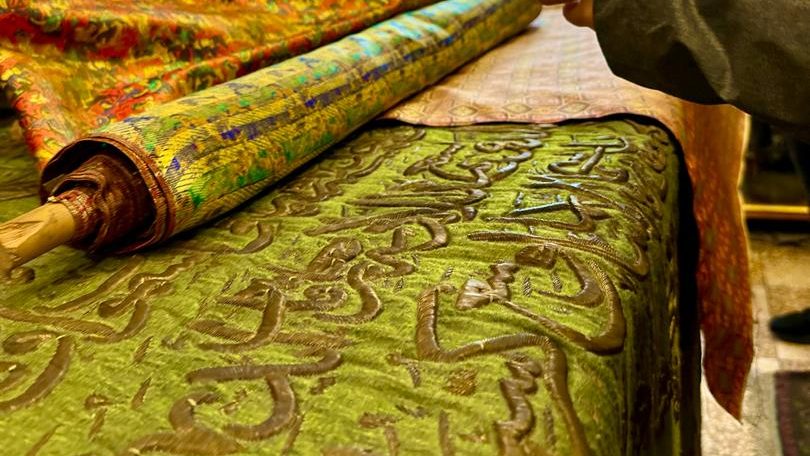
A Fabric That Changes With the Light
One understands Damascus brocade or Damascene brocade best when viewed up close.
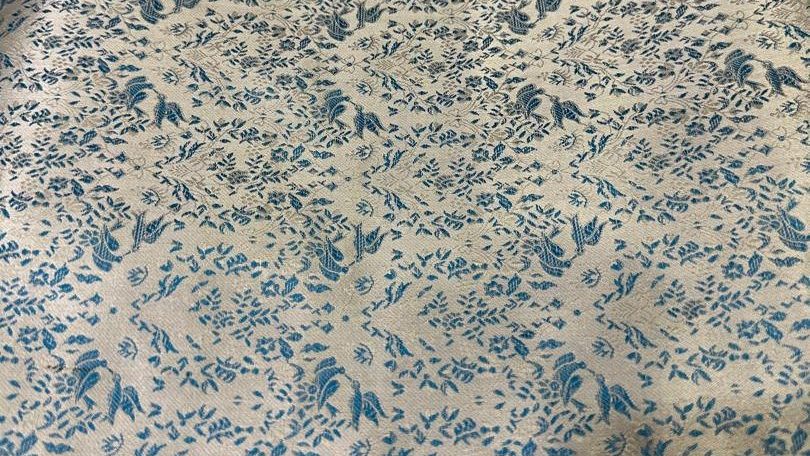
From across a room, the fabric may appear floral, geometric or covered in curling arabesques. As the viewer approaches, individual threads begin to reveal themselves. Smooth silk forms the background, while additional threads rise slightly above the surface to create the design.
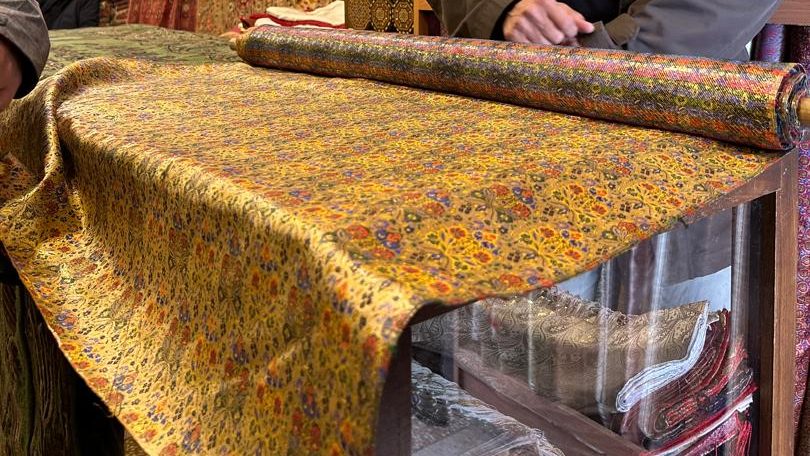
Light moves differently across each material. Silk produces a soft glow, while metallic threads catch the light more sharply. When you turn the fabric toward a window, the pattern may shine.
This changing surface is part of brocade’s appeal. The textile never looks completely still. Its details emerge and disappear as the cloth moves, making it particularly suitable for garments, curtains and ceremonial spaces.
Traditionally, Damascene or Damascus brocade used natural silk and precious or metal-wrapped threads. Modern fabrics may also use manufactured fibers and metallic substitutes, which are more affordable and easier to obtain. What defines brocade technically is not simply the material, but the creation of raised woven motifs through supplementary threads introduced during weaving.
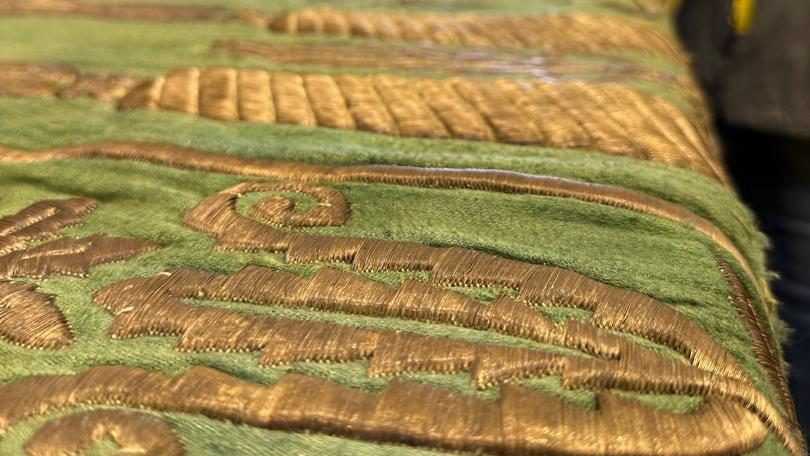
Brocade Is Not Embroidery
People seeing Damascus brocade for the first time often describe it as embroidered silk. The confusion is understandable because the patterns can look as though someone stitched them onto the finished fabric.
People create brocade and embroidery in different ways.
Embroidery begins with an existing piece of cloth. A crafts person then decorates its surface using a needle and additional thread. In brocade, the loom weaves the fabric while the decorative threads enter. The crafts person creates the structure and the decoration together.
The loom holds a set of lengthwise threads called the warp. We call the threads that pass across them the weft. Additional patterning wefts appear only where the design requires them, creating motifs that seem to float or rise above the background.
We cannot simply remove the complex brocade pattern from the cloth. It is part of the fabric’s construction.
The difference also explains the concentration required from the weaver. A mistake is not simply a misplaced stitch that one can remove easily. It may affect the structure of the pattern across many threads.
Brocade and Damask Are Not the Same Fabric
Another common confusion concerns brocade and damask.
Historically, people linked damask to Damascus, and damask became an international term for a particular type of patterned textile. Damask generally produces a reversible design through contrasting weave structures. The pattern may be visible on both sides, with light and shadow changing according to the direction of the threads.
Brocade usually creates a more raised and decorative surface through supplementary weft threads. Viewers usually see the fabric’s most elaborate design from the front, while the reverse reveals loose or carried patterning threads. The Syrian Heritage Archive distinguishes damask as a patterned, often double-faced fabric and brocade as a textile with relief designs primarily visible on one face.
People often mix the terms in travel writing, shops, and popular stories because Damascus became famous for both traditions. However, they are not technically identical.
For a visitor, the simplest distinction is this: damask often reveals its pattern through the weave’s changing shine, while brocade appears to place an additional decorative layer within the fabric.
A Reputation More Than Eight Centuries Old
People did not create Damascus’s reputation for luxury textiles as a modern invention for souvenir shops.
In the mid-12th century, the geographer al-Idrisi described brocade as one of the city’s most important industries. He praised Damascus brocade as expensive and exceptionally well made, comparing it favorably with textiles produced in the Byzantine world, Khuzestan and Isfahan. He also admired the city’s decorated silk work, presenting Damascus as part of an international competition among the greatest textile centers of the period.
Royal demand linked Damascus brocade directly to production by the 14th century. A historical account from 1374 records that the Mameluke Sultan al-Ashraf Shaʿban ordered the governor of Syria to send brocade, embroidered goods, gold and silver needles, ornamented saddles and specialized artisans to Cairo. The palace reportedly took on the appearance of a workshop as textile makers carried out the commission.
These accounts help explain the fabric’s royal reputation. Brocade was valuable not only because its raw materials could be expensive, but because producing it required specialized knowledge, coordinated labor and considerable time.
A ruler displaying Damascus brocade was therefore displaying more than silk. The fabric represented access to skilled craftsmen, international trade and a city renowned for refinement.
Why Damascus Became a Textile City
Damascus occupied an ideal position for textile production. It stood along commercial routes connecting the Mediterranean, Anatolia, Iraq, Iran and regions farther east. Materials, merchants and techniques could move through the city, while its wealthy urban population created demand for high-quality furnishings and clothing.
Textile making was once deeply embedded in the city’s economy. Researchers at the Syrian Heritage Archive collected data showing that one-third of Damascus’s 18th-century trades and shops tied to textiles. The importance of the industry remains visible in Damascene family names associated with spinning, dyeing, weaving, silk trading, shuttle making and fabric finishing.
One person did not produce brocade from beginning to end. The craft depended on an entire network.
Silkworm breeders produced cocoons. Reelers unwound the delicate filaments. Spinners and winders prepared the thread. Dyers created the required colors. Warp setters arranged thousands of threads in the correct order. Pattern designers translated flowers, animals and geometric forms into technical plans. Card makers prepared instructions for the loom. Weavers finally brought all these elements together.
The finished fabric was therefore the product of a community, even when one family’s name appeared on the workshop door.
Weavers prepare silk spools, colored threads, and warp threads before weaving.
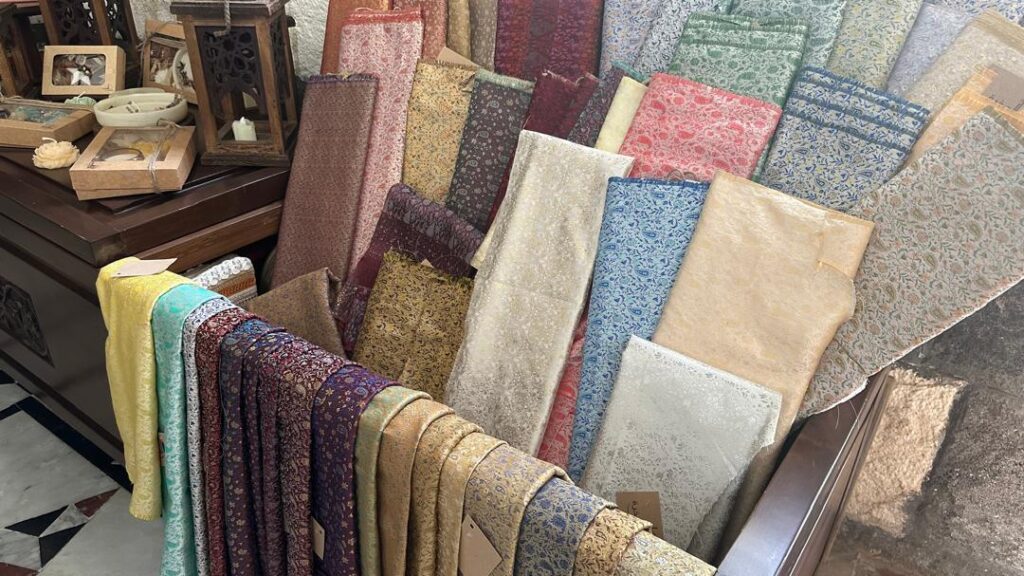
From Cocoon to Loom
The elegance of brocade begins with something extremely fragile: a silkworm cocoon.
Laborers unwind silk filaments from cocoons and combine them to form usable threads. Workers must then clean the threads, twist them, dye them, wind them onto bobbins, and prepare them for weaving. Even before the loom begins moving, a considerable amount of labor has already taken place.
Syria historically had its own sericulture traditions, particularly in western regions where mulberry trees and silkworm cultivation supported the production of raw silk. Damascene workshops also used imported silk and metallic threads, connecting local craftsmanship with wider commercial networks.
Preparing the warp is one of the most demanding stages. You must arrange thousands of threads at the correct tension. If the threads become uneven, tangled, or misordered, they affect the entire fabric.
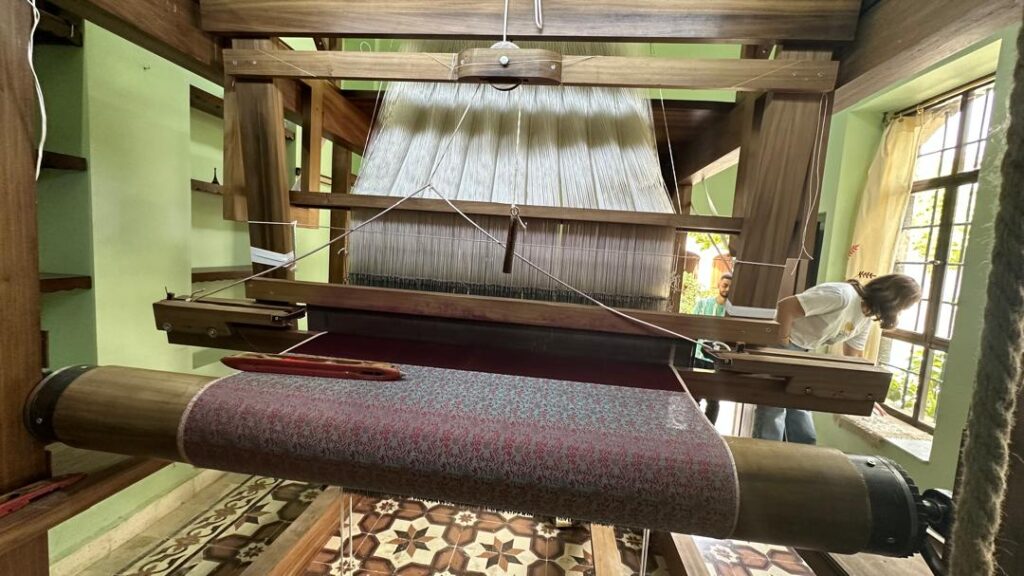
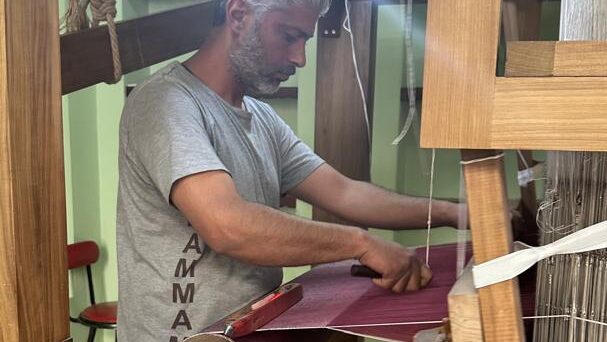
At the loom, the weaver coordinates hands and feet. Pedals determine which warp threads rise. The shuttle carries weft across the width of the fabric. The reed presses each passage firmly into place. Patterning threads appear according to the design encoded into the loom.
The final movement can look smooth and repetitive, but it depends on constant awareness. The weaver listens to the machine, watches the tension and notices irregularities that an inexperienced observer would never see.
When a Loom Became a Form of Programming
One of the most fascinating chapters in Damascene brocade’s history is the introduction of the Jacquard mechanism.
In early 19th-century France, engineers developed the Jacquard system, and punched cards controlled the lifting of threads during each weaving stage. The position of holes in the cards translated a visual design into a sequence of mechanical instructions.
We coded a brocade pattern before it reached the loom.
During the early 20th century, Damascene textile manufacturers imported modern machinery and adapted it to local traditions. The Mezannar family founded a factory near Bab Sharqi in 1890, then brought mechanical looms from Lyon and later partnered with Swiss machinery suppliers. Two Armenian pattern specialists, Dikran and Yervant Stepanian, arrived in Damascus in 1937 and became known for translating detailed designs into punched-card systems for Jacquard looms.
The process began with a carefully measured drawing. We transferred every part of the design onto a grid. That grid determined where workers punched holes in the cards. We connected the cards into a chain and passed them through the loom, controlling thousands of thread movements.
A flower on a piece of Damascene brocade was therefore both an artistic image and a technical program.
Patterns That Carry the Memory of Damascus
We do not choose brocade patterns solely for their attractiveness. Damascus’s landscape, architecture, stories, and social imagination connect many brocade patterns.
Jasmine is among the most recognizable motifs. Its small flowers recall the vines that climb across courtyard walls and balconies throughout the city. Grape leaves refer to gardens and orchards around Damascus, while roses, basil leaves, pomegranates and curling branches transform the fabric into an idealized garden.
Other patterns draw from geometry, calligraphy or stories. Artistic traditions arriving from Persia, Anatolia, Europe and elsewhere influenced Damascene designs. Damascene designers did not merely copy foreign imagery; they adapted it, reorganizing it within local compositions and weaving techniques. The Mezannar family, for example, drew inspiration from museum catalogs of Persian, Ottoman and other historical textiles while creating patterns suited to Damascene production.
The names of patterns add another layer of meaning. One of the best known is “The Lover and the Beloved”, or al-ʿashiq wa al-maʿshuq. A pair of birds facing one another links the design to affection, unity, and inseparability.
Some patterns became connected with specific people or events. Once a design entered a workshop catalog, artisans could weave it for decades, preserving a story long after the original commission had passed.
Why Brocade Became a Royal Fabric
Royal courts have always understood the power of textiles.
A palace can display stone, wood and metal, but fabric creates movement and intimacy. It covers the body, surrounds the throne, hangs beside the bed and transforms ceremonial rooms. Because textiles are portable, they can also travel as diplomatic gifts more easily than architecture.
This brocade proved especially well suited for this world. Its silk suggested refinement, its metallic threads reflected candlelight, and its complex patterns demonstrated the skill and wealth required to commission it. Craftspeople could fashion it into robes, dresses, cushions, curtains, wall coverings, and ceremonial furnishings.
The fabric did not need to carry a crown to appear royal. Its materials and labor already communicated privilege.
Historical records showing brocade ordered for the Mameluke court support this connection. Later Damascene manufacturers continued creating special patterns for official gifts and international clients, reinforcing brocade’s reputation as the appropriate fabric for an important occasion.
The Queen Elizabeth Story: Gift, Gown and Legend
No story has contributed more to the modern reputation of Damascene brocade than its connection with Queen Elizabeth II.
The version frequently repeated in Syria says that the future queen wore Damascus brocade for her wedding to Prince Philip in 1947. Some accounts describe silk woven with gold thread in Damascus and decorated with two birds representing “The Lover and the Beloved.”
The Mezannar brothers created a remarkable Damascene brocade for the royal wedding. The Syrian Heritage Archive records that President Shukri al-Quwatli commissioned the Mezannar brothers to produce an original pattern for the occasion. The workshop created “The Inseparable Ones” and prepared approximately 200 meters of white silk brocade interwoven with gold as a gift for Princess Elizabeth. Damascene textile circles still recognize the design as the Elizabeth pattern.
We should exercise caution about the claim that the official wedding gown was made from this brocade. The Royal Collection Trust identifies the Norman Hartnell wedding dress as ivory duchesses satin decorated with seed pearls, silver thread, crystals and appliqué tulle. Its official description does not identify Damascene brocade as the principal fabric.
Syria presented an important Damascene brocade commission for the wedding, and craftsmen used duchesses satin for the gown. Over time, the story of the royal gift and the story of the wedding dress appear to have merged in popular memory.
This clarification does not make the Syrian connection less impressive. A newly independent Syria selected Damascene brocade to represent the country at one of the most visible royal occasions of the century. The choice itself demonstrates the status the fabric held.
The Mezannar Family and the Modern Age of Brocade
The history of the Mezannar family offers a window into the transformation of Damascene textile production.
Anton Elias Mezannar established his factory near Bab Sharqi in 1890, building on an earlier family tradition of handwoven silk-and-cotton textiles. By the early 20th century, the factory had expanded and introduced machinery from Europe while continuing to employ Syrian textile knowledge.
The next generation specialized in Damascus brocade, worked with international loom manufacturers and collaborated with designers capable of preparing complex Jacquard patterns. In 1936, the family received a gold medal at the Damascus trade fair, reflecting the workshop’s prominence during that period.
This history challenges the idea that tradition and innovation are opposites.
Damascene craftsmen did not preserve brocade by refusing every new technology. They studied imported machinery, adapted it and used it to produce local designs. The loom might have come from Lyon or Switzerland, but the jasmine, birds and stories woven through it belonged to Damascus.
The craft survived because its makers knew how to change without surrendering its identity.
From Royal Clothing to Damascene Homes
Brocade’s royal reputation can make it seem distant from ordinary life, but the fabric also entered Damascene homes in smaller and more personal ways.
Wealthy families used patterned silk of Damascus brocade for cushions, curtains, formal reception rooms and decorative panels. Brocade could cover a chair, line a box or appear as part of a bride’s possessions. A carefully preserved length of fabric might pass between generations and emerge again for a wedding or special occasion.
As lifestyles changed, brocade acquired new forms. Modern workshops and designers began using it for handbags, purses, shoes, jackets, table runners, framed panels and smaller accessories.
This adaptation has a practical purpose. Few buyers can afford or use several meters of heavy luxury fabric, but a small brocade object can make the craft accessible to a wider audience.
The danger lies in people loosely applying the word brocade to cheap synthetic textiles that imitate the appearance of original. Genuine handwoven or high-quality Damascene brocade requires far more preparation, expertise and time than a mass-produced imitation.
How to Look at a Piece of Brocade
A visitor does not need to be a textile expert to appreciate the craft, but a few details can reveal the quality of a piece.
First, move the fabric of Damascus brocade under the light. Good brocade should not appear flat. Different threads will reflect light in different ways, allowing the design to change as the angle changes.
Next, look closely at the edges of the motif. The pattern should feel woven rather than printed on top. Individual threads may be visible, especially where metallic or contrasting colors form the design.
Examine the reverse when permitted. It may reveal supplementary patterning threads and show how the craftsman constructed the motif. The craftsman polishes the front more than the back, helping distinguish brocade from reversible damask.
Ask about the materials. Natural silk feels and behaves differently from synthetic fiber, although identifying it accurately can require experience. Readers should understand that metallic threads may contain precious metals, metal wrapping, or modern substitutes, and therefore terms like “gold thread” do not automatically mean solid gold.
Primarily, ask who made the textile and where they wove it. A meaningful piece of brocade should have a human story behind it.
A Craft in Danger of Disappearing
The greatest threat to Damascene brocade is no longer foreign competition for royal customers. The knowledge required to make it has already disappeared.
Natural silk has become difficult and expensive to obtain. Many workshops closed; machinery suffered damage or was lost; experienced craftsmen aged without enough apprentices to replace them. Synthetic fabrics can reproduce the general appearance of brocade quickly and cheaply, reducing the market for labor-intensive weaving.
The craft also demands patience from learners. A new weaver must understand thread tension, machinery, pattern systems and the behavior of silk. Learners cannot master these skills through a brief demonstration.
In 2025 and 2026, the Al Sakhra Association in Old Damascus continued operating a restored traditional brocade loom with master weaver Mohammad Al-Shammaa. The workshop now lets visitors observe the process and links preservation efforts to community work and training. Recent coverage by the World Crafts Council also described it as Syria’s last working traditional brocade loom.
Cultural organizations publicly presented traditional weaving at Damascus’s NASTEX 2026 textile exhibition. They used demonstrations to highlight heritage techniques and their potential economic future.
These efforts offer hope, but one operating loom cannot carry an entire tradition alone.
Why Preserving Brocade Matters
It may be tempting to ask whether a luxurious fabric still matters in a country facing more urgent economic and social needs.
But preserving brocade is not only about saving an expensive object.
The craft contains knowledge of silk, color, pattern, mechanics, mathematics and design. It records the history of families, neighborhoods and commercial routes. It shows how Syrian artisans responded to influences from China, Persia, Europe and the Ottoman world without losing their own visual identity.
The craft can also create skilled employment. A living craft supports weavers, designers, tailors, sellers, restorers and teachers. When visitors buy authentic pieces or pay to experience a working workshop, heritage becomes part of the local economy rather than an object locked behind museum glass.
Most importantly, brocade presents Syria through creativity.
It reminds the world that Damascus was not only the seat of empires or the setting of political events. It was a city of workers who understood how to turn thousands of almost invisible threads into something strong enough to survive centuries.
Experiencing Damascene Brocade as a Visitor
Seeing brocade in a shop is beautiful. Seeing it on a loom is unforgettable.
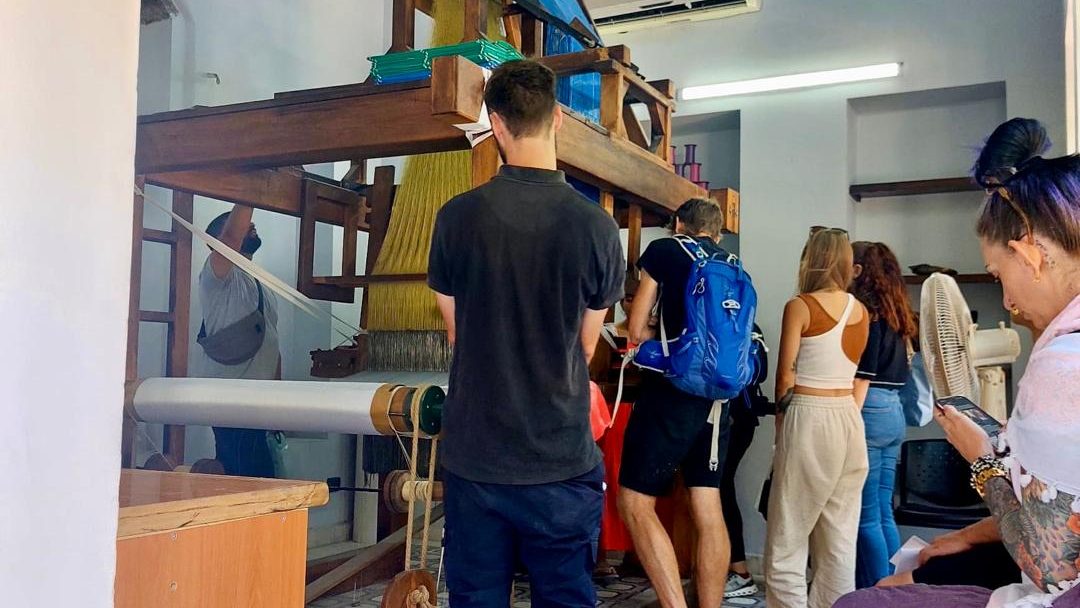
The first impression is usually the scale of the machine. A traditional loom may fill much of the room, with threads stretching in several directions and mechanisms rising above the weaver. The finished fabric appears small compared with the structure required to create it.
Then comes the sound: the movement of wood and metal, the beat of the reed, the passing shuttle and the repeated rhythm controlled by the weaver’s feet.
Watching for several minutes changes the way the finished textile is understood. A floral motif that seemed simply decorative becomes evidence of hundreds of decisions. Each line has been translated into thread movement. Every color required preparation. Every centimeter represents time.
Visitors to Old Damascus can connect this experience with the wider city. Jasmine brocade can be compared with jasmine growing across courtyard walls. Geometric designs can be recognized in stone floors and wooden ceilings. Metallic threads can be seen beside the brass, silver and mother-of-pearl work found in neighboring workshops.
The fabric begins to look like Damascus because designers used the same artistic language.
A Royal Reputation Earned by Human Hands
The royal stories surrounding Damascene brocade are attractive because they place a Syrian craft inside palaces and international ceremonies.
But royalty is not the most remarkable part of its story.
What is remarkable is that the weaver sits before the loom.
The designer is transforming jasmine into a technical grid. The card maker punches thousands of instructions. The silk worker prepares threads fine enough to disappear between the fingers. The family preserves an old pattern because a grandparent once wove it.
Kings and queens gave the fabric prestige, but craftsmen gave it life.
Damascus Woven Into Cloth
A piece of Damascene brocade is easy to admire for its beauty. It is harder to see everything held inside it.
Traces of medieval markets, Mameluke courts, and Silk Road exchanges persist. Memories of looms destroyed and workshops rebuilt endure. Syrian hands have adapted European machines, Armenian designers have entered the Damascene industry, and local families have become inseparable from textiles.
Gardens too include jasmine, roses, basil and grapevines preserved in thread long after their natural flowers have faded.
This is why brocade deserves more than a passing glance in a souvenir shop. It is not merely a luxury fabric decorated with gold and silver. It is a woven record of Damascus itself—complex, luminous, influenced by the world and still unmistakably Syrian.
Its royal reputation may attract attention.
Its human story is what makes it precious.
Experience Damascene Brocade with Syrian Guides
Watching artisans weave Damascene brocade impresses you more than seeing it as a finished fabric. During our Syrian Guides tours, we let visitors enter a traditional workshop in Old Damascus and watch artisans practice this extraordinary craft firsthand.
The workshop preserves the oldest brocade loom in Damascus that is still functioning, described by Syrian Guides as Syria’s last working traditional hand-loom for Damascene brocade. Visitors can stand beside the loom, listen to its rhythmic movement and watch thousands of silk and metallic threads gradually form flowers, birds and traditional Damascene patterns.
Meeting the artisans also reveals what photographs cannot show: the concentration required to control the loom, the preparation behind every pattern and the enormous amount of time needed to weave even a small length of fabric. Preparing a traditional loom can take around a month, while weaving a single meter of multicolored brocade may require two full days of work.
This is the kind of experience we want our guests to have in Syria—not simply viewing beautiful objects in shops or museums, but meeting the people who keep the country’s living heritage alive.
Explore Syria with Syrian Guides
Visit the workshop, meet the weaver and watch Damascus being woven into silk before your eyes.
Sources and Further Reading
- Syrian Guides. “How One Hidden Workshop Is Keeping Syrian Brocade Alive.”
A detailed look inside the Old Damascus workshop preserving Syria’s last working traditional brocade hand-loom. - Crafts of Syria. “Damascus: Brocade Makers.”
Historical accounts of Damascus’s brocade industry, including the 12th-century geographer al-Idrisi praise for its quality and international reputation. - Crafts of Syria. “Damascus: Goldsmiths.”
A historical record of a 1374 Mameluke royal order requesting Damascene brocade, embroidery and specialized craftspeople for the court in Cairo. - Syrian Heritage Archive. “A Family of Damascene Silk Manufacturer.”
The history of the Mezannar family, Jacquard machinery in Damascus, traditional pattern design and the brocade created for Princess Elizabeth’s 1947 wedding. - Syrian Heritage Archive. “The Art of Syrian Textile Production.”
An introduction to Syrian weaving structures and the technical differences between brocade, damask and other traditional textiles. - Syrian Heritage Archive. “Silk Fabric and Social Ties in Syria.”
Background on Damascus’s textile trades, specialized craftspeople, silk production and the introduction of punched-card weaving. - Syrian Heritage Archive. “Insights into Syria’s Centuries-Old Silk Craft.”
Information about Syrian sericulture and the use of imported silk and metallic threads in Damascene brocade. - Syrian Heritage Archive. “Traditional Textiles: An Endangered Tradition.”
An examination of the decline of traditional textile crafts and the cultural importance of preserving their knowledge. - SANA. “Syrian Artisans Showcase Traditional Weaving at NASTEX Textile Exhibition.”
Recent reporting on Damascene brocade weaver Mohammad al-Shammaa, the labor involved in preparing and operating the loom, and the challenges facing the craft. - Royal Collection Trust. “Queen Elizabeth II’s Wedding Dress.”
The official description of Princess Elizabeth’s 1947 wedding gown, identifying its principal fabric as ivory duchesses satin and clarifying the distinction between the gown and Syria’s brocade wedding gift.