
Most ancient cities are the colour of sand. Bosra is different.
Approaching the city across the plains of southern Syria, visitors encounter walls, arches, columns and houses built from dark volcanic stone. Under bright sunlight, the basalt can appear charcoal grey. After rain, it becomes almost black. Against the surrounding landscape, the city looks powerful, severe and unlike almost anywhere else in Syria.
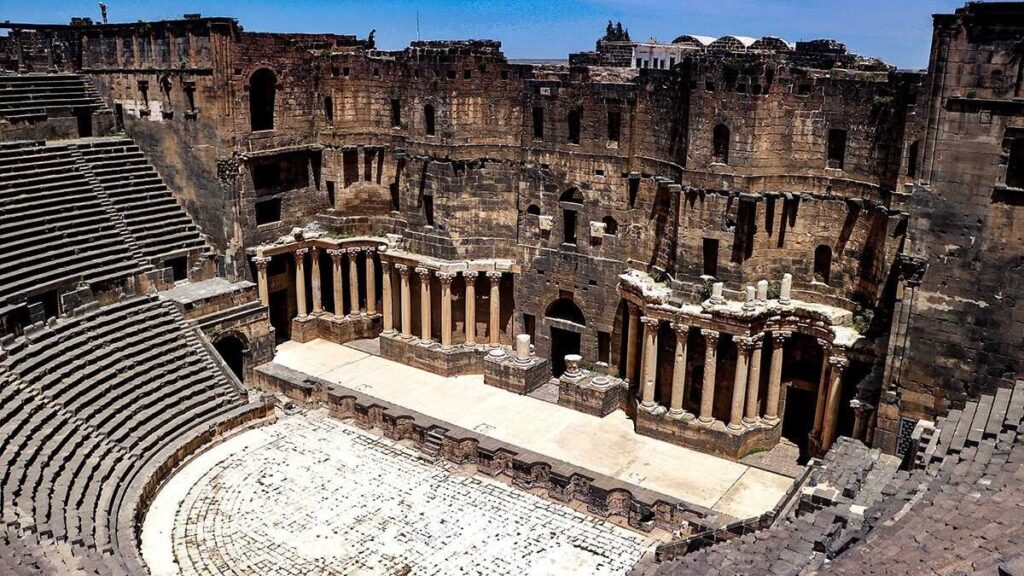
At its centre stands one of the best-preserved Roman theatres in the world. Nearby are Byzantine churches, early Islamic mosques, Roman streets, underground water systems and traditional houses, all shaped by the same hard black stone.
Bosra is often introduced as an archaeological site, but it is much more than that. It is a city where more than two thousand years of history remain layered together, and where the material beneath the ground gave the entire place its unmistakable identity.
A Black City in Southern Syria
Bosra lies in the Hauran region of southern Syria, not far from the Jordanian border. The wider landscape was shaped by ancient volcanic activity, leaving behind an abundance of basalt. Because this dark stone was durable and readily available, local builders used it for almost everything: city walls, homes, temples, streets, churches, mosques, doorways and roof supports.
This gave Bosra a visual unity that few cities possess. Even buildings constructed centuries apart appear connected because they share the same material. A Roman arch, a Byzantine wall and an Islamic house may differ in purpose and style, yet all rise from the same dark volcanic stone.
The basalt also gives Bosra a different atmosphere depending on the weather. In strong sunlight, its rough surfaces create deep shadows. At sunset, the stone can take on warmer brown and purple tones. When wet, it darkens dramatically. The city seems to change colour while remaining unmistakably itself.
Why Was Bosra Built from Basalt?
Basalt is a volcanic rock formed when lava cools and solidifies. It is dense, heavy and extremely hard. These qualities make it highly durable, but they also make it more difficult to shape than softer stones such as limestone.
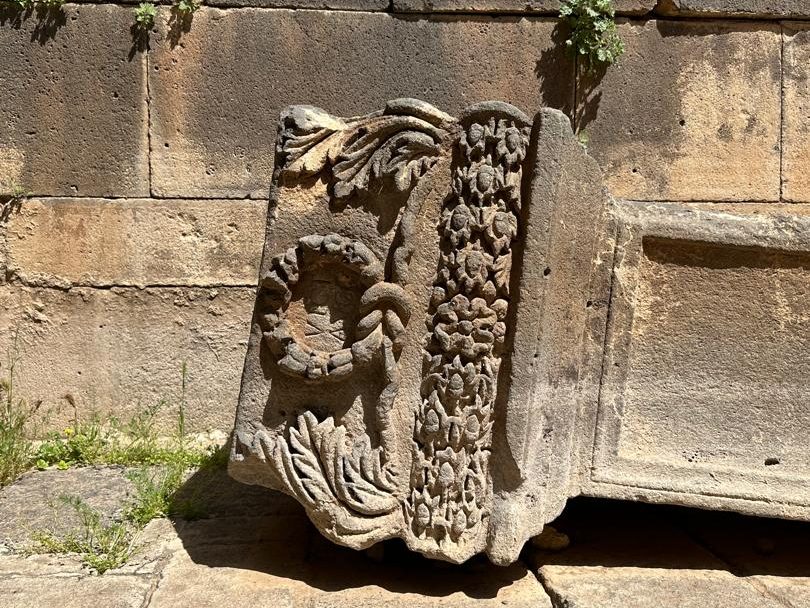
Builders in the Hauran therefore developed techniques suited to the material. Large rectangular blocks were carefully fitted together, while architectural details were often bold and deeply carved. Columns, lintels and even roof supports could be made from stone rather than timber.
Wood was relatively scarce in parts of southern Syria, while basalt was plentiful. In some traditional Hauran buildings, builders used projecting stone brackets and short basalt beams to support flat stone roofs. They created an entire architectural system around the material available beneath their feet.
The result was not merely practical. Over time, it became a regional architectural language. Bosra’s buildings feel solid and permanent because, in many ways, they were built to outlast generations.
From Ancient Settlement to Nabataean City
Bosra’s history began long before the Romans. The settlement existed for centuries before becoming a major urban centre, and its location made it strategically important. It stood near routes connecting Arabia, Damascus and the Mediterranean world.
The city became especially significant under the Nabataeans, the Arab kingdom best known today for Petra. Bosra, known in antiquity as Bostra, developed into an important northern centre of Nabataean power. Caravans carrying incense, spices and other goods passed through the region, connecting the Arabian Peninsula with cities farther north and west.
This commercial role helped Bosra grow, but the city visible today is not the creation of a single civilisation. Nabataean, Roman, Byzantine and Islamic layers stand beside and sometimes directly on top of one another.
Bosra is therefore not a frozen image of one historical period. It is a record of repeated transformation.
When Bosra Became a Roman Capital
In AD 106, the Roman Empire annexed the Nabataean kingdom and created the province of Arabia. Bosra became its capital.
This dramatically increased the city’s political, administrative and military importance. It was renamed Nova Trajana Bostra in honour of Emperor Trajan and developed into one of the leading Roman centres in the region.
Roads connected Bosra with Damascus, the Red Sea region and other parts of the empire. One of the most important was the Via Nova Traiana, a Roman route extending south through the newly created province.
As a provincial capital, Bosra gained the monumental architecture expected of an important Roman city. It had public streets, gates, baths, temples, markets and a large theatre. UNESCO describes Bosra as the former capital of the Roman province of Arabia and an important stop on later caravan and pilgrimage routes. The city was added to the World Heritage List in 1980.
The Theatre That Survived the Centuries
Bosra’s greatest monument is its Roman theatre. Built during the second century AD, it could accommodate thousands of spectators. Its broad semicircular seating area faces a monumental stage building whose columns, niches and doorways once formed the architectural background for performances.
The theatre is impressive not only because of its scale, but because so much of it survives. Many Roman theatres lost their upper seating levels or stage façades over time. Bosra’s theatre remained unusually complete, partly because it was later enclosed within a fortified citadel.
From the outside, visitors may initially believe they are approaching a medieval fortress. Massive defensive walls, towers and a moat surround the structure. Once inside, however, the fortress suddenly opens onto the curved seating of a Roman theatre.
This is one of Bosra’s greatest surprises: a building created for performance was later transformed into a stronghold.
A Stage Built for Sound
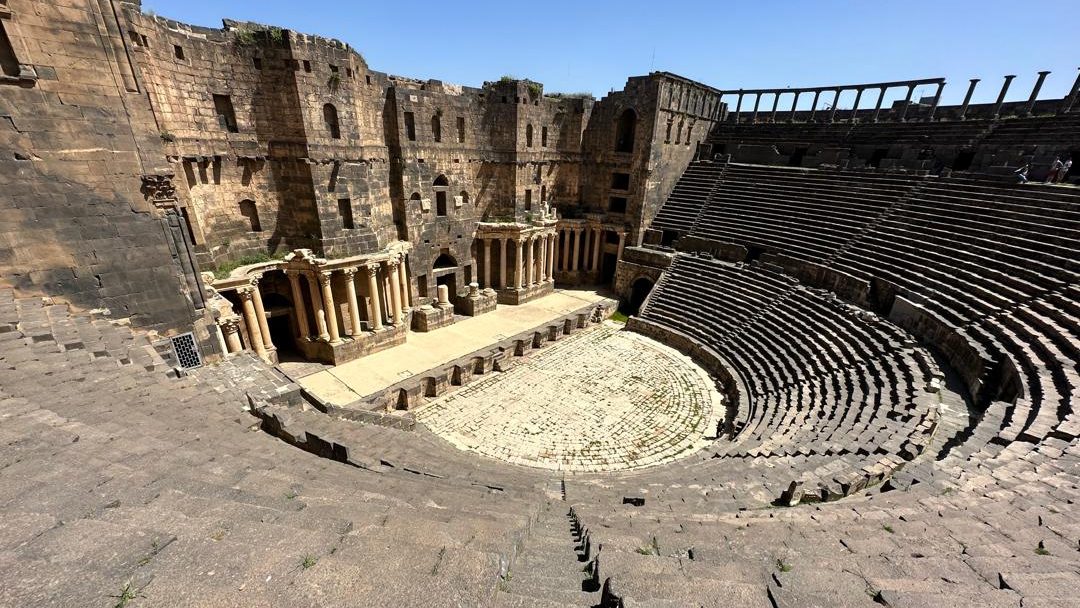
Stand near the centre of the theatre and speak. Your voice carries upward across the rows of stone seating.
Roman theatres were designed so that large audiences could see and hear performances without modern amplification. The semicircular shape directed attention toward the stage, while the steeply rising seats created clear sightlines.
The theatre would have hosted dramatic performances, public spectacles and civic gatherings. It was a place of entertainment, but also one where the city expressed its public identity. Seating was often organised according to social rank, meaning that the arrangement of the audience reflected the hierarchy of the city itself.
Today, the crowds are gone, but the architecture still directs every visitor toward the same point. The stage remains the focus, and from there even an ordinary voice can seem unexpectedly powerful.
How a Theatre Became a Citadel
The theatre’s survival is closely connected to its later military use. During the Islamic period, particularly under Ayyubid rule, defensive towers and walls were constructed around it. The former Roman monument became the centre of a fortress capable of controlling the surrounding region.
This transformation may seem unusual, but the theatre offered several advantages. Its heavy stone construction was already strong, its location was strategically important, and its internal spaces could be adapted. Additional walls, towers and a moat made the structure even more defensible.
The theatre was not simply abandoned when its original purpose ended. It was reused.
This pattern appears throughout Bosra. Temples became churches, earlier walls were incorporated into later houses, and columns and blocks were reused in new buildings. Every civilisation inherited a city that already existed and adapted what it found.
Walking Through a Roman City
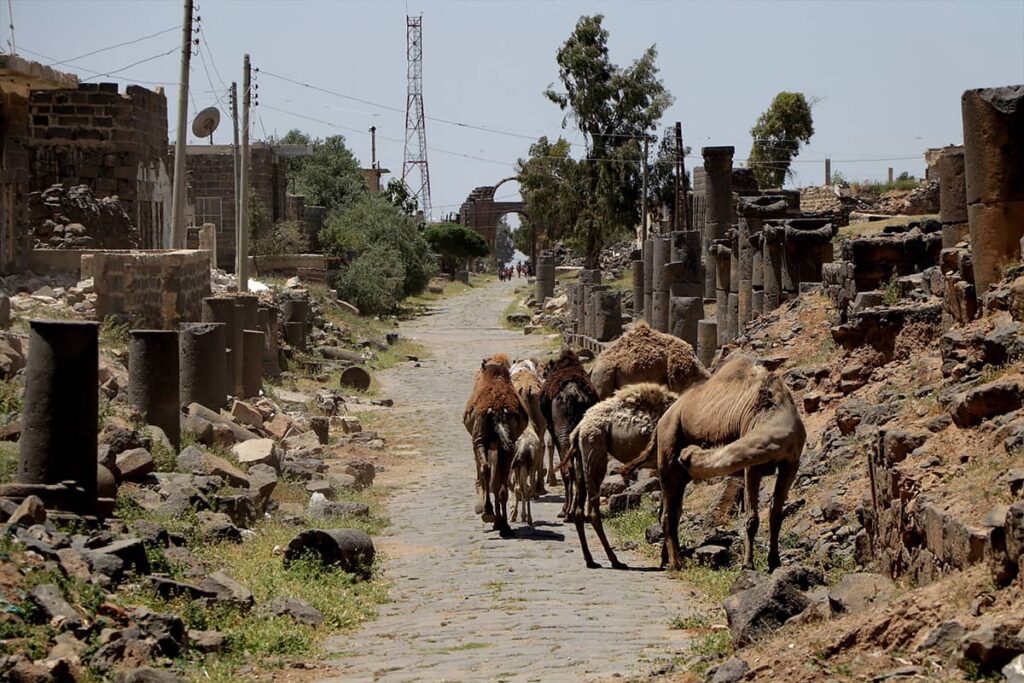
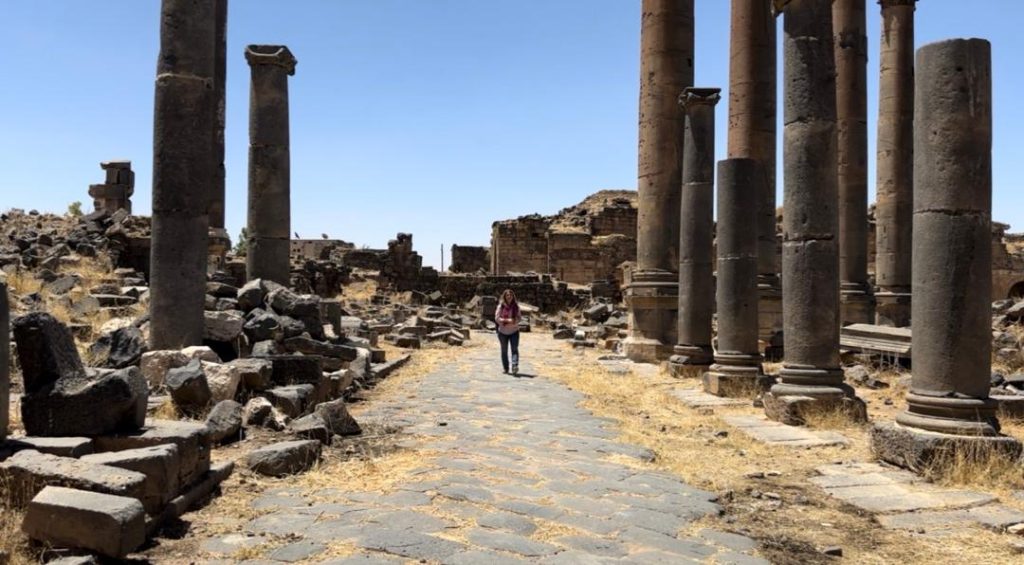
Beyond the theatre, Bosra preserves parts of its Roman street plan. Visitors can walk along stretches of paved road between dark basalt walls and scattered columns. At major intersections once stood monumental arches and important public buildings.
Among the surviving remains are sections of colonnaded streets, public baths, gateways and structures connected with the city’s commercial and administrative life.
It takes some imagination to reconstruct the original scene. The streets would have been busier and more decorated. Columns supported covered walkways, shops opened onto public routes, and carts, animals, soldiers, merchants and residents moved through the city.
Yet Bosra is easier to imagine than many archaeological sites because the ruins are not limited to low foundations. Walls still rise around you. Doors still lead somewhere. The basalt creates narrow passages, enclosed rooms and strong lines across the landscape.
Visitors do not merely look at the ancient city from a distance. They walk inside its spaces.
The Monument Known as the Kalybe
One of Bosra’s unusual Roman monuments is commonly called the Kalybe and is sometimes associated locally with the name “Cradle of the King’s Daughter.”
Its original purpose has been debated, but it was probably connected with imperial or civic representation. What remains is a monumental basalt façade with niches and architectural details that once formed part of a larger public structure.
The building shows how Roman architectural ideas were translated into local stone. In cities built from limestone or marble, decorative forms could be refined and delicate. In Bosra, the same monumental ambitions were expressed through dark, hard basalt.
The result feels heavier and more sculptural. The stone changes the character of Roman architecture and makes it look entirely at home in the Hauran.
A Major Christian Centre
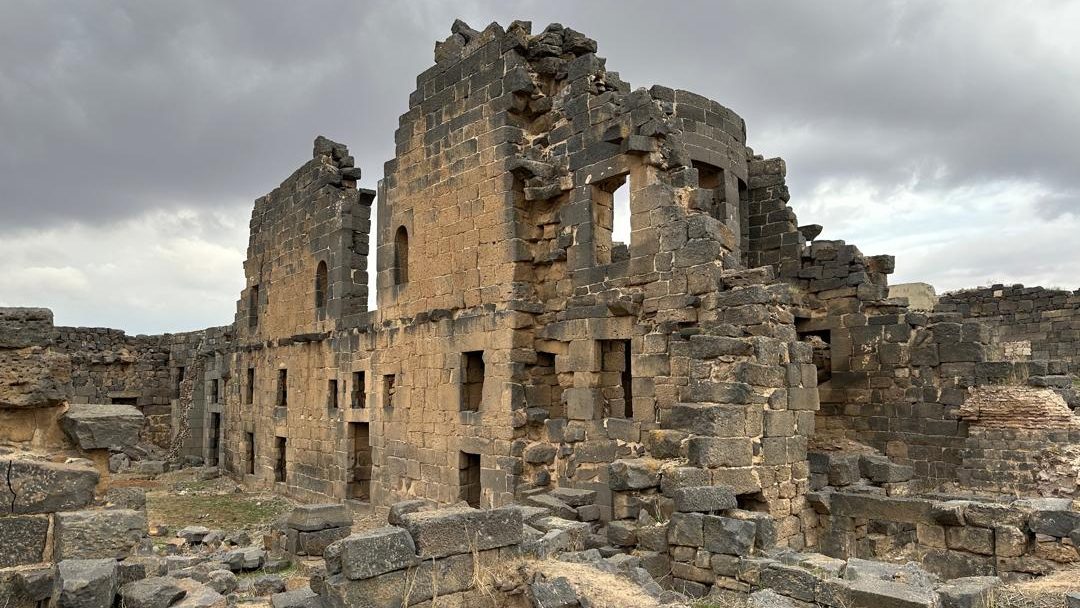
As the Roman Empire became Christian, Bosra developed into an important ecclesiastical centre. Churches were constructed across the city, and Bosra became the seat of a bishop and later an archbishop. Its position along important routes also increased its religious significance.
Among the best-known Christian monuments are the remains of the Cathedral of Bosra and the church associated with Saints Sergius, Bacchus and Leontius.
The cathedral, constructed during the early Byzantine period, had a centralised plan and a large dome. Although much of it is now ruined, its design was architecturally ambitious. Some scholars have examined whether churches of this type in Syria influenced later developments in Byzantine architecture.
What is certain is that Bosra was not a minor religious settlement. It was an active centre where architects experimented with large ceremonial spaces.
The black stone continued to define these buildings. Christian Bosra looked different from the pale-stone cities seen elsewhere in the Mediterranean. Its churches rose from the same basalt as its Roman monuments.
Bosra in Early Islamic History
Bosra also occupies an important place in Islamic tradition. According to traditional accounts, the young Prophet Muhammad travelled through the region with a caravan and encountered a Christian monk known as Bahira, who recognised signs of his future prophetic role.
The story is associated with a building in Bosra known as the Monastery or Church of Bahira, although the connection between the surviving structure and the traditional account cannot be established with certainty.
After the Muslim conquest of Syria in the seventh century, Bosra remained important. Its position on routes toward Arabia made it a stop for travellers and pilgrims.
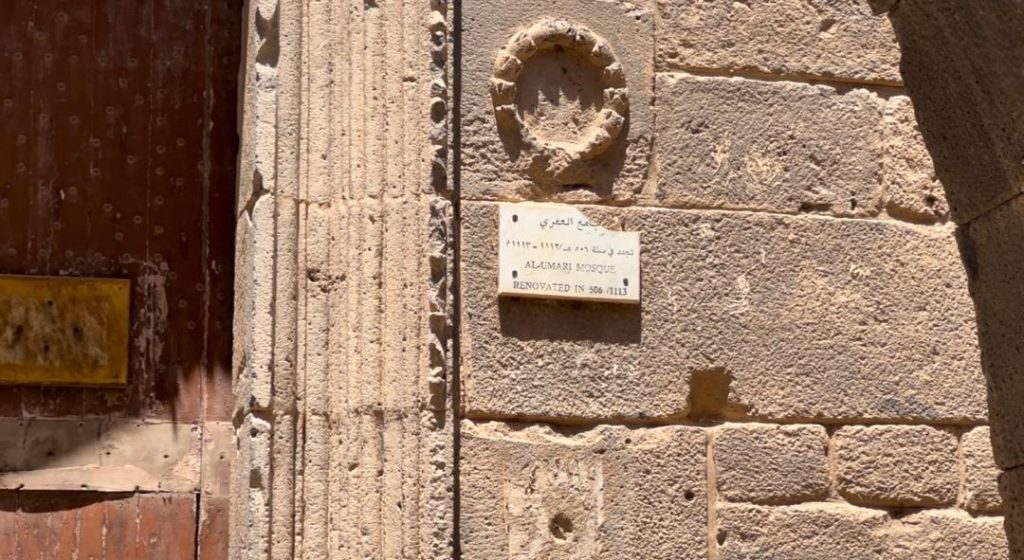
Mosques were established within the city, including the Al-Omari Mosque, considered one of the early mosques of Syria, although it underwent several phases of alteration and restoration.
The coexistence of Roman, Christian and Islamic monuments is central to Bosra’s significance. Different religious and political eras were not erased from the city; they became layers within the same urban landscape.
A City on the Pilgrimage Road
Bosra’s importance did not disappear after antiquity. For centuries, it stood along routes used by caravans and pilgrims travelling south toward the holy cities of Arabia.
Travellers needed water, food, accommodation, security and places of worship. Bosra provided them.
Its geographic position, which had supported Nabataean and Roman trade, now served new networks of movement. This continuity is one of the city’s most fascinating qualities.
The travellers changed. The empires changed. The reasons for travel changed. Yet Bosra remained a stopping place.
Its history is therefore not only about monuments. It is also about movement: merchants, soldiers, pilgrims, officials and families passing through the same landscape across many centuries.
Water Beneath the Black Stone
A city of Bosra’s size could not survive without reliable water management. Southern Syria has seasonal rainfall, so communities developed sophisticated ways of collecting and storing water.
Bosra contained reservoirs, cisterns, channels and underground spaces designed to preserve water supplies. Its large Roman reservoir is among the most visible parts of this system.
Water management supported households, public baths, agriculture, animals and passing caravans. The dark stone city may appear harsh from the outside, but its survival depended on careful environmental knowledge.
Builders understood where water moved, how to collect it and how to store enough of it to support urban life through dry periods. Like Bosra’s architecture, its water systems reflect adaptation rather than excess.
Houses With Stone Roofs
Bosra is not made only of grand public monuments. Its traditional domestic architecture is equally revealing.
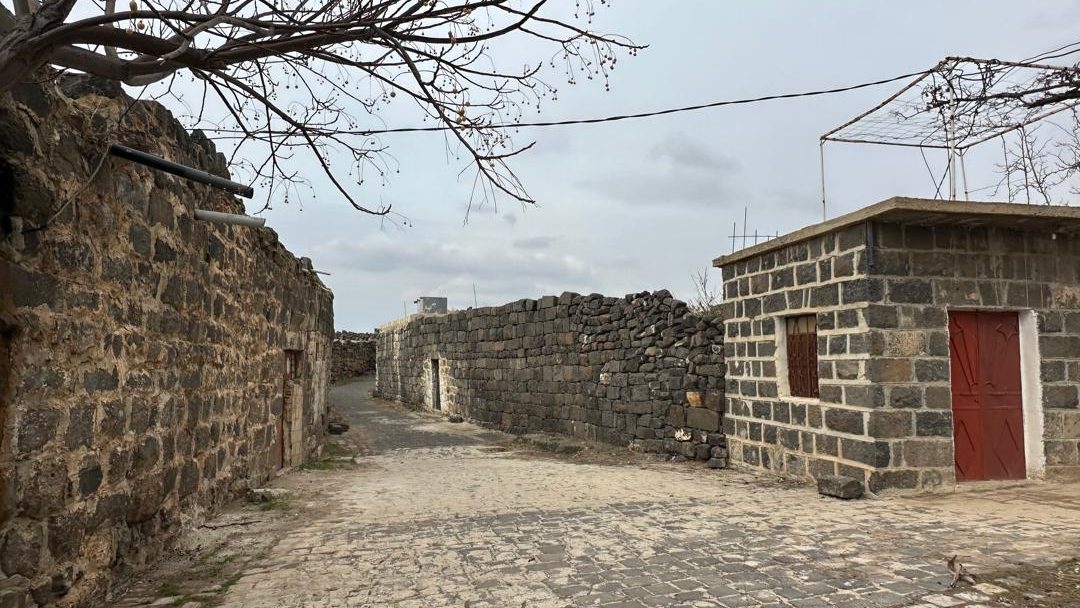
In the old city, houses were built with thick basalt walls. Because long wooden beams were not always readily available, builders developed roofing methods that relied heavily on stone.
Short basalt beams could be laid across narrow spaces or supported by projecting stone brackets. Flat slabs then completed the roof.
These homes can appear austere from the outside, but their interiors were organised around family life, storage, animals and seasonal needs. The same volcanic stone used by emperors, bishops and military commanders was also used by ordinary residents.
This gives Bosra an unusual continuity. Monumental and domestic architecture belong to the same visual world.
When Ancient Columns Became Part of Homes
One of the most striking aspects of Bosra is the way later residents reused ancient material. A Roman column might become part of a wall. A carved stone could appear beside a domestic doorway. A house might be built directly against an earlier monument.
From a modern archaeological perspective, this can look like the alteration or loss of an ancient building. From the perspective of residents, however, the old city was a source of strong and readily available construction material.
Bosra was never simply abandoned and rediscovered. People continued living among its ruins, adapting them to new needs.
This created a complicated urban landscape in which archaeology and everyday life became inseparable. The city was not merely a museum. It was a home built inside history.
Why Does Bosra Feel So Different?
Part of the answer is colour.
Many visitors to Syria become accustomed to limestone: the pale façades of Damascus, the warm stone of Aleppo or the light-coloured ruins of Palmyra. Bosra breaks that pattern.
Its basalt absorbs light rather than reflecting it. Arches look heavier. Doorways appear deeper. Columns cast stronger shadows. Even small structures can feel monumental.
But colour alone does not explain the experience. Bosra is also unusually compact. Important structures from different periods stand close together. Visitors move quickly from a Roman street to a Byzantine church, an Islamic mosque or an inhabited basalt house.
History is not separated into distant archaeological zones. It overlaps.
The theatre may be Roman inside and medieval outside. A Christian building may use stone taken from an earlier monument. A modern path may follow an ancient route.
Bosra feels less like a collection of separate ruins and more like one long architectural conversation.
Damage, Protection and Responsibility
Bosra’s survival should not be taken for granted. The site suffered during the conflict in Syria, and areas around the Roman theatre and the Ayyubid citadel were affected.
The Ancient City of Bosra remains on UNESCO’s List of World Heritage in Danger. Concerns have also been raised about illegal excavations, inappropriate construction, conservation needs and the protection of the historic urban fabric.
Protecting Bosra requires more than repairing its most famous monuments. Its value also lies in the relationship between buildings, streets, archaeological remains, traditional homes and the surrounding landscape.
An isolated Roman theatre would still be extraordinary, but Bosra’s true importance comes from the complete city around it.
What Visitors Should Notice
During a Syria tour, ost visitors naturally focus on the theatre, but Bosra rewards closer observation.
Notice how the basalt changes colour in the sunlight. Look for ancient inscriptions and reused stones in later walls. Examine the depth of the doorways and the size of the blocks. Compare Roman decorative forms with the simpler surfaces of traditional homes.
Walk slowly through the old streets instead of moving directly from one monument to another. Listen inside the theatre. Look outward from the upper seating toward the surrounding plain.
And pay attention to scale. A photograph may show the darkness of the stone, but it rarely communicates its weight. Standing beside a basalt doorway or beneath a massive block makes the physical effort behind the city much clearer.
The Best Time to Experience Bosra
Bosra is especially atmospheric in the softer light of morning or late afternoon.
At midday, the contrast between the bright sky and black stone can be intense. Toward sunset, architectural details become easier to see, and the basalt begins to reflect warmer tones.
Spring can bring greener surroundings, making the dark ruins stand out more strongly against the landscape. Cooler weather also makes walking through the exposed archaeological areas more comfortable.
The theatre is impressive at any hour, but the wider city reveals itself slowly, particularly when the changing light begins to enter the rough surfaces of the stone.
More Than a Roman Theatre
It would be easy to describe Bosra as the city with one of Syria’s greatest Roman theatres.
That would be true, but incomplete.
Bosra was a Nabataean centre, a Roman provincial capital, a Christian religious city, an Islamic settlement, a fortress and a station on trade and pilgrimage routes.
Its residents built temples, churches, mosques, baths, houses, reservoirs and defensive walls. They inherited monuments from earlier generations, transformed them and passed them on again.
The black basalt ties these different periods together. It gives the city its colour, strength and character.
A City Carved from Its Own Landscape
Bosra does not feel as though it was placed upon the land. It feels as though it emerged from it.
Its walls, roads and monuments are made from the volcanic ground beneath them. The city borrowed the colour of the Hauran and turned it into architecture.
That is what makes Bosra unforgettable.
You may arrive expecting a Roman theatre. You leave remembering an entire black city: arches against the sky, footsteps on basalt streets, churches and mosques standing among ancient walls, and a stage that has carried voices across stone for nearly two thousand years.
Bosra is not simply a place where history survived. It is a place where history became part of the landscape.
Sources and Further Reading
- UNESCO World Heritage Centre. “Ancient City of Bosra.”
The principal reference for Bosra’s history as the capital of the Roman province of Arabia, its caravan-route importance, Roman theatre, early Christian ruins and historic mosques.
https://whc.unesco.org/en/list/22/ - UNESCO World Heritage Centre. “Documents Related to the Ancient City of Bosra.”
UNESCO decisions, conservation reports, maps and official documents concerning Bosra’s World Heritage status and preservation.
https://whc.unesco.org/en/list/22/documents/ - UNESCO World Heritage Centre. “Director-General Condemns Destruction of Vestiges in the Ancient City of Bosra.”
Information about conflict-related damage to the western courtyard beside the Roman theatre and parts of the surrounding Ayyubid citadel.
https://whc.unesco.org/en/news/1416 - UNESCO World Heritage Committee. “Decision 47 COM 7A.49: Ancient City of Bosra.”
A recent update on restoration work, conservation concerns, the proposed recovery plan and Bosra’s continued inclusion on the List of World Heritage in Danger.
https://whc.unesco.org/en/decisions/8716/ - ICOMOS. “Ancient City of Bosra, Syrian Arab Republic, No. 22 Bis.”
An official evaluation concerning the boundaries, significance and protection of the World Heritage property.
https://whc.unesco.org/document/159641 - French Ministry of Culture. “Bosra.” Heritage of the Middle East.
An overview of Bosra’s Roman theatre, early Christian monuments, mosques and role as a Roman provincial capital and pilgrimage stop.
https://archeologie.culture.gouv.fr/proche-orient/en/bosra - Annie Sartre-Fauriat. “Maisons et palais de Bosra, IIe siècle–VIIIe siècle apr. J.-C.” Syria: Archéologie, art et histoire.
A scholarly study of ancient houses and palatial buildings in Bosra, useful for understanding the city’s domestic architecture alongside its monumental remains.
https://journals.openedition.org/syria/2210 - University of Exeter. “Bosra City Gate.” Architecture and Asceticism Project.
A photographic and architectural record of one of Bosra’s city gates built from local basalt.
https://architectureandasceticism.exeter.ac.uk/items/show/691 - UNESCO World Heritage Centre. “Ancient City of Bosra Gallery.”
Official photographs showing Bosra’s theatre, basalt architecture, archaeological remains and urban landscape.
https://whc.unesco.org/en/list/22/gallery/